Between July 2024 and April 2026, I published 21 guest posts on one article directory, ArticleBiz. Together they have reached 39,060 readers, earned five-star ratings across the collection and a warm reader comment, and given me a public byline from my first week as an MSc student onwards.
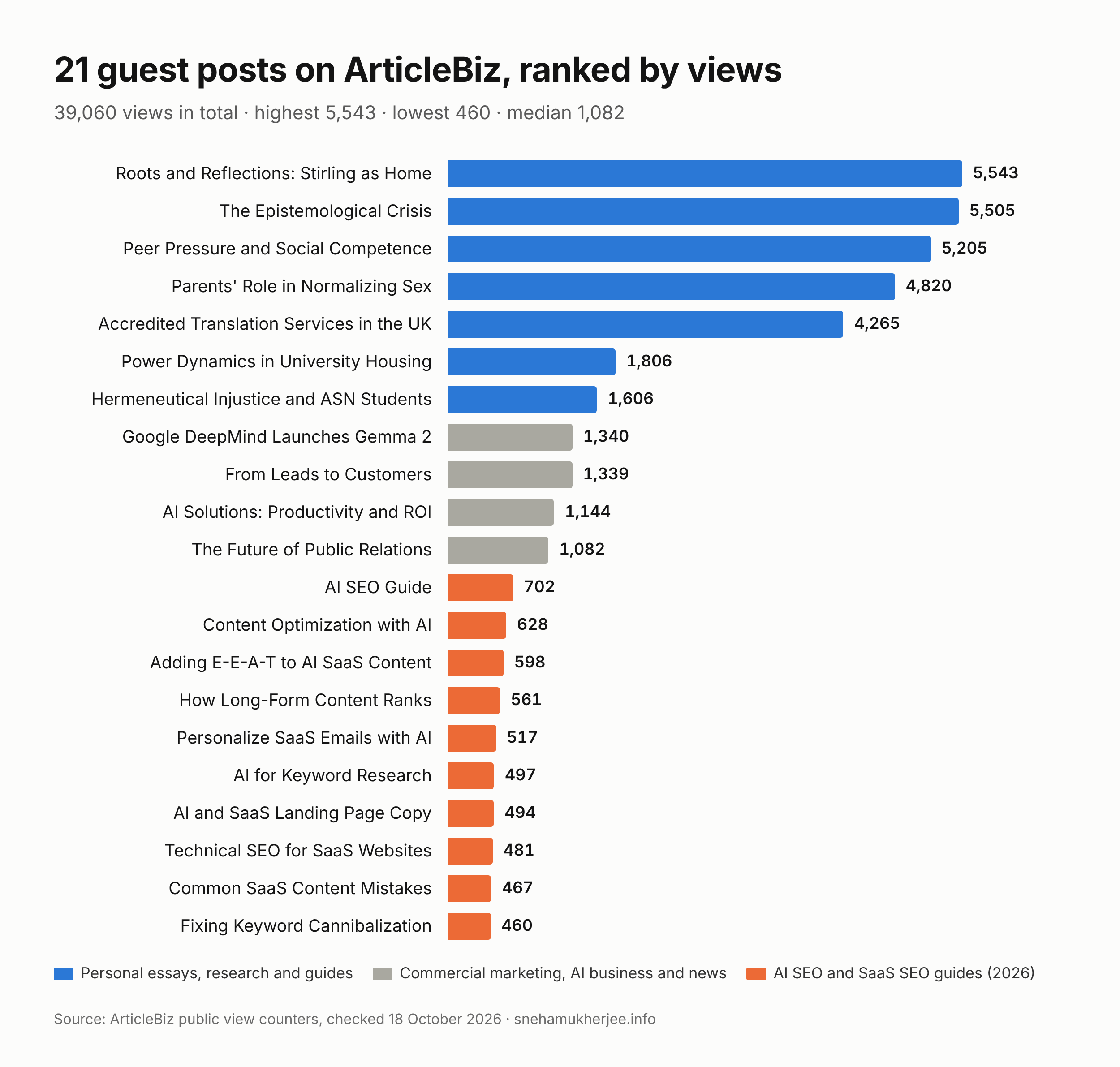
That's a reach I'm proud of. My two most-read pieces have each passed 5,500 views, and five of my articles have been read more than 4,000 times each. Those articles weren't SEO pieces. They were short, personal and specific, and they found their readers on their own.
This post shares all 21 articles with their real view counts, what my best performers have in common, and the tips I'd give anyone starting their own guest posting journey in 2026.
Key takeaways
My 21 ArticleBiz articles have reached 39,060 views in total, an average of 1,860 per article, as of 18 October 2026.
My top five articles alone have 25,338 views, and each one has been read more than 4,000 times.
My two July 2024 student essays are still my most-read work, with 5,543 and 5,505 views.
My February 2025 research write-ups reached 14,290 readers between them, on topics few other sites cover.
Short, specific and original pieces of around 1,000 words performed best.
Readers rated my work highly: most rated articles carry a five-star score.
Every article is a lasting public snapshot of my growth, from MSc student to SEO Growth Strategist.
What is ArticleBiz, and why is it a great place to start?
ArticleBiz is a free article directory: anyone can submit an article, and once it's approved it's published under your name, added to the site's RSS feeds, and made available for other publishers to reprint. For a new writer, that means a public byline, a bio and a permanent page, at no cost.
How submitting works
The flow is simple. You submit an article through a form, pick a category, add an author bio (the site calls this a "resource box"), and wait for approval. Once it's live, your article gets a permanent URL, a category page, a word count and a public view counter, so you can watch your readership grow.
Each article page also has a five-star rating widget and a comment box, so readers can respond to your work directly.
What you get as an author
Under the ArticleBiz terms of service for authors, you keep full ownership and copyright of your work. ArticleBiz publishes it and distributes it through its RSS feed.
You also grant permission for your article to be reprinted in other ezines, websites and print publications. That gives your writing the chance to travel further than one site.
What publishers agree to when they reprint you
The ArticleBiz terms of service for publishers protect your work. A publisher who reprints your article must publish it unchanged, include your resource box, keep your links live, and never sell your article or use it for spam. Your name and bio travel with your writing wherever it goes.
My full ArticleBiz record: all 21 articles, views and ratings
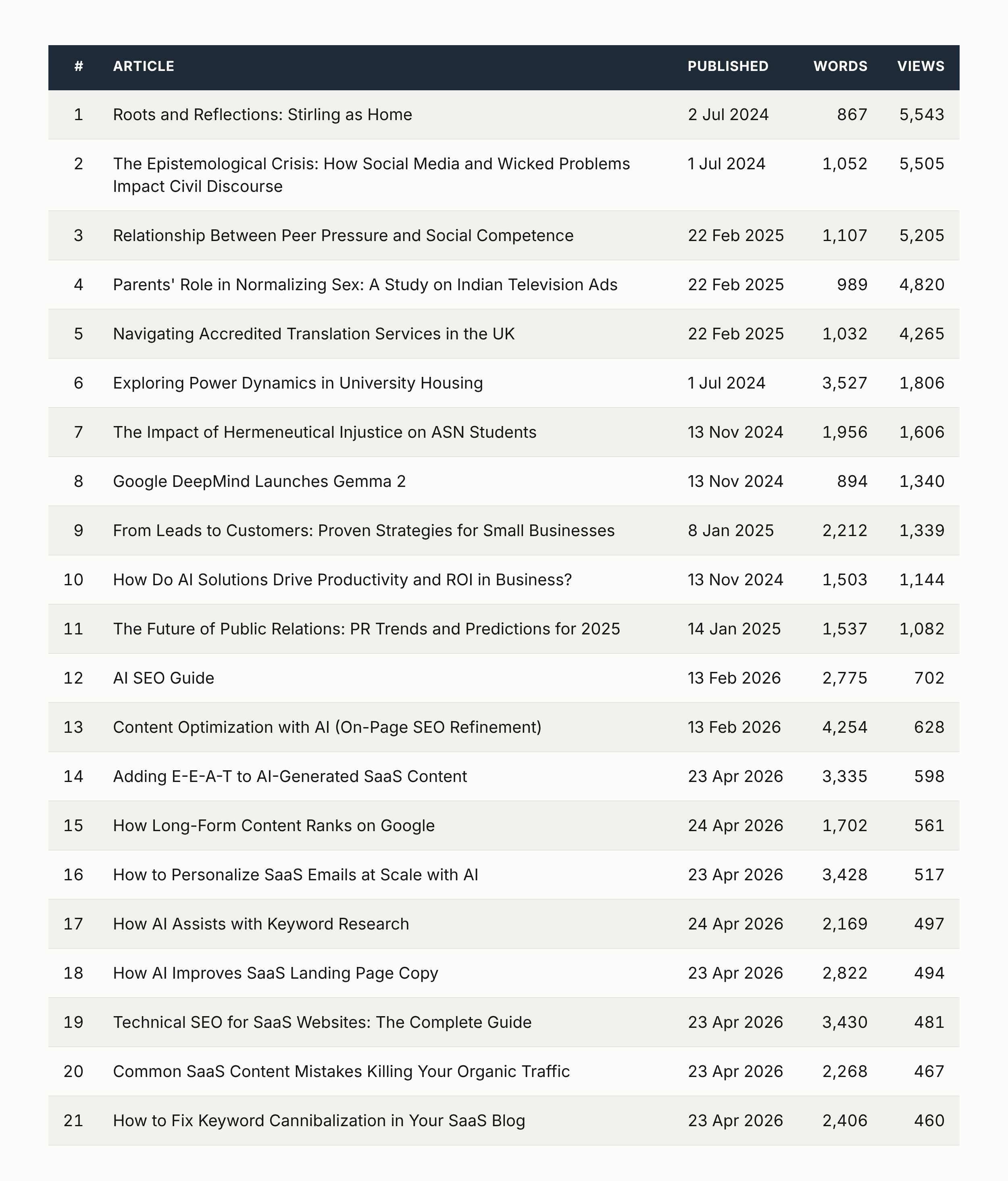
Across 21 articles published between 1 July 2024 and 24 April 2026, my ArticleBiz author page shows 39,060 total views, an average of 1,860 views per article. My best article has been read 5,543 times.
Every number below comes from the public counter on each article page, checked on 18 October 2026. You can browse the full list on my ArticleBiz author page.
My journey in four phases
My 21 articles fall into four phases, and together they tell the story of how I grew from a linguistics student into an AI SEO and SaaS content specialist.
Phase 1 (July 2024): student essays that found a big audience
I published my first three articles on 1 and 2 July 2024, while studying for my MSc in English Language and Linguistics at the University of Stirling. Together they now have 12,854 views, about a third of my all-time total.
Roots and Reflections: Stirling as Home is an 867-word personal essay that walks from Stirling Castle along the River Forth and ends on the idea that home is something you feel. It's my most-read article, with 5,543 views.
The Epistemological Crisis responds to Fred D'Agostino's work on "wicked problems" and argues for civility as the way out of online polarisation. It's just 38 views behind, at 5,505.
Exploring Power Dynamics in University Housing is a 3,527-word Critical Discourse Analysis drawing on Norman Fairclough and Rodney H. Jones. It's my most academically ambitious piece, with 1,806 views and two five-star votes.
Phase 2 (November 2024 to February 2025): finding my commercial voice
In this phase I published eight articles and started writing for business audiences. My commercial and tech pieces each reached more than 1,000 readers:
The Impact of Hermeneutical Injustice on ASN Students: an academic essay on children with Additional Support Needs in Scotland, 1,606 views.
Google DeepMind Launches Gemma 2: AI news coverage, 1,340 views.
From Leads to Customers: a lead generation guide for small businesses, 1,339 views.
How Do AI Solutions Drive Productivity and ROI in Business?: case studies from Coca-Cola, UPS and JPMorgan Chase, 1,144 views.
The Future of Public Relations: small business marketing on social media, 1,082 views.
Then, on 22 February 2025, I published three articles that became some of my biggest successes, with 14,290 views between them:
Relationship Between Peer Pressure and Social Competence: a study of 90 students in Bengaluru, 5,205 views.
Parents' Role in Normalizing Sex: a study of parents' views on sex education, 4,820 views.
Navigating Accredited Translation Services in the UK: a practical guide to the CIOL, ITI and ATC, 4,265 views.
Phase 3 (February 2026): stepping into AI SEO
On 13 February 2026, I published my first ArticleBiz content on the topic I now write about full time. AI SEO Guide covers AI-assisted keyword research, SERP analysis and drafting with tools like ChatGPT, Surfer SEO and Clearscope. It has 702 views and my only reader comment, from Riya Agrahari, who praised its balanced, practical take on AI and E-E-A-T.
Its companion, Content Optimization with AI, is my most comprehensive piece at 4,254 words, with 628 views. You'll find my latest thinking in what AI SEO is and how it works.
Phase 4 (April 2026): a full SaaS SEO series
On 23 and 24 April 2026, I published eight in-depth SaaS and SEO guides, which have reached 4,075 readers in their first six months. They cover E-E-A-T for AI content, long-form ranking, AI email personalisation, AI keyword research, landing page copy, technical SEO, common content mistakes and keyword cannibalisation.
The series leader is Adding E-E-A-T to AI-Generated SaaS Content, with 598 views and a five-star rating. It sets out a seven-step framework for content that earns trust. I go deeper on the same idea in why AI content doesn't rank and in my SaaS SEO content growth engine.
What worked best: four patterns behind my most-read articles
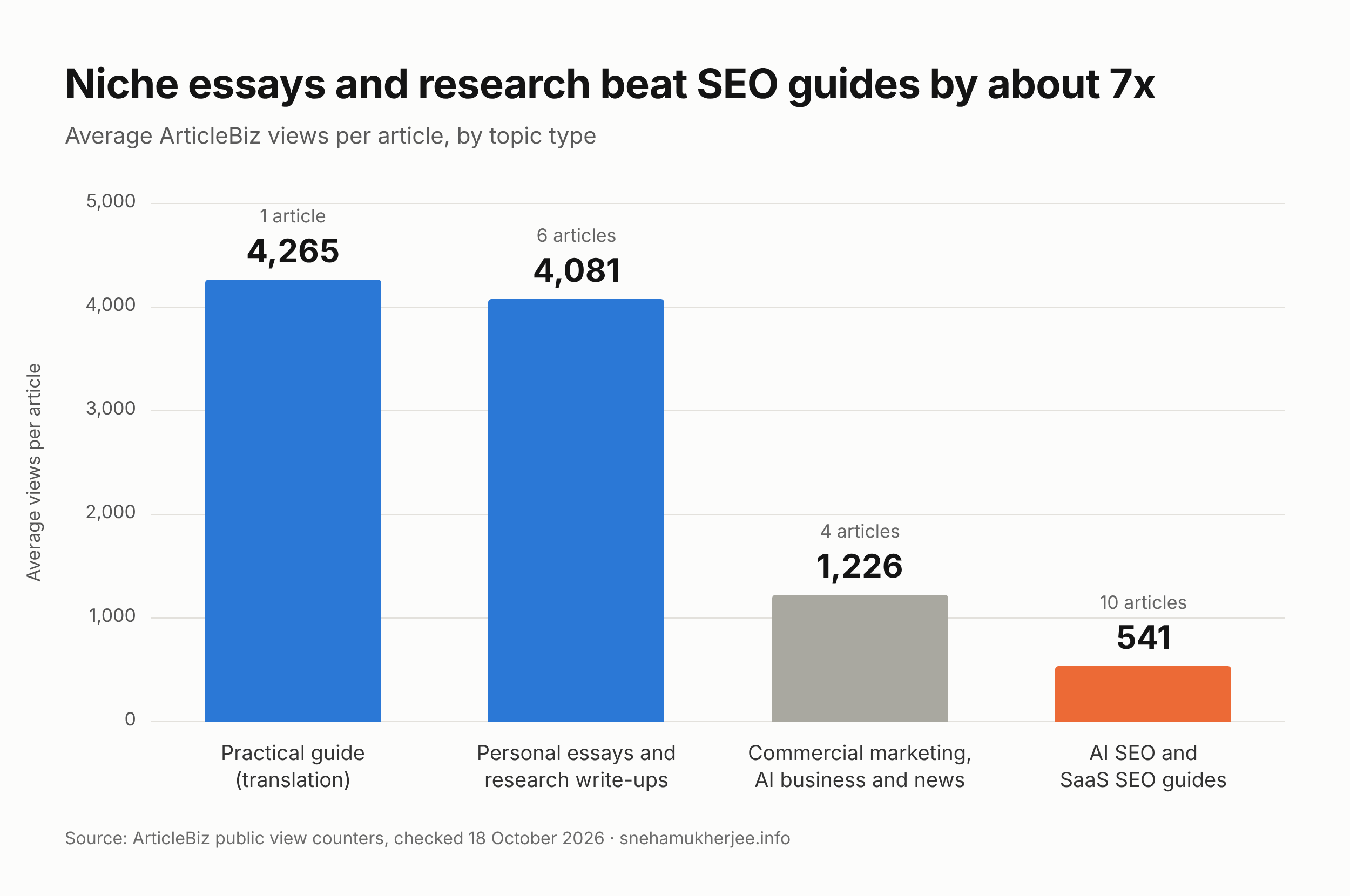
My most successful articles share four traits: they're short, specific, original and personal. My top five pieces average 5,068 views each.
1. Short pieces won big
All five of my most-read articles are between 867 and 1,107 words. Together they have 25,338 views, two-thirds of my total. A focused 1,000-word piece is quick to read and easy to share.
2. Niche topics found loyal readers
My research summaries cover subjects very few other pages address: peer pressure among North-Indian students in Bengaluru, parental attitudes to TV advertising, and hermeneutical injustice in Scottish early years education. On a niche topic, you become one of the few answers, and readers find you.
3. Personal writing connected
My Stirling essay and my reflection on civil discourse are written in my own first-person voice. Two years on, they're still my two most-read articles.
4. Practical guides delivered steady value
My guide to accredited translation services in the UK has 4,265 views. Clear, useful advice on a specific need keeps attracting readers month after month.
How my bio tracks my growth
Read in order, my six ArticleBiz bios form a timeline of my career, from MSc student to SEO Growth Strategist in under two years.
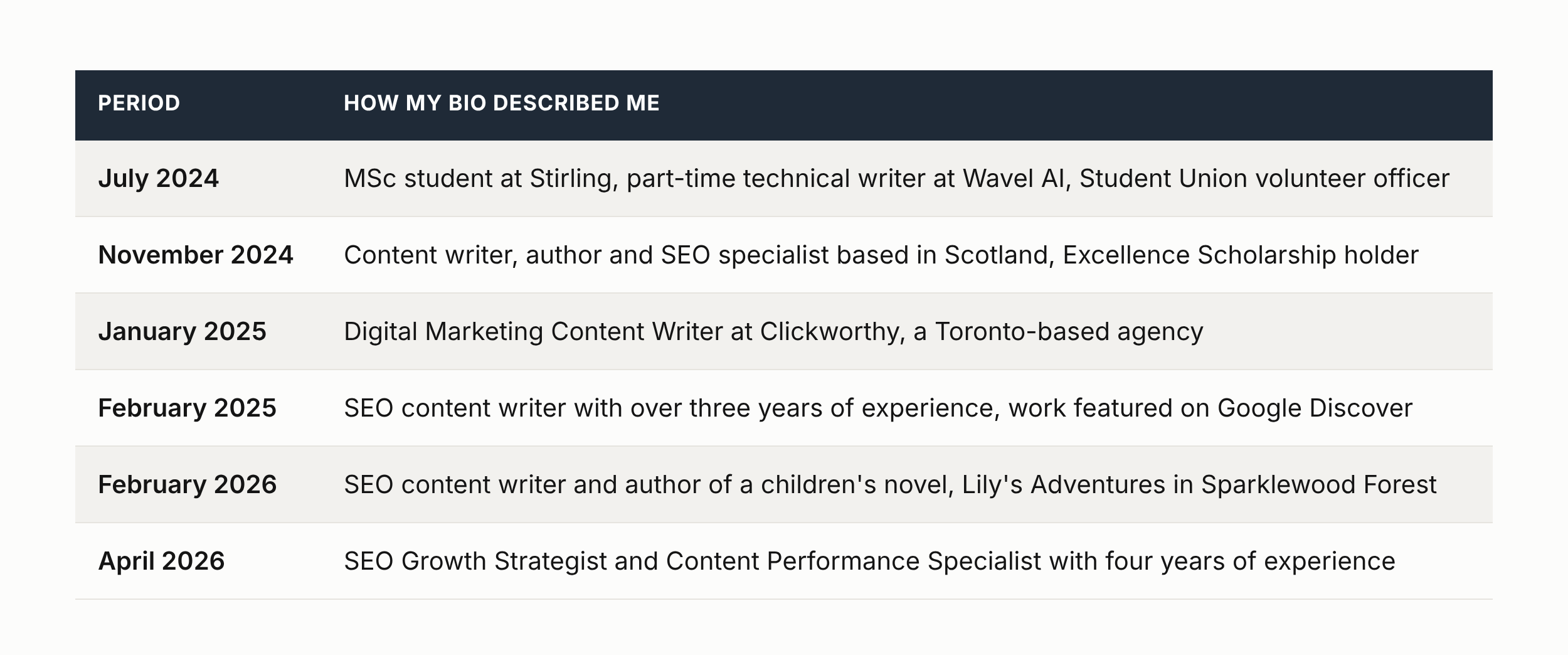
Each one is a snapshot of where I was on the day I published. Together, they show steady growth in skills, roles and focus.
Where article directories shine in 2026
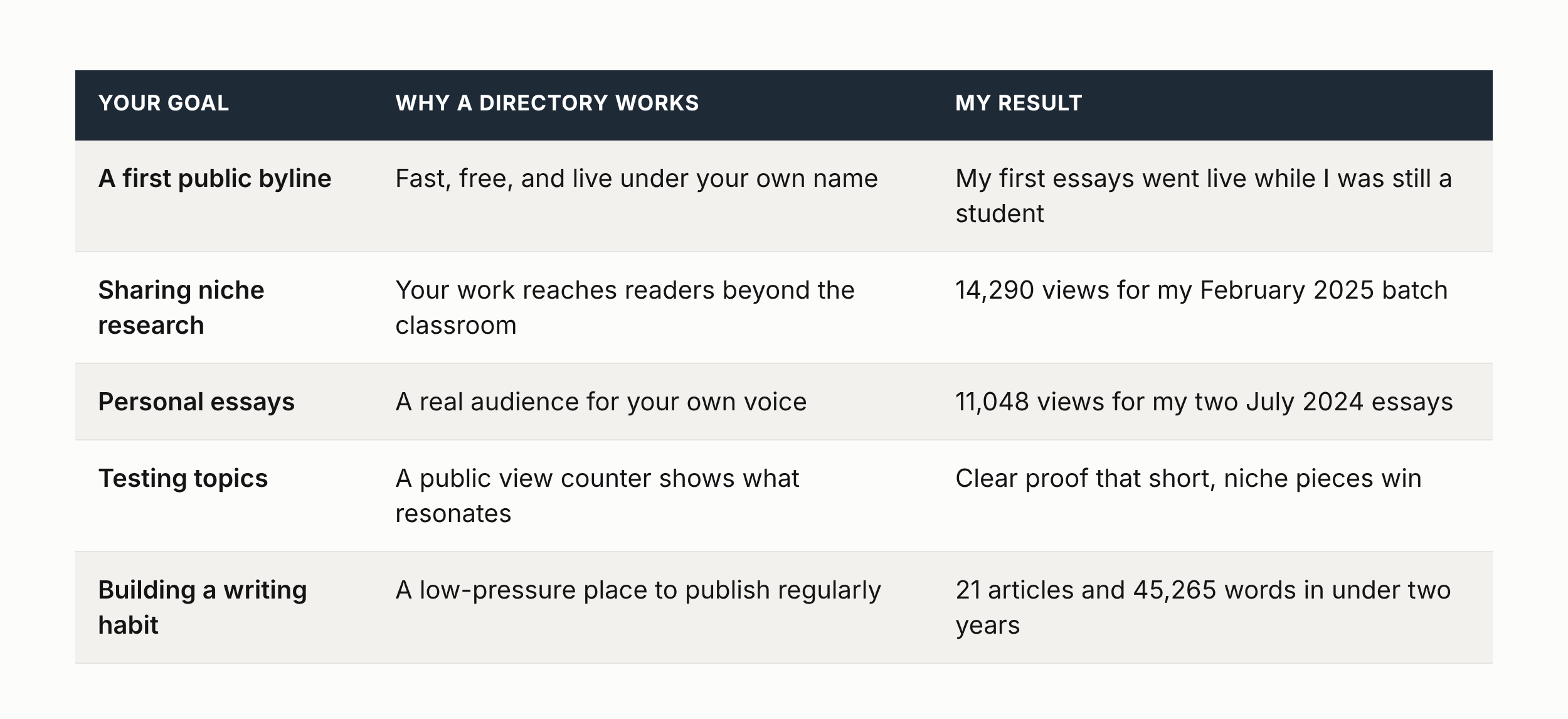
Article directories are a great fit for first bylines, niche research, personal essays and topic testing. My own results show it clearly.
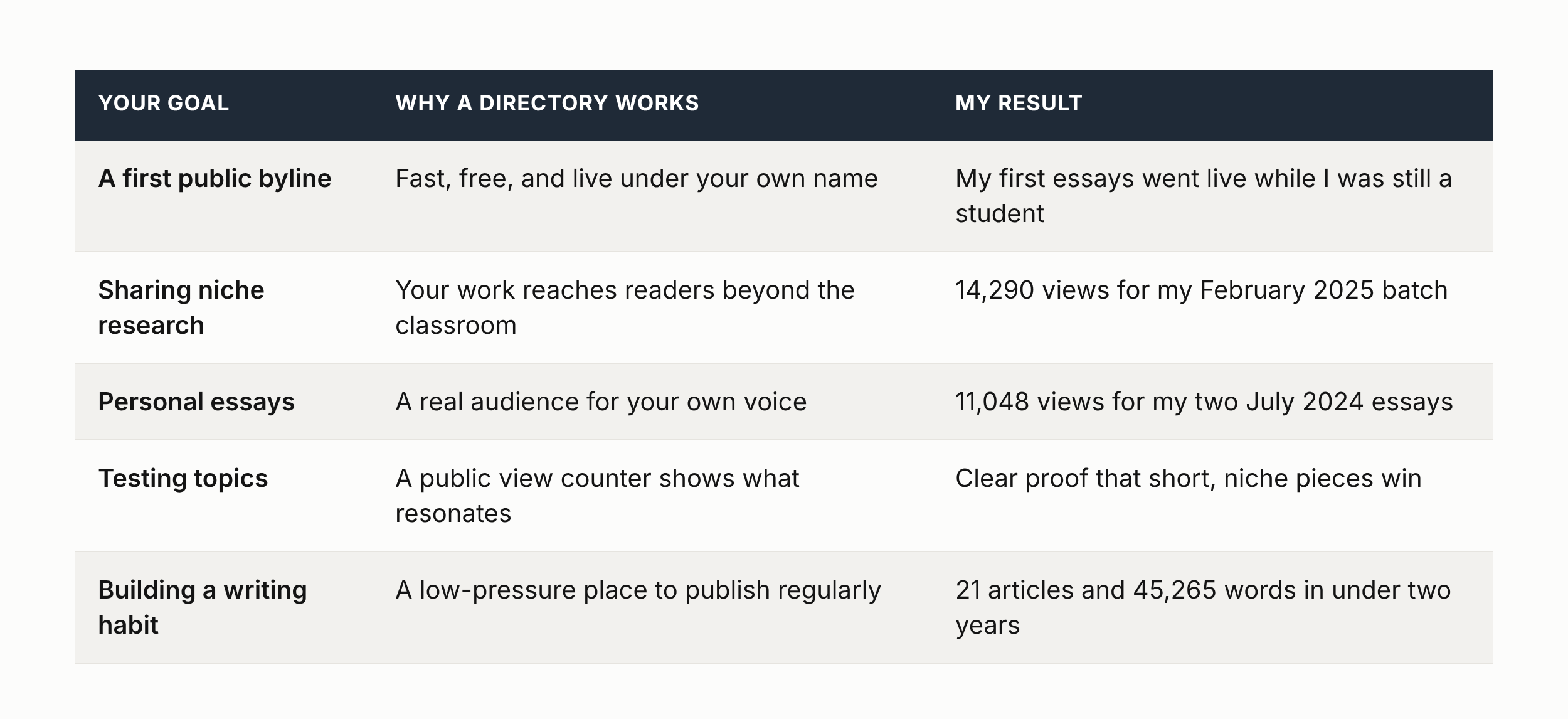
Guest posting has always been about exposure, branding, reach and community. Google's Matt Cutts made that point in his 2014 post, The decay and fall of guest blogging for SEO: writing for real readers is the reason to guest post. That's exactly how I've used ArticleBiz. For the bigger picture on how search is changing, see my full breakdown of traditional SEO vs AI SEO.
My tips for a great guest post
Pick a clear goal, choose a niche angle, keep it focused, and polish it before you submit. These tips come straight from what worked in my own 21 articles.
Before you write
Decide the goal of your post: a byline, an audience, a topic test or credibility.
Browse the category first and look for an angle few others have covered.
Choose a niche topic you can own. My niche research pieces became some of my most-read work.
Aim for around 1,000 words. All five of my top articles are close to that length.
Before you submit
Read the platform's author terms so you know exactly how your work will be shared.
Write a bio that will age well: your name, your field and one stable link.
Use full URLs with "https://" for the profiles you'll keep long term.
Make sure your title and first paragraph make the same promise.
Give the draft a final proofread for formatting, links and dates.
After it goes live
Open the live page and enjoy reading it as your readers will.
Record the URL, date and view count in a tracking sheet so you can watch it grow.
Check your own analytics for visitors arriving from the site.
Share it on your own channels and link to it from your website.
Guest posts as a portfolio in the AI search era
The best way to get lasting value from guest posts is to connect them to a home base you own. That's what this post does: every one of my 21 ArticleBiz articles is now linked from my own site, with notes on what each one covers and when I wrote it.
AI search tools read and summarise pages across the web, so a clear, consistent picture of who you are matters more than ever. Here's how I bring it together:
Keep one current author page on your own site with your name, role, focus and links.
Use the same name and profile links everywhere you control.
Publish your newest, best work on your own domain, so it's the strongest source on the topic.
Link to your guest posts with context, so readers see them as a timeline of your growth.
My guides on how to rank in AI search results, how to use GSC data for AI SEO and the complete AI SEO system for 2026 go deeper on each of these steps.
Final thoughts
Twenty-one articles, 45,265 words and 39,060 readers. ArticleBiz gave me my first public byline, a real audience for my student research, and a lasting record of my growth as a writer.
My advice is simple. Write short, specific pieces on topics you know well, give them your own voice, and connect them to a site you own. That's how a handful of guest posts becomes a portfolio.
If you want to see where my thinking is now, start with what AI SEO is and how it works, then read why AI content doesn't rank. And if you've guest posted on a directory yourself, I'd love to hear your numbers.
Frequently asked questions
What is an article directory?
An article directory is a website where anyone can submit articles for free, usually in exchange for an author bio with a link. Approved articles are published under the author's name and offered to other publishers to reprint. ArticleBiz is one example.
Can other websites republish my ArticleBiz articles?
Yes. By submitting, you give permission for your articles to be reprinted in other ezines, websites and print publications. Publishers must keep the article unchanged and include your bio, so your name travels with your work.
How many views can an ArticleBiz article get?
My 21 articles have 39,060 views in total, an average of 1,860 each, as of 18 October 2026. My most-read article has 5,543 views, and five articles have passed 4,000.
What kind of articles get the most views on an article directory?
In my experience, short, specific articles on niche topics do best. My five most-read pieces are personal essays, research summaries and a practical guide, all between 867 and 1,107 words.
Is guest posting still worth it in 2026?
Yes, when you write for real readers. Guest posting gives you exposure, a public byline and a way to test topics. Pair it with your own website and it becomes part of a strong, lasting portfolio.