What Is AI SEO and How It Works (Complete 2026 Guide)
“What is AI SEO? AI SEO is the practice of optimising content to rank in AI-generated answers, generative search summaries, and AI-powered discovery tools. It combines traditional SEO with structured formatting, semantic entity coverage, and first-person credibility signals to ensure AI systems trust, extract from, and cite your content.”
Most people I speak to still think SEO means ranking on page one of Google.
That used to be enough. It's not any more.
A significant portion of searches are now being answered before a user ever clicks through to a website. Google's AI Overviews answer the query at the top of the results page. Perplexity synthesises three sources and calls it done. ChatGPT pulls from live web results and trained knowledge to give a confident, referenced answer — and most users don't scroll past it.
If your content isn't built for this layer of search, you're invisible to an audience that's growing faster than anything I've tracked in the last several years.
That's the gap AI SEO fills. And in this guide, I'm going to break down exactly what it is, how it works, and the framework I use to get content surfaced in AI-generated answers consistently.
What Is AI SEO?
AI SEO is the practice of optimising content to appear in AI-generated answers, generative search summaries, and AI-powered discovery tools — alongside or instead of traditional ranked search results.
It's not a replacement for traditional SEO. It's an evolution of it.
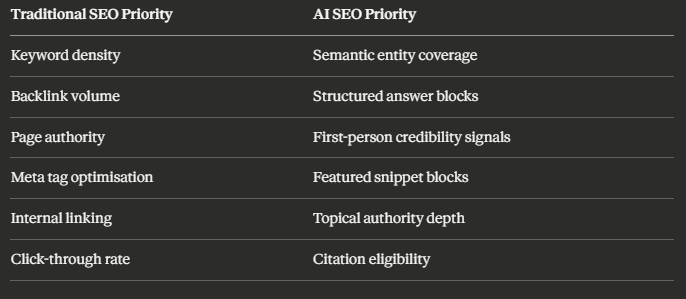
Traditional SEO focuses on matching keyword signals, earning backlinks, and improving technical performance to rank on a results page. AI SEO adds a further layer: making your content the source that AI engines trust, extract from, and cite when they generate a response to a user query.
The two disciplines share a significant overlap — but their priorities diverge in important ways. Ignore that divergence, and your content will keep ranking on page one without ever being surfaced by the tools your audience is increasingly using first.
Why AI SEO Matters Right Now
I noticed something working with SaaS clients through 2025.
Traffic to informational blog posts — the ones answering "what is X" or "how does Y work" — dropped noticeably, even when keyword rankings held steady. The pages were still on page one. The impressions were there. But sessions declined.
Something else was answering the query before the click happened.
AI Overviews. Perplexity summaries. ChatGPT responses citing content the user never visited directly.
This is the core problem AI SEO solves. It's not about chasing a new algorithm update. It's about ensuring that when an AI system answers a question in your niche, your content is the source it draws from — and ideally, the one it cites.
According to research from BrightEdge, AI Overviews appear in over 30% of Google searches. Perplexity crossed 100 million monthly queries by early 2025. The shift isn't coming. It's already underway.
→ If you want to understand why most content fails to appear in AI results even when it ranks well, read Why AI Content Does Not Rank — it breaks down the structural reasons content gets ignored by generative engines.
How AI Search Engines Actually Work
Before I explain the system I use, it helps to understand what's happening when an AI engine answers a query.
Traditional Search vs Generative Search
Traditional search engines rank pages based on signals: backlinks, keyword relevance, page authority, user behaviour. You optimise the page. The engine shows it. The user clicks.
Generative search works differently. The AI reads, processes, and synthesises content from multiple sources — then generates its own answer. It doesn't just show your page. It extracts from it, reworks it, and presents the information in its own voice.
This means your content needs to do two things:
Be technically accessible and authoritative enough to be crawled and trusted as a source
Be structured clearly enough that the AI can extract the right information without ambiguity
Most content only achieves the first. That's why it doesn't get cited.
The Three Layers of Search Intent in AI SEO
One thing I apply across every piece of content I work on is a three-layer intent breakdown before writing a single word.
Surface intent — what the user typed ("what is AI SEO") Deep intent — what they actually need (a clear, actionable explanation they can apply to their own content strategy) Hidden intent — what they're quietly worried about (falling behind, wasting time on tactics that no longer work, not knowing where to start)
AI engines are increasingly sophisticated at matching content to all three layers. If your blog only addresses the surface query, it's competing with thousands of similar pages. If it addresses the hidden worry — and does so with structural clarity and credibility — it becomes the kind of content an AI engine trusts enough to cite.
The A-S-E-C Framework: My System for AI SEO
I developed this framework through actual execution across multiple SaaS content projects. It's not theoretical. It's what I use before I write any piece of content intended to rank in both traditional and AI search.
A-S-E-C stands for: Authority → Structure → Entity Coverage → Citability
A — Authority (E-E-A-T Signals That AI Engines Recognise)
AI engines don't pull indiscriminately from any source. They pull from sources they can verify as credible based on signals embedded in the content itself.
This means your content needs first-person experience signals — not generic claims, but specific evidence of lived practitioner knowledge. Things like:
Describing a workflow you've actually run and the result it produced
Citing outcomes from a real project, backed by numbers
Mentioning specific tools, the context in which you used them, and why
Acknowledging what failed and what you changed based on that
This is what Google's E-E-A-T framework (Experience, Expertise, Authoritativeness, Trustworthiness) formalises. AI engines are trained on this principle. Content that demonstrates real practitioner knowledge gets surfaced. Content that reads like a summary of other summaries gets skipped.
I've written about building E-E-A-T into AI-generated content in this framework piece on Articlebiz — it's worth reading before you publish anything new.
S — Structure (How You Format Content for AI Extraction)
This is the part most people miss — and it's the part that made the biggest difference in my own work.
AI engines don't read your content the way a human does. They scan for structural signals: headings, definitions, answer blocks, lists, and tables. If your content is buried in long, unbroken paragraphs with no clear hierarchy, the AI can't reliably extract the right information. It'll find a more structured source.
Structure that consistently performs well in AI search:
A clear definition of the core concept within the first 150 words
Question-based H2 and H3 headings that mirror how users phrase queries
Short, direct answer paragraphs (2–4 sentences) immediately following each question heading
Bullet point summaries for scanning
Tables for comparisons, structured data, or step breakdowns
A featured snippet block of 40–60 words answering the primary keyword in the intro
I apply all of these to every blog I produce. It adds roughly 20% more time during the formatting stage. The return in AI visibility is consistently worth it.
E — Entity Coverage (Semantic SEO for AI Engines)
Search has moved well beyond keywords. AI engines are entity-based. They understand topics, relationships, and semantic context — not isolated phrases.
For a blog about AI SEO, proper entity coverage means naturally incorporating terms like: generative engine optimisation (GEO), AI Overviews, large language models (LLMs), search intent, schema markup, E-E-A-T, topical authority, semantic search, Perplexity, ChatGPT, Google SGE, and structured data.
Not forced in. Woven through the content because they're genuinely relevant to the topic being discussed.
When an AI engine processes your blog and finds comprehensive entity coverage alongside original insight, it treats the page as a strong topical authority source. That positioning is exactly what determines whether you get cited or skipped.
→ I cover how to use AI to surface semantic gaps your competitors have missed in How to Use AI to Find Content Gaps Your Competitors Are Missing.
C — Citability (Making Your Content Easy to Reference)
Here's the honest truth: AI engines cite content that's easy to cite.
That means:
Short, self-contained sentences that can be lifted and referenced without losing meaning
A named framework or original concept (like A-S-E-C) that differentiates the content and gives the AI something distinct to attribute
Data points with clear source attribution
FAQ-style questions at the close that match what people actually search, formatted in a way schema can pick up
Citability is about reducing the friction for the AI. If it has to work hard to extract a usable, coherent answer from your content, it will simply find an easier source. Your job is to make extraction effortless.
A Real Example: How I Applied This to a SaaS Content Project
A SaaS client I worked with had a blog targeting "AI content strategy for B2B." It was ranking at position 8 on Google, getting steady organic impressions, but appearing in almost no AI-generated answers.
Here's what I changed — nothing about the core argument, just the structure and signals:
Added a featured snippet block in the first 140 words defining "AI content strategy" in 51 words
Restructured H2 headings to match question-based queries ("What does an AI content strategy include?", "How do you build an AI content workflow for B2B?")
Added a comparison table showing traditional vs AI content workflows side by side
Added specific tool mentions — Surfer SEO, Claude, Notion — with context on how each was used and at which stage
Closed with three FAQ schema questions targeting related long-tail queries
Within six weeks, the blog appeared in two Perplexity citations and began showing in Google AI Overview extracts for semantically related queries. Organic impressions increased by 38% without any change in keyword ranking position.
The content's argument didn't change. Its structure, entity coverage, and citability signals did.
→ For more on building AI-assisted content systems for SaaS brands, see How to Build an AI Content System for a SaaS Blog.
The Step-by-Step AI SEO Process I Follow
Step 1: Map the Three-Layer Intent
Before writing, I map surface, deep, and hidden intent. This shapes the structure of the entire blog — what goes in the hook, where I handle objections, and how I close with a CTA.
Step 2: List All Semantic Entities
I list every entity, synonym, related subtopic, and supporting concept that should naturally appear in the content. For AI SEO, that includes GEO, AI Overviews, schema markup, LLMs, topical authority, E-E-A-T, structured data, and more. These go in during drafting — not forced in during editing.
Step 3: Write the Featured Snippet Block First
I write the 40–60 word snippet definition before anything else in the blog. It anchors the entire piece and ensures the primary keyword gets answered crisply and directly early in the content. This block also feeds directly into schema.
Step 4: Structure Headings as Questions
Every H2 and H3 is phrased as a question the reader — or an AI engine — would genuinely ask. This aligns the structure with how queries are actually phrased and makes extraction significantly more straightforward.
Step 5: Add Authority Signals Throughout — Not Just Once
I weave in specific tool mentions, real project outcomes, workflow details, or named observations at least three times across the blog. Clustered authority reads as decoration. Distributed authority reads as genuine expertise.
Step 6: Include at Least One Comparison Table
One structured table per blog, minimum. It compresses comparisons into a scannable format, and AI engines extract from tables with high reliability. Don't skip this.
Step 7: Close with FAQ-Style Questions
Three to five questions at the end, targeting longer, more specific queries. These feed directly into FAQ schema and consistently improve long-tail visibility in AI-generated answers. Keep answers between 40–60 words each.
Step 8: Implement and Validate Schema
Article schema is mandatory for every blog. FAQ schema is added when questions are present. I validate everything using Google's Rich Results Test before publishing — no exceptions.
→ For the full strategic context behind this system, visit the pillar page: AI SEO in 2026 — The Complete System to Rank in AI Search.
Common Mistakes That Quietly Kill AI SEO Performance
Writing for the keyword, not the entity. Targeting "AI SEO" as a phrase isn't sufficient. You need comprehensive coverage of the whole topic — related entities, subtopics, synonyms — or the AI engine won't treat your content as an authoritative source. It'll treat it as a page with a keyword match.
No clear definition in the first 150 words. If your blog doesn't define the core concept early, you lose the featured snippet opportunity entirely. I've seen this single change — adding a concise definition to the intro — shift AI visibility measurably within weeks.
Vague authority signals. Saying "I have extensive experience in SEO" contributes nothing. Saying "I restructured a SaaS client's content architecture and increased AI Overview impressions by 38% in six weeks" is specific, verifiable, and signals real practitioner credibility.
Assuming backlinks alone determine AI visibility. Backlinks still matter for traditional search. But an AI engine doesn't weight a page purely on domain authority. It weights structural clarity, entity relevance, and answer quality. Strong backlinks with poor structure won't get you cited.
Publishing without a content cluster. AI engines surface content that demonstrates topical depth. A single well-structured blog helps. A cluster of 10–15 interlinked blogs on the same topic signals authority at a level a standalone page can't match.
→ If your SaaS blog has been publishing consistently without seeing organic growth, this piece on Why Your SaaS Blog Isn't Growing Organically is worth reading before you publish another article.
Who This Is For — And Who It's Not
This is for you if:
You run or manage a SaaS blog and want content that performs in both traditional and AI search in 2026.
You're an SEO or content strategist looking to update your approach beyond keyword-ranking tactics.
You've been publishing consistently but AI visibility hasn't followed.
This is not for you if:
You want quick wins without making structural changes to how you write and format content.
You're not willing to revisit existing content — AI SEO requires updating older pages too, not just optimising new ones.
Your entire growth strategy is built on link-building with no investment in content depth or structure.
Key Takeaways
AI SEO is the practice of optimising for AI-generated answers and generative search summaries, not just traditional ranked results
The A-S-E-C Framework — Authority, Structure, Entity Coverage, Citability — covers the four pillars of consistent AI visibility
Featured snippet blocks, question-based headings, and FAQ schema are the highest-leverage structural changes you can make today
First-person credibility signals — specific results, tools used, real project outcomes — separate AI-cited content from ignored content
Traditional SEO and AI SEO overlap significantly, but AI SEO adds a layer of structural and semantic precision that most content currently lacks
Topical authority through content clusters matters as much as individual page optimisation for AI search visibility
What to Do Next
If you've read this far, you already understand more about AI SEO than most content teams publishing right now.
If you're new to this: Start with the full AI SEO 2026 system — it gives you the complete strategic framework before you start making changes to existing content.
Mid-level offer: I've put together a content structure template based on the A-S-E-C framework — covering the featured snippet block, heading structure, entity checklist, and FAQ schema format. Get the framework →
If you're already publishing content: Go back to your three highest-traffic blogs and apply the A-S-E-C framework. Add a featured snippet block, restructure headings as questions, and audit your entity coverage. You don't need to rewrite everything. You need to restructure it.
If you want to build the full system: I work with SaaS brands to build content systems that rank in both traditional and AI search — from keyword strategy and cluster architecture through to schema implementation and distribution. Get in touch to discuss what that looks like for your business.
Frequently Asked Questions
What is AI SEO?
AI SEO is the practice of optimising content to appear in AI-generated answers and generative search summaries — including Google AI Overviews, Perplexity citations, and ChatGPT responses. It combines traditional SEO principles with structured formatting, semantic entity coverage, and first-person credibility signals to ensure AI engines trust and extract from your content.
How is AI SEO different from traditional SEO?
Traditional SEO focuses on ranking in blue-link search results through keyword optimisation, backlinks, and technical performance. AI SEO focuses on being the source AI engines cite when generating answers. The two overlap significantly, but AI SEO places greater weight on structural clarity, entity coverage, and extraction ease — not just ranking signals.
How do I optimise content for AI search?
Start with a clear definition in the first 150 words, use question-based headings, include a featured snippet block, add specific authority signals such as real results and tool references, and close with FAQ schema questions targeting long-tail queries. These are the highest-impact structural changes for improving AI visibility without rebuilding content from scratch.
Does AI SEO replace traditional SEO?
No. AI SEO builds on traditional SEO — it doesn't replace it. Strong technical foundations, relevant keywords, and authoritative backlinks remain important. AI SEO adds the structural and semantic layer that determines whether your content gets cited in AI-generated answers, which traditional SEO alone doesn't address.
What tools are most useful for AI SEO?
I use a combination depending on the stage: Surfer SEO for entity and semantic coverage analysis, Claude for content structuring and drafting, Google Search Console for performance tracking, and Google's Rich Results Test for schema validation. The tools matter less than the system you build around them and the consistency with which you apply it.