Why Most AI Content Does NOT Rank (And How to Fix It)
“You’re producing more content than ever. Your competitors are too. Google is ranking almost none of it. Here’s the uncomfortable truth — and what actually works.”
Let's skip the pleasantries.
You've seen the pitch. "10x your content output with AI." "Publish 50 blog posts a month." "Dominate your niche overnight." Sounds great. So you set up the workflow, prompt the model, and flood your site with articles.
Three months later? Crickets. Maybe a handful of impressions. Zero page-one rankings. And a growing suspicion that you've been lied to.
You haven't been lied to exactly. But you've been given a hammer and told everything is a nail. The truth is messier — and more fixable than you think.
The problem
Google Doesn't Hate AI Content. It Hates Bad Content.
Here's what nobody selling AI content tools wants you to know: Google's algorithms aren't scanning for "was this written by a robot?" They're scanning for one thing — does this page actually help the person who searched for it?
Most AI content fails that test. Not because it's AI-generated. Because it's predictable, shallow, and structurally identical to ten thousand other pages answering the same query.
“The real issue: When everyone prompts the same model with the same query, they get roughly the same output. You’re not creating content — you’re cloning it. Google has seen it before. Your reader has read it before. Nobody wins.”
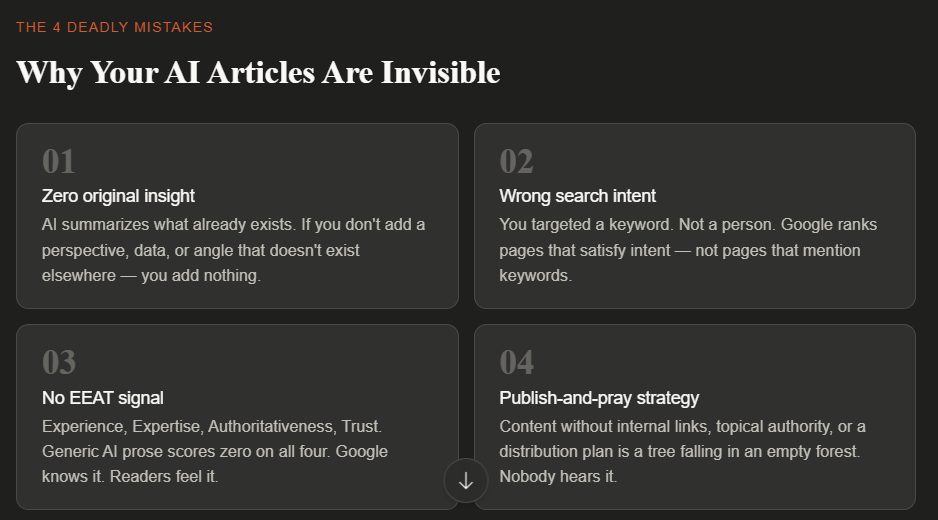
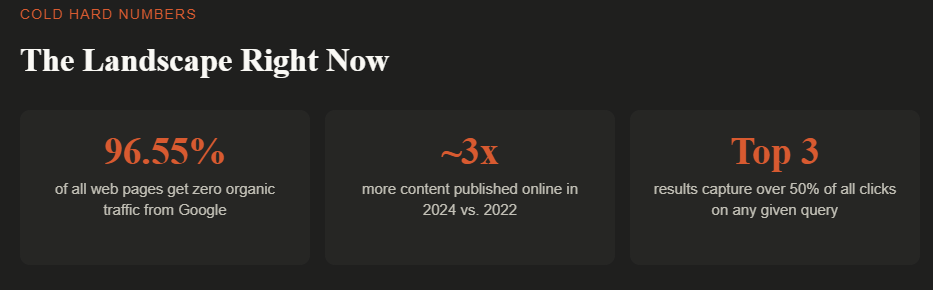
The bar is not "publish content." The bar is "publish the best answer to this specific question, from a source Google trusts." AI makes it cheaper to miss that bar at scale.
The fix
How to Make AI Content That Actually Ranks
"AI is a co-writer, not a ghostwriter. The moment you remove the human, you remove the rankable part."
1
Start with a search intent audit, not a keyword list
Google the keyword before you write a word. Look at what's ranking. Is it listicles? Deep guides? Product pages? Tool comparisons? That's your format. Now ask: what's missing from all of them? That's your angle.
2
Inject proprietary data, experience, or opinion
Run a small survey. Pull your own analytics. Share a counterintuitive take from your actual work. These are the signals that differentiate your page from every other AI-generated piece on the same topic. Google rewards it. Humans share it.
3
Use AI for the scaffold, not the substance
Let AI generate your outline, first draft, and structural skeleton. Then rewrite the introduction yourself. Add your examples. Insert your data. The AI gets you to 60% faster — you take it to 100% better.
4
Build topical authority before chasing volume
Pick one sub-topic and own it completely before expanding. Ten deeply interlinking articles on a narrow theme outranks 100 disconnected posts every time. Google wants to trust you as a source — give it a reason to.
5
Treat publishing as the starting line, not the finish
Update content quarterly. Add new data. Improve CTR with better headlines. Build backlinks through distribution — not just hoping Google finds you. Most ranking gains happen 6–18 months after publication, when updated and promoted properly.
The bottom line
The Opportunity Is Real — If You Play It Right
Here's the good news hiding in all of this: because most people are using AI to produce forgettable filler, the gap between average content and great content has never been wider. That gap is your opportunity.
The brands that will win search in the next three years won't be the ones who published the most. They'll be the ones who used AI intelligently — to move faster, not to think less.
Use it as a leverage tool. Keep the strategy, the perspective, and the editorial judgment human. That's the version of AI content that ranks. That's the version Google rewards. And that's the version readers actually trust.
“One-sentence rule to live by: Before publishing any AI-assisted piece, ask — “Is there anything on this page that couldn’t be found on 10 other sites?” If the answer is no, you’re not done yet.”
Ready to fix your content strategy?
Ask me to audit your current content approach, build a topical authority map, or write an optimized piece for a specific keyword.