AI SEO in 2026: The Complete System to Rank in AI Search
Search has quietly changed under everyone's feet. I noticed it first when I started seeing a box at the top of Google answers — no blue link, no click. Just an answer. Then Perplexity started pulling my competitors' content before mine. Then ChatGPT started being used as a search engine by people I work with every day.
Traditional SEO still matters. But it no longer works alone. The rules have shifted — and the shift is permanent.
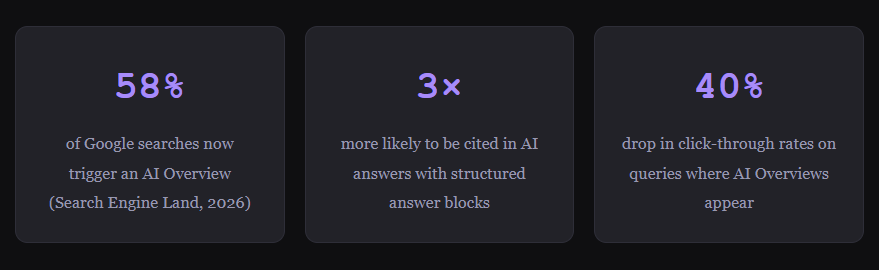
AI SEO is the practice of optimising content so it gets retrieved, cited, and ranked by AI-powered search systems. Google AI Overviews, ChatGPT, Perplexity, and similar engines now sit between your content and your audience. If your content is not structured for these systems, it does not get surfaced — regardless of how well it ranks on a keyword.
In this guide, I'll walk through the exact system I use. No theory-heavy frameworks. Just what works.
What is AI SEO in 2026?
“AI SEO is the practice of optimising content to appear in AI-generated search results — including Google AI Overviews, Perplexity, and ChatGPT. It involves structured formatting, entity-rich language, clear direct answers, and topical authority so AI systems can extract, cite, and rank your content over competitors.”
It is not a replacement for traditional SEO. It is an extension of it — one that most content teams are ignoring.
Where traditional SEO focused on keywords, backlinks, and page authority, AI SEO focuses on extractability. Can an AI system read your content and pull a clear, accurate, citable answer from it? If not, your content gets skipped — even if it ranks on page one.
I think of it as writing for two audiences simultaneously: the human reader who needs clarity and depth, and the AI layer that needs structure and directness.
How AI SEO is Different from Traditional SEO
The difference is not subtle. It changes how you approach every piece of content before you write a single word.
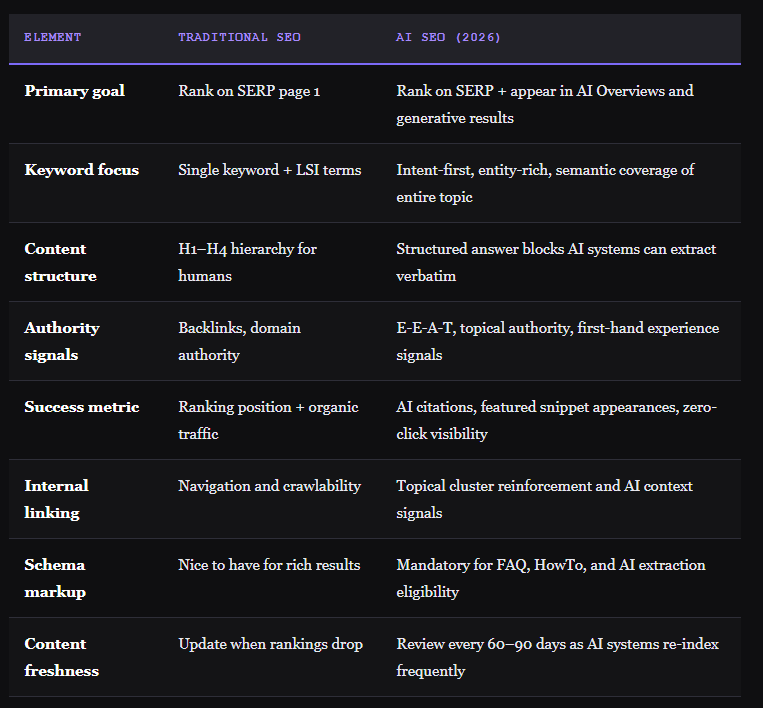
The shift is not just technical. It is strategic. Content that wins in AI search is content that is clear enough to be summarised, authoritative enough to be cited, and structured enough to be extracted. Most content fails all three.
Why Most AI Content Does Not Rank
This is the part nobody wants to admit. A lot of what is being published right now — in the name of AI SEO — does not work. I have audited enough content strategies to see the same patterns failing repeatedly.
The biggest mistake is writing for keywords instead of intent. People still treat AI SEO like it is keyword SEO with a different name. They pack in the phrases, optimise the meta, and call it done. But AI systems do not retrieve based on keyword match. They retrieve based on clarity, depth, and topical relevance.
Second is generic structure. Intros that spend three paragraphs explaining what the blog will cover. H2 headings that ask questions but take four paragraphs to answer them. No direct answer blocks. No schema. Nothing a machine can extract and serve in two seconds.
Third is missing topical authority. Publishing one blog on AI SEO and expecting to compete against someone who has published thirty interconnected posts on the same topic cluster is simply not realistic.
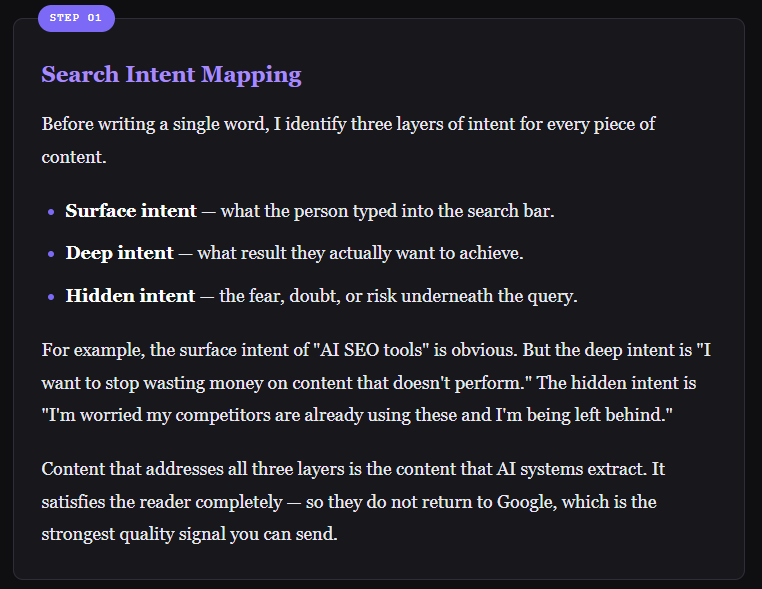
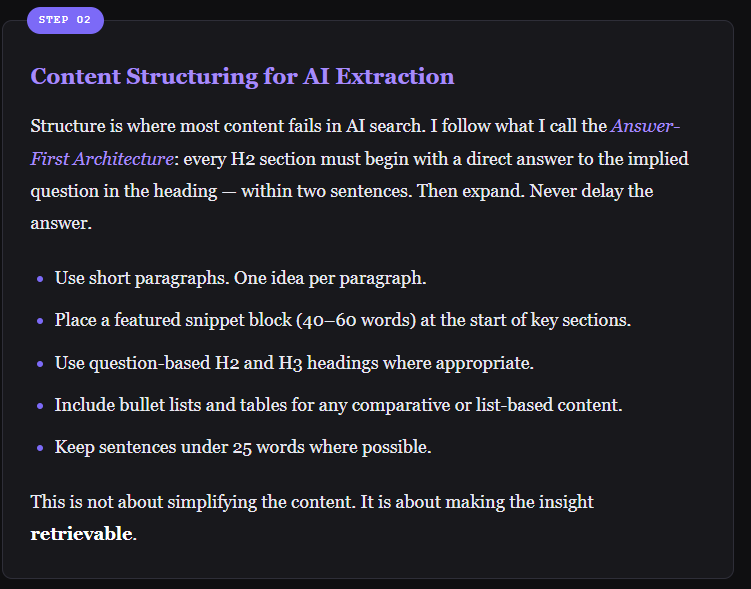
The Complete AI SEO System (Step-by-Step)
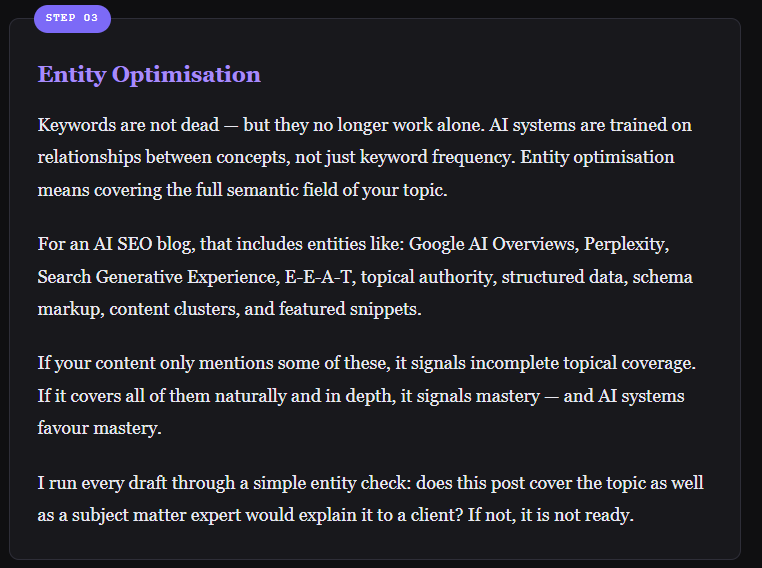
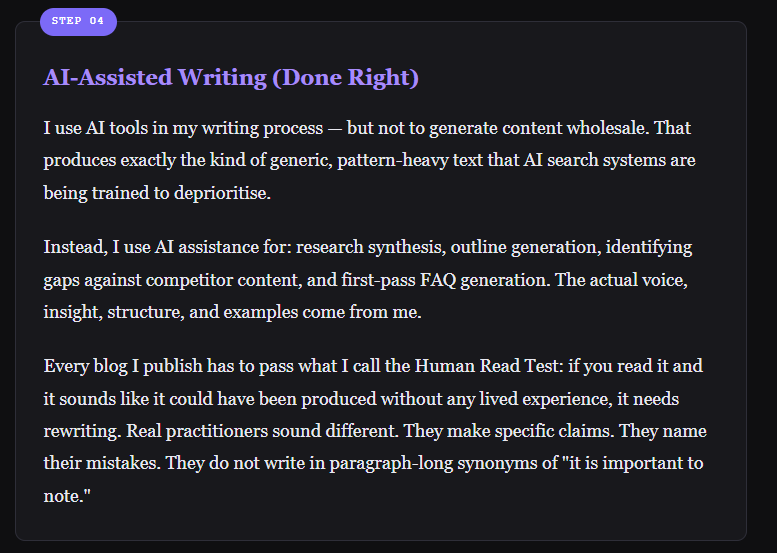
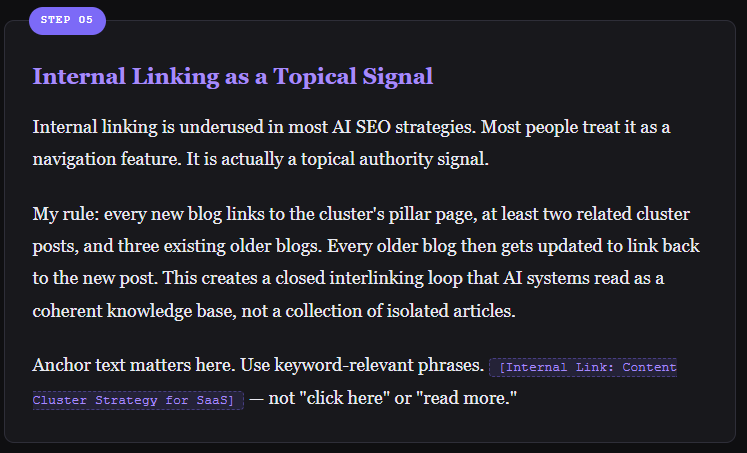
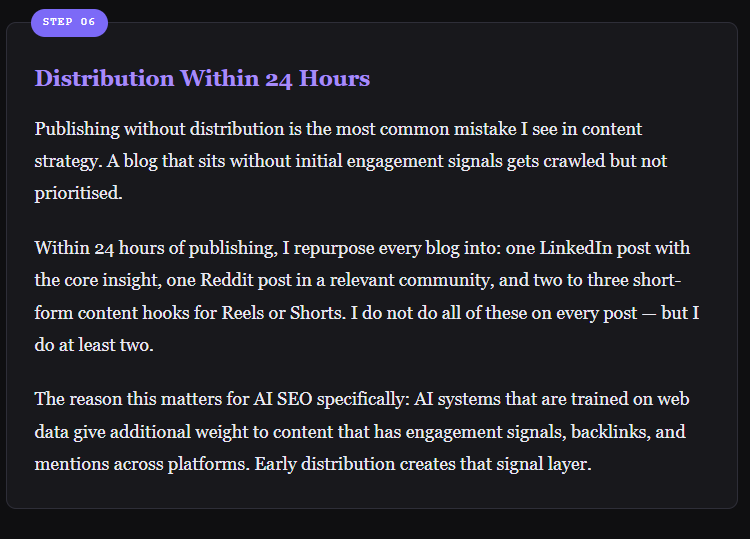
I built this system after testing across multiple SaaS content projects. It is not based on theory — it is what I have seen work consistently when executed properly.
How to Optimise Content for AI Search Engines
This is the section most guides skip. They talk about AI SEO without explaining how AI extraction actually works.
AI search engines retrieve content in a specific way. They look for content that can answer a query clearly, without the reader needing to continue searching. Here is what I have found works:
Define the topic within the first 100–150 words. Do not make the AI system read five paragraphs before finding out what the article is about.
Include structured answer blocks. Concise, 40–60 word paragraphs that directly answer a question. These are what get extracted into AI Overviews.
Use question-based headings. "What is AI SEO?" performs better in AI search than "AI SEO Overview." It mirrors how humans query.
Add FAQ schema. If your content includes questions, mark them up properly. It signals to the AI systems that this content is structured for extraction.
Demonstrate credibility signals. Mention real tools used, real outcomes observed, real client situations (anonymised). AI systems trained on E-E-A-T signals respond to this.
Keep paragraphs under five lines. Dense text blocks are extraction-unfriendly.
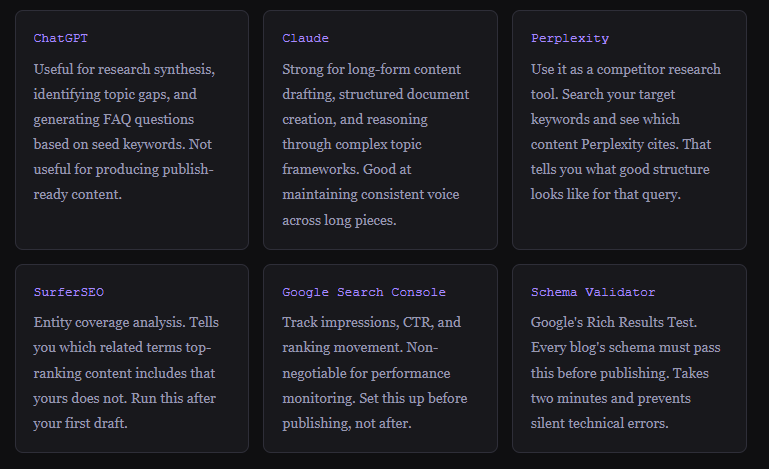
AI SEO Tools You Can Use
I want to be honest here: no single tool does AI SEO for you. These tools assist with specific parts of the process. The strategy, insight, and structure still have to come from you.
AI SEO Mistakes to Avoid
I have made most of these. Some of them cost months of wasted content production before I caught them.
Publishing without schema markup. Schema is not optional anymore. For AI search visibility, FAQ and Article schema are the baseline minimum for every blog.
Writing for volume over depth. Ten thin blogs will not outperform three deeply structured, entity-rich posts in AI search results. Depth wins.
Ignoring the hidden intent layer. If your content does not address the underlying doubt or risk behind the query, the reader will not convert — even if they find you.
Using generic transition language. Phrases like "in conclusion," "it is important to note," and "in today's digital landscape" are the fastest way to make content sound generated and untrustworthy. Cut them entirely.
Skipping the distribution step. Publishing and walking away means zero initial engagement signals. That slows down indexing and AI retrieval.
Not updating old content. AI systems re-index frequently. Content that sat at position three in 2024 may have dropped because a competitor updated their post and you did not. Review every 60–90 days.
Breaking topical authority by jumping between clusters too early. Publish 8–12 posts within a single cluster before expanding. Scattered topics do not build authority.
The most expensive mistake, though, is confusing activity with strategy. Publishing consistently matters. But publishing consistently without a defined intent, cluster, and conversion path is just producing noise.
FAQ Section
What is AI SEO?
AI SEO is the practice of optimising content to rank in AI-generated search results — including Google AI Overviews, Perplexity, and ChatGPT. It combines traditional SEO signals with structured formatting, entity coverage, and direct answer blocks that AI systems can extract and cite in their responses.
Does AI-generated content rank on Google in 2026?
Yes — but only when it demonstrates genuine expertise and original insight. Google's systems evaluate quality and helpfulness, not the method of creation. Content produced with AI assistance that lacks depth, first-hand experience, or unique perspective will not rank, regardless of how well it is formatted.
How do you rank in AI search in 2026?
To rank in AI search, focus on building topical authority within structured content clusters, use clear definition blocks within the first 150 words, include FAQ and Article schema, and write content that answers the query completely — so the reader does not need to return to Google. Consistent publishing within a defined cluster and strong internal linking accelerate results.
What is the difference between traditional SEO and AI SEO?
Traditional SEO focuses on ranking on Google's ten blue links through keywords, backlinks, and on-page optimisation. AI SEO extends this to optimise for AI-generated answers, where extractability, structure, and topical authority determine whether your content gets cited in AI Overviews, ChatGPT answers, or Perplexity results.
How often should I update AI SEO content?
Review every 60–90 days using Google Search Console data. Prioritise updates when rankings drop by more than three positions, CTR declines below your baseline, or a competitor publishes a significantly stronger post on the same keyword. Update the dateModified field in your schema after every revision.
Final System Summary
The AI SEO System — At a Glance
Map three layers of intent before writing: surface, deep, and hidden intent.
Define the topic within the first 100–150 words — every time, without exception.
Use Answer-First Architecture: direct answer in the first two sentences of every H2 section.
Include structured answer blocks of 40–60 words for featured snippet eligibility.
Cover entities, not just keywords — full semantic field coverage signals mastery.
Use AI tools for research and outlining; your voice and insight must lead the content.
Link every new post to the pillar page, two cluster posts, and three older posts.
Implement Article schema and FAQ schema as the minimum for every blog.
Distribute within 24 hours — at least one LinkedIn post and one Reddit post.
Review and update every 60–90 days based on ranking, impressions, and CTR data.
Publish 8–12 posts in a single cluster before expanding to a new topic.
Every blog must be the best result on the internet for its target query — not just better than average.
AI SEO is not complicated. But it does require a complete shift in how content is planned, structured, and published. The teams that treat it as keyword SEO with a new coat of paint will keep losing ground. The ones who build proper systems — intent mapping, topical clusters, extractable structure, consistent distribution — will compound their advantage over the next 12 months.
I have seen this play out enough times to say it without hedging: structure and authority win in AI search. Everything else is noise.