How I Built My SEO Personal Brand From Scratch
On 21 April 2025, my website had zero impressions in Google Search Console.
Not low impressions. Not a handful. Zero. The kind of zero that Google records when it hasn't decided your website exists yet in any meaningful search context.
Twelve months later, the same site had crossed 20,178 total impressions, was receiving organic traffic from over 130 countries, and had individual pages generating thousands of impressions on topics I'd deliberately chosen to own.
I'm not sharing this because the numbers are exceptional. In the world of high-traffic content sites, 20K impressions is a starting point, not a destination. I'm sharing it because the journey from zero to that first significant milestone is exactly where most personal brands stall — and I have the actual data to show what the path looks like, month by month, decision by decision.
This is not a theoretical framework. Everything in this blog is drawn from real Search Console data on a real personal brand site. The numbers are pulled directly. The mistakes are mine. The pattern is repeatable.
Building an SEO personal brand from scratch means creating a structured content system on a personal website that earns organic search visibility over time through keyword architecture, topical depth, and consistent publishing. The process typically takes 6–12 months to generate meaningful, compounding impressions — and the first milestone, 20K impressions, is achievable within that window with the right content strategy and review cycle.
Who This Is For (And Who It Isn't)
This is for you if:
You're building a personal brand as a, Best Niche Writer for Top companies, consultant, strategist, or specialist
You have a personal website but it's generating little to no organic traffic
You want to understand what the growth journey actually looks like — with real numbers, not projections
You're prepared to invest 6–12 months in building something that compounds
You're a writer, content strategist, photographer, or practitioner who wants your website to work as hard as your work does
This is not for you if:
You're looking for social media growth tactics — this is purely organic search
You want results in 30 days
You're expecting the journey to be linear (it isn't)
The Problem With Personal Brand SEO Advice
Most advice about building a personal brand focuses on social media presence, consistency, and "showing up." And while none of that is wrong, it misses the layer that produces lasting discoverability: organic search.
A personal brand that only exists on LinkedIn or Instagram disappears from view the moment you stop posting. A personal brand that has built SEO equity on a website it owns keeps generating impressions, clicks, and enquiries while you sleep, travel, or step away for three months.
The problem is that most personal brand builders don't think of their website as a content growth engine. They treat it as a portfolio — a static proof of existence. And a static website generates no impressions, no ranking signals, and no inbound traffic.
Why most SaaS blogs aren't growing organically traces back to the same root issue that affects personal brand sites: content volume without content architecture. The same logic applies at the personal brand level — and the fix is the same.
What My Data Actually Looked Like at the Start
Let me make this concrete with real numbers.
April–May 2025: True Zero
On 21 April 2025, zero impressions. The next day, still zero. On 23 April, two impressions — at an average position of 38, meaning nowhere near page one, barely being seen. One click arrived on 24 April. That was it.
For the entire last week of April 2025, the site generated a total of seven impressions. Not per day — total, across the week.
This is what a genuinely new site looks like in Search Console. Not suppressed or penalised — simply unseen. Google hadn't yet formed an opinion about what the site was or what it should rank for.
The first pattern that appeared: brand name searches.
The query "sneha mukherjee info" eventually became the highest-performing query on the entire site — 64 clicks, 107 impressions, a 59.81% CTR, at average position 1.83. Brand search doesn't happen by accident. It happens because people you've engaged with elsewhere — LinkedIn, a client meeting, a referral — search your name directly. Those first brand clicks tell Google that the site has legitimate demand, which helps every other page.
This matters more than most personal brand builders realise. Your brand name is your first keyword. Ranking for it at position 1–2 with a high CTR sends a trust signal that accelerates the indexing of everything else.
The Growth Journey: Month by Month
Here is exactly how the impression growth progressed, drawn directly from Search Console data:
April–June 2025 — Foundation Phase
Single digits to low double digits per day. The site was being indexed but had no cluster depth and no topical authority. Impressions spiked briefly on specific days (28 May: 4 clicks, 7 impressions; 1 June: 2 clicks, 2 impressions at position 1) but these were isolated brand visits, not content-driven ranking.
The lesson from this phase: the site was alive but invisible. Technical indexing was working. Topical authority hadn't started yet.
July–August 2025 — First Content Signals
9 July 2025: 5 clicks, 119 impressions, average position 17.7. The first real impression spike. The London gangs historical article had started gaining traction. By 2 August: 81 impressions.
This is a pattern I've seen across multiple projects. The first content piece to gain traction is rarely the one you expect. In my case, a long-form historical article about London's gang culture — written with research depth and narrative specificity — began appearing in searches before any of the more strategically targeted content did. Impressions don't always follow your editorial plan. They follow search demand and content depth.
September–October 2025 — Consistency Builds
By September, daily impressions settled into a consistent 12–31 range. Not exciting, but consistent — and consistency is the signal that matters at this stage. Average positions were improving across a range of queries. The site was being seen.
By late October, the pattern changed: 26 October, 188 impressions. 27 October, 142. The first real sustained impression spike. The site had passed some internal Google threshold and content was appearing more broadly across the query landscape.
November–December 2025 — Compound Effect Begins
November 2025 is when the compound effect became visible in the data.
5 November: 9 clicks, 68 impressions, CTR 13.24% 6 November: 9 clicks, 106 impressions, CTR 8.49% 7 November: 10 clicks, 107 impressions, CTR 9.35%
Three consecutive days of double-digit clicks. For a personal brand site with no paid promotion, this represented the system beginning to work as designed.
By 26 November: 346 impressions in a single day. The highest single-day figure to that point — more than the entire first week of April combined.
December brought 240 impressions on 3 December, 224 on the 4th. The pattern had shifted from irregular spikes to consistent daily presence.
January–March 2026 — Authority Consolidation
January and February showed steady daily impressions in the 30–100 range, with periodic strong days. The content system was compounding — older posts were gaining authority from new posts linking to them, and new posts were being indexed faster because the site had established topical credibility.
Then 30 March 2026: 470 impressions in a single day. The highest single-day figure in the site's history to that point. Followed by 309 on 31 March.
This wasn't a viral moment. It was the compound effect reaching critical mass — multiple posts generating impressions simultaneously, a cluster of content that collectively signalled topical authority on a subject Google had decided the site could answer reliably.
April 2026 — Sustained Growth
By April 2026, the site was consistently generating 80–160 impressions per day, with strong days reaching 362 impressions (21 April) and 323 (9 April). Daily clicks regularly reaching double digits on good days — 10 April: 10 clicks, 11 April: 6 clicks, 20 April: 11 clicks, 26 April: 11 clicks.
The total: 20,178 impressions across all pages, 608 clicks, from 130+ countries.
What the Traffic Breakdown Actually Reveals
The device, country, and page data tell a more specific story than the overall numbers suggest.
Device data:
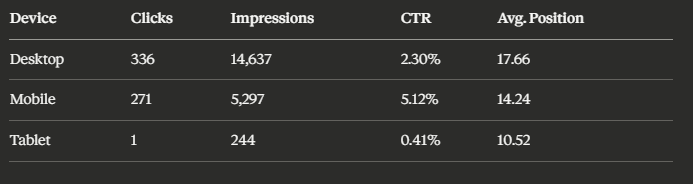
Mobile users convert at more than double the rate of desktop users (5.12% vs 2.30%) — despite ranking lower on average (14.24 vs 17.66). This tells me that mobile searchers on this site have higher intent when they click. They're looking for something specific. The content is satisfying it.
Desktop has the impression volume (14,637 vs 5,297) but lower CTR — suggesting that desktop users are exposed to the content in broader, lower-intent search contexts. Titles and meta descriptions need to work harder on desktop to earn the click.
Country data — the gap that matters most:
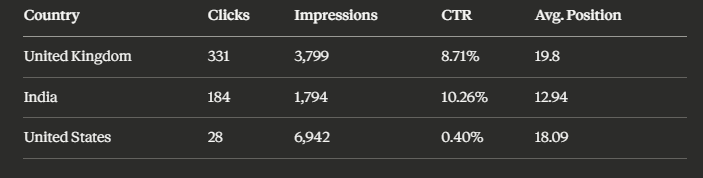
The United States data is the most important number in this entire dataset.
6,942 impressions. 28 clicks. A 0.40% CTR.
The US is generating more than double the impressions of any other country — but converting at a fraction of the rate. This is not a traffic problem. This is a CTR problem. The content is appearing in US searches but the titles and meta descriptions are not compelling enough for US searchers to click.
This single data point represents the clearest growth opportunity in the entire account. Fix the CTR in the US — bring it from 0.40% to even 2% — and the click volume from that market increases by 5x without publishing a single new piece of content.
The UK at 8.71% CTR and India at 10.26% CTR are performing exceptionally — meaning the content is highly relevant to searchers in those markets and the titles are earning the click. The task is replicating that performance in the US.
What the Page Data Shows About Content Strategy
The top-performing pages reveal both what's working and where the strategy is bifurcated.
The homepage (22.86% CTR, position 5.61): This is brand search converting efficiently. A 22.86% CTR at position 5.61 means people searching for the brand name are clicking through at a high rate. Strong brand signal. Good.
The London gangs article (0.93% CTR, 6,755 impressions): The highest-impression page on the site — but with a CTR below 1%. This is the classic "ranking but not clicking" problem. The impressions are real, the content is being seen, but the title or meta description isn't compelling enough to earn the click at scale. A single title test on this page could unlock 50–100 additional clicks per month.
The Steve McCurry photography article (1.20% CTR, 2,587 impressions): Ranking in position 9.78, appearing consistently, but CTR needs work. The content is strong enough to rank — the title isn't strong enough to earn the click.
The school catering bid guide (4.29% CTR, 700 impressions): Significantly better CTR than the two articles above, at a much lower impression volume. This suggests higher-intent searchers. People searching for school catering bids want a specific answer — and the title is delivering enough clarity to earn the click.
The Playbook content (ChatGPT vs Claude: 11.11% CTR, 54 impressions): The highest CTR of any content page on the site. Low volume — this content is new and still gaining traction. But an 11.11% CTR signals that the title and meta description are working exceptionally well for the intent of that query. As the Playbook cluster builds impressions, this CTR performance will produce compound click growth.
This contrast matters: the oldest, highest-impression pages have the worst CTR. The newest, strategically targeted Playbook content has the best CTR. The work is now to grow impressions on the high-CTR pages while fixing the titles on the high-impression, low-CTR pages.
The Query Data: What People Are Actually Searching For
The query report reveals both the current reality and the significant unrealised opportunity.
What's working:
"sneha mukherjee info" — 64 clicks, 59.81% CTR, position 1.83. The brand name anchor query. This is the foundation.
"school caterers cutting portion sizes, using cheaper ingredients due to funding shortages" — 5 clicks, 71 impressions, 7.04% CTR, position 2.21. A very specific, long-tail query with high intent — and the content is ranking second for it. This is exactly the kind of specific, well-researched content that wins low-competition queries quickly.
The CTR opportunity hiding in plain sight:
"writing seo" — 0 clicks, 275 impressions, position 1. This query is appearing at position 1 for a term with real search volume — and converting at 0%. That is not a content failure. That's a title and meta description failure. Something about how the page appears in search results is not earning the click despite ranking first.
"technical writer keywords" — 0 clicks, 367 impressions, position 74.09. The highest-impression query that isn't converting — but for a different reason. Position 74 means page 8 in search results. This is a content improvement opportunity: the page exists and is being seen for this query, but it needs to be stronger to rank on page one where clicks happen.
The gap between impressions and clicks across the query set:
The pattern across hundreds of queries is consistent: strong impressions at positions 14–80, very low CTR. This tells one clear story: the content is topically relevant enough to appear in searches, but either ranking too low for meaningful click volume, or the titles aren't compelling enough when the content does appear on page one.
Both are solvable. The AI SEO 2026 system addresses exactly this gap — content appearing in AI-generated answers and standard search but not converting because the presentation layer hasn't been optimised for the intent.
The System That Produced This Growth
Looking back at the data, the growth came from four things working together — not from any single action.
1. Publishing content with genuine depth on specific subjects
The London gangs article (6,755 impressions) and the Steve McCurry photography article (2,587 impressions) didn't rank because they were well-written. They ranked because they covered their subjects with historical specificity and research depth that competing content didn't match. How long-form content ranks on Google is determined by this depth layer — not length alone.
2. Building a visible brand name anchor
The 59.81% CTR on "sneha mukherjee info" is not accidental. It's the result of appearing in LinkedIn content, published work, professional profiles, and other contexts that drove people to search the name directly. Brand search is the first SEO metric worth building on a personal brand site — and it can't be bought, only earned.
3. Starting the Playbook content cluster
The Playbook content — despite lower impression volumes — is already showing the highest CTR rates on the site: 11.11% on ChatGPT vs Claude, 1.39% on content gap analysis with only 72 impressions, early impressions on the AI SEO content. This is newer content building toward topical authority in a defined, searchable subject area. Building an AI content system for a SaaS blog is one of the cluster posts showing early traction.
4. Geographic distribution without targeting
Traffic arriving organically from 130+ countries — the UK, India, US, South Africa, Canada, Finland, Ghana, Palestine, Swaziland — is not the result of geographic targeting. It's the result of content that answers questions people in those countries are searching. The content repurposing workflow distributes content into social channels that amplify this geographic reach — Reddit, LinkedIn, and short-form content create the initial engagement signals that help content reach searchers beyond the immediate audience.
The Three Decisions That Accelerated Growth
Looking at the data clearly, three specific decisions accelerated the trajectory.
Decision 1: Publishing content with information gain, not just coverage
The articles that generated the most impressions — London gangs history, Steve McCurry's photography style — weren't written to rank for short, easy keywords. They were written because there was a genuine gap in the available content on those subjects. High specificity, original research, real narrative depth. Why AI content doesn't rank is almost always a failure of information gain — content that covers a topic without adding anything new to it.
Decision 2: Building the Playbook as a separate, targeted cluster
The journal content generates broad impressions across diverse, unrelated topics. The Playbook generates narrow, high-intent impressions in a defined subject area: AI SEO, SaaS content systems, and performance-driven content strategy. The Playbook pages are outperforming journal pages on CTR because they're built with keyword architecture, not just editorial interest.
Using AI to find content gaps competitors are missing is the methodology behind the Playbook content planning — not just writing what seems relevant, but identifying where existing content falls short.
Decision 3: Not waiting for perfect conditions
The data shows early periods of near-zero performance. April 2025 was genuinely nothing. May 2025 was almost nothing. June and July were inconsistent. The right response to that data wasn't to second-guess the content strategy — it was to keep publishing with depth and let the compound effect build. The biggest mistakes SaaS founders make with AI content includes exactly this: stopping or pivoting during the foundation phase before the compound effect has had time to appear.
What I'd Do Differently Now
The data reveals three clear opportunities that weren't fully capitalised on.
Fix the US CTR problem first. 6,942 impressions in the US generating a 0.40% CTR is the single largest untapped opportunity in the account. The content is ranking. The titles aren't earning the click. Every top-impression page needs a US-audience-optimised title test. Content optimisation with AI for on-page SEO covers exactly this — and it's the first place I'd focus.
Update the London gangs article title immediately. 6,755 impressions and 0.93% CTR means roughly 63 people out of every 6,755 who saw the article in search results clicked on it. That's an extraordinary waste of earned impressions. A compelling title rewrite — addressing the curiosity and specificity of what searchers want — could realistically triple click volume from that single page without any new content being written.
Build the Playbook cluster faster. The ChatGPT vs Claude page at 11.11% CTR is showing what happens when content is perfectly matched to intent in a targeted cluster. Every new Playbook post published reinforces that cluster's authority. Turning one SaaS blog post into 10 pieces of content is the distribution layer that amplifies each new Playbook post's initial engagement signals.
The Four-Part Personal Brand SEO Framework
Based on this build, here is the framework I'd use to build a personal brand SEO presence from zero:
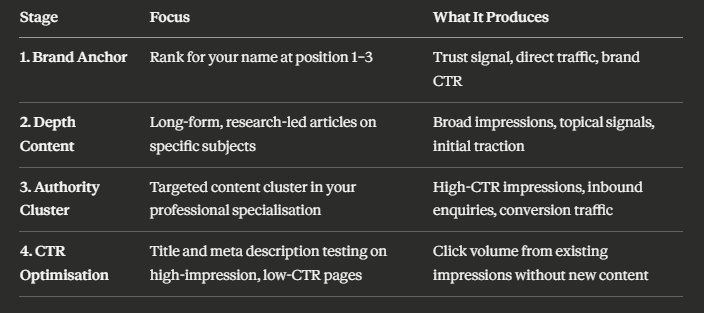
Most personal brand builders spend all their energy on stage 2 and skip stages 1, 3, and 4 entirely. The data shows that stage 1 (brand anchor) and stage 4 (CTR optimisation) are the two fastest levers for meaningful traffic improvement at any stage of the build.
For the full cluster-building mechanics — applied specifically to SaaS and B2B content — the scalable SaaS content growth engine guide walks through the same architecture at a larger scale.
What 20K Impressions Means (And What It Doesn't)
20,178 impressions across 12 months is a milestone, not an arrival.
At 608 clicks from those impressions, the overall CTR sits at approximately 3.0%. With better titles on high-impression, low-CTR pages — particularly the London gangs article and the US market gap — 1,000+ clicks from the same impression base becomes achievable.
The Playbook cluster is the future growth engine. The journal content is the historical impression base. The brand search is the anchor.
The next 12 months look different from the first 12 because the foundation is now built. New content doesn't start from zero — it starts from a site that Google already recognises as a relevant source in multiple subject areas. The AI SEO system for ranking in 2026 addresses what changes in the second phase of a personal brand SEO build — and how AI search surfaces personal brand authority differently from standard ten-blue-links search.
Adding E-E-A-T signals to content becomes more important at this stage — not just writing well, but demonstrating lived expertise in ways that AI and human readers can verify. A photography portfolio, published work history, and documented results — like this Search Console data — are all E-E-A-T signals that strengthen personal brand authority over time.
The 130+ countries that have generated impressions on this site have done so because content depth travels. A well-researched article on a specific subject gets found by searchers in Finland and Ghana and Palestine not because of international targeting — but because the internet is global and good content doesn't stay local.
That, more than any metric, is what a personal brand SEO system produces: discoverability that extends beyond your immediate network, your posting schedule, and your online activity. A system that keeps working even when you're not.
Key Takeaways
A personal brand site starts at zero and stays invisible until Google forms an opinion about what it is — cluster depth is what forms that opinion
Brand name search is the first keyword worth building — a 59.81% CTR on branded queries sends trust signals that accelerate all other content indexing
The compound effect becomes visible around months 4–6 and accelerates significantly by months 8–10 — the early period of near-zero impressions is normal, not a failure signal
High-impression, low-CTR pages (like 6,755 impressions at 0.93% CTR) represent the most immediate growth opportunity — a title test can unlock clicks without any new content
Country-level CTR data reveals market-specific opportunities: 6,942 US impressions at 0.40% CTR is a title problem, not a content problem
Mobile CTR (5.12%) outperforming desktop (2.30%) suggests mobile users have higher intent — content needs to be optimised for mobile reading and mobile search presentation
The highest CTR comes from content that's precisely matched to specific intent — not broad, evergreen content
20K impressions in 12 months is achievable with depth content, a targeted authority cluster, brand anchor building, and an active CTR review cycle
What to Do Next
If your personal brand site is at zero or near-zero, start with the foundation: confirm indexing, publish one depth article on a subject you know better than most, and let Google form its first opinion about what your site is about.
If you're between 1K and 10K impressions, your fastest lever is probably the CTR audit — find your highest-impression, lowest-CTR pages and rewrite the title and meta description before writing anything new.
If you're at 10K and climbing, the Playbook model is worth building: a targeted content cluster in your professional specialisation, built with keyword architecture, that generates high-intent impressions and converts them into enquiries.
For the email nurture layer — what happens after someone lands on the site and gives you their address — automating SaaS email sequences with AI covers the workflow I'd apply to keep that subscriber engaged through to a genuine conversation.
And if you want to talk through what the next phase of a personal brand SEO build looks like for your specific keyword landscape and subject area — start here.
Frequently Asked Questions
1. How long does it take to build an SEO personal brand from scratch? Based on real Search Console data, meaningful impression traction typically begins around month 3–4 and the compound effect becomes clearly visible by month 6–8. Reaching 20K total impressions takes approximately 10–12 months with consistent depth content publishing and an active review cycle. The first 90 days feel slow — that's normal, not a signal to change the strategy.
2. What type of content generates the most impressions for a personal brand site? Research-depth content on specific subjects consistently outperforms general expertise content. In real data, a historical article on London gang culture generated 6,755 impressions — more than any other page — because it covered the subject with a level of specificity and depth that competing content didn't match. Depth and specificity win over broad coverage.
3. Why does my personal brand site have high impressions but almost no clicks? This is almost always a title and meta description problem, not a content problem. If Google is showing your page in search results, the content is relevant. If searchers aren't clicking, your title or description isn't compelling or specific enough for the intent of that query. The fix is a title rewrite — test 2–3 alternatives and monitor CTR in Search Console over 30–45 days.
4. Does a personal brand site need a separate content cluster or is a blog enough? A general blog generates diverse impressions across unrelated topics, which builds no specific topical authority. A targeted content cluster — 10–15 posts on a single defined subject area — tells Google that the site is the authoritative source on that subject. Both serve different purposes, but the cluster is what drives the highest-intent, most commercially relevant traffic.
5. How important is country-specific performance data for a personal brand site? Country-level CTR data is one of the most actionable pieces of information in Search Console. A 0.40% CTR in the US against 6,942 impressions — compared to 8.71% CTR in the UK and 10.26% in India on the same content — means the content is ranking but titles aren't resonating with US searchers specifically. Understanding these gaps by market reveals exactly where to focus title optimisation before writing any new content.