How to Use Google Search Console Data for AI SEO (A Real-World Breakdown)
Quick Summary
GSC is the primary data source for both traditional SEO and AI SEO decisions
The four metrics that matter: position, impressions, CTR, and query-to-page mapping
Impression spikes with zero clicks are a diagnostic signal, not a failure
The IQPA Loop (Impressions, Query, Position, Action) is the framework for monthly GSC audits
Real data from snehamukherjee.info shows a clear pattern: sandbox period, breakthrough window, then volatility — all readable in advance through GSC
Pages ranking 11 to 30 are the highest-ROI optimization targets
AI Overviews have shifted the goal from CTR optimization to impression share and citation potential
A 45-minute monthly audit is enough to stay ahead of most content competitors
The Problem: Most people open GSC, look at total clicks, close it, and do nothing. That is not an SEO strategy. That is just checking a scoreboard.
The Shift: GSC in 2026 is not a reporting tool. It is a signal layer. Every impression, every position, every zero-click tells you exactly what Google and AI engines think about your content's authority and relevance.
The Fix: Run a monthly GSC audit using four lenses — position bands, impression-to-click gaps, CTR by intent, and query clusters. Then map that to your content update queue.
Keep reading to learn:
Why high impressions with zero clicks is actually useful data
How I moved from position 94 to position 1 using GSC signals
What AI Overviews have done to traditional CTR benchmarks
The exact audit process I follow every 30 days
Everyone talks about AI SEO like it is some separate discipline. New tool. New playbook. New rules.
It is not.
At the foundation, AI SEO still runs on the same signals Google has always used: relevance, authority, structure, and click behavior. What changed is where the clicks go. AI Overviews, featured snippets, and generative search answers now intercept traffic before it reaches your site. So the question is not just "does my content rank?" It is "does my content get cited?"
GSC tells you both.
It shows you:
What queries Google is already matching your content to
How often your pages appear versus how often people click through
Whether your content is being seen in positions where AI extraction is likely (top 3) or buried where it is invisible (position 40 and beyond)
The mistake I see constantly: people optimize for rankings without reading what their rankings actually mean. A page sitting at position 39.9 with 90 impressions is not failing. It is a candidate. It is telling you "Google thinks this is relevant, but not confident enough yet." That is a content quality signal, not a traffic problem.
The Four Metrics That Actually Matter
Most GSC guides list every metric. I will not do that. Here are the only four that drive decisions.
1. Average Position
This tells you where Google consistently slots your content. Under 10 means you are in the game. Between 11 and 30 is the optimization zone — small content improvements here have outsized impact. Over 30 means Google has not committed to your page yet.
2. Impressions
Impressions without clicks are not wasted. They tell you Google is surfacing your content but users are not choosing it. The fix is almost always the title or the meta description, not the content itself.
3. CTR (Click-Through Rate)
This is where search intent shows up as a number. A 0% CTR at position 5 means your title does not match what the user actually wanted. A 39% CTR at position 3 means you nailed the intent and the copy.
4. Query-to-Page Mapping
The most underused view in GSC. Filter by page, then check which queries are driving impressions. This tells you exactly what topics Google associates with each piece of content — which is almost always different from what you wrote it for.
How to Read Impression Spikes Without Panicking
Here is something that trips up a lot of content creators.
You publish a blog. For the first few weeks, you get low impressions, a few clicks, decent positions. Then suddenly: impressions spike to 50, 90, even 119 in a single day — but clicks drop to zero. Positions fall to 60, 70, even 90.
Your first reaction is panic. It looks like a penalty. It feels like a failure.
It is neither.
What you are seeing is Google re-indexing your content against a broader query set. The algorithm is testing your page against more searches to determine where it actually belongs in the hierarchy. The position drop is temporary. The impression spike is Google doing its job.
The key question to ask when this happens is: which queries drove those impressions?
If the new queries are semantically related to your target keyword, that is a good sign. Google is expanding your content's relevance footprint. If the queries are completely unrelated, that is a topical authority problem — your content cluster is not strong enough yet to give Google a clear signal about what you are an expert in.
The GSC-to-AI Optimization Framework
I call this the IQPA Loop (Impressions, Query, Position, Action). It is a four-step cycle I run on every blog every 30 to 60 days.
Step 1: Impressions check
Pull the last 28 days. Flag any page with over 50 impressions and under 2% CTR. These are your highest-priority pages. Google thinks they are relevant. Users do not agree.
Step 2: Query audit
For each flagged page, check the query breakdown. Look for three things:
Queries you did not target but are ranking for anyway
Question-format queries that your content does not directly answer
Branded queries mixed in with informational ones (this tells you something about brand recognition)
Step 3: Position band analysis
Sort all pages into three bands:
Position 1-10: Protect and optimize for AI extraction (add featured snippet blocks, FAQ schema)
Position 11-30: These are the highest-ROI targets. A content refresh often moves them into page one.
Position 31+: Diagnose whether this is a topical authority issue or a content quality issue before investing time
Step 4: Action queue
Build a prioritized update list based on impression volume, not just rankings. A page at position 25 with 300 impressions deserves more attention than a page at position 8 with 12 impressions.
A Real Data Breakdown: snehamukherjee.info
Let me show you what this looks like in practice using real GSC data.
The data below covers snehamukherjee.info from April to July 2025. This is not a theoretical example. These are actual numbers from an early-stage content site in the AI SEO and SaaS content strategy niche.
Phase 1: Indexed but Untested (April 21 to May 6, 2025)
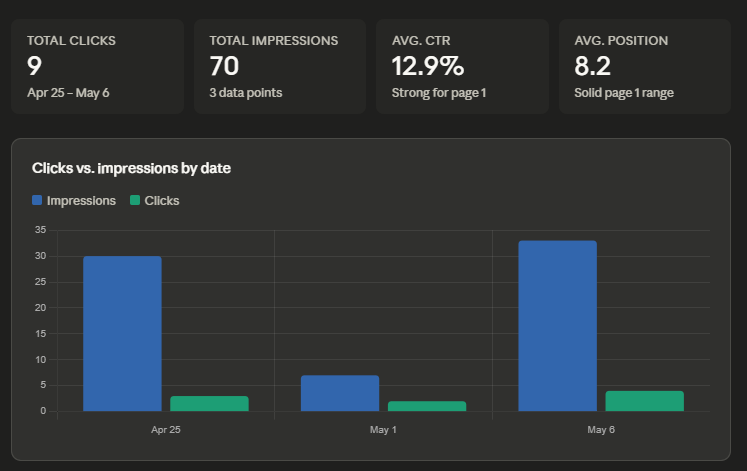
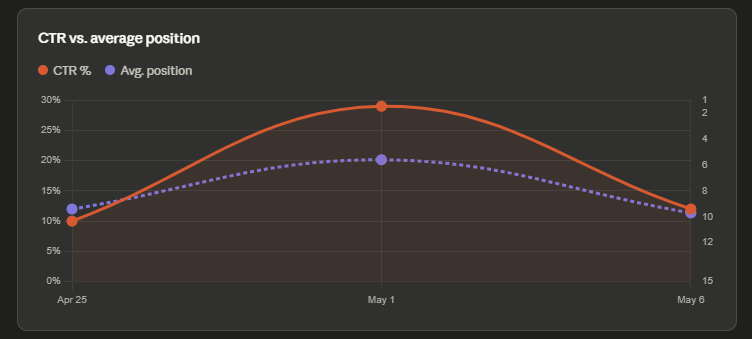
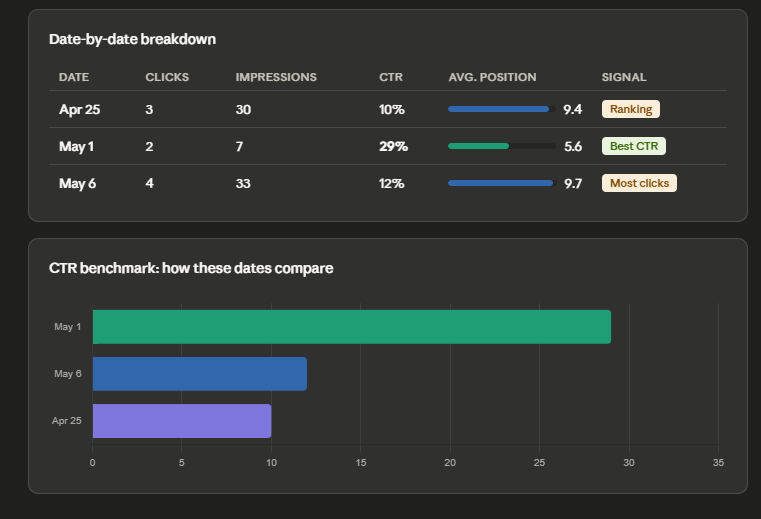
This phase is exactly what healthy early indexing looks like. Small impression counts but respectable positions between 5 and 10. The CTR on May 1 (29% at position 5.6) shows strong title-to-intent alignment for those specific queries.
Phase 2: The Impressions Plateau (Late May to Early June 2025)
Then came the dip. Positions moved to 57, 64, 68, even 94 on some days. Impressions were still being generated — 48, 55, 56 on individual days — but clicks dropped to zero across almost the entire stretch.
This is the sandbox period most new content sites go through. Google had enough data to surface the content but not enough confidence to rank it high. The site's topical authority was still building.
The right move here: keep publishing, keep interlinking, do not touch the existing pages.
Phase 3: The Position-1 Window (June 1 to June 13, 2025)
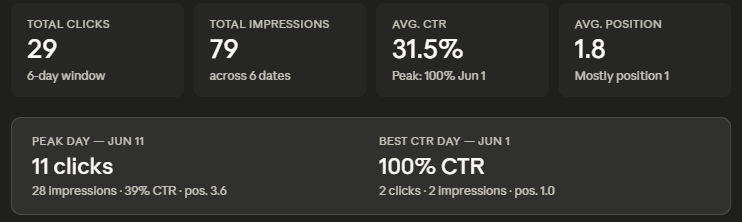
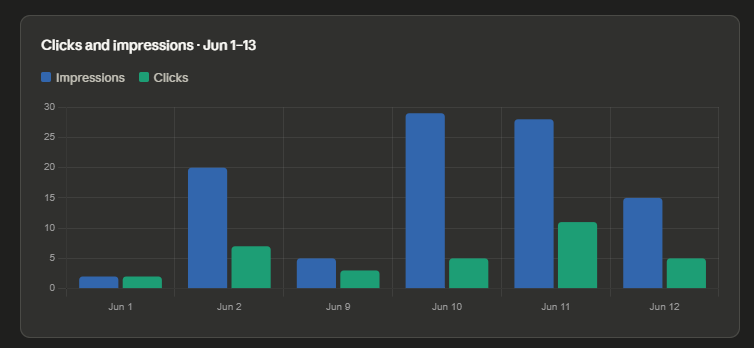
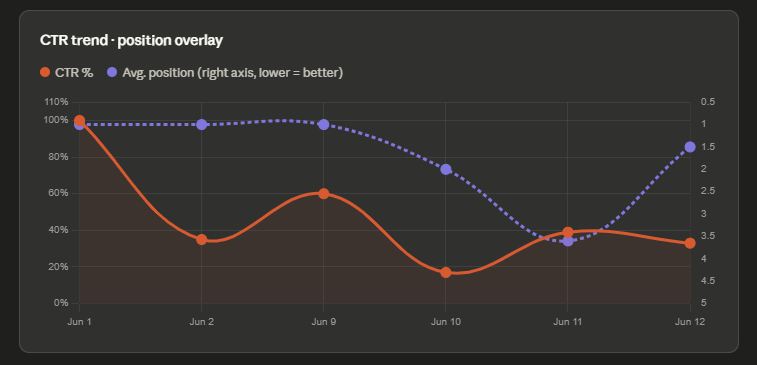
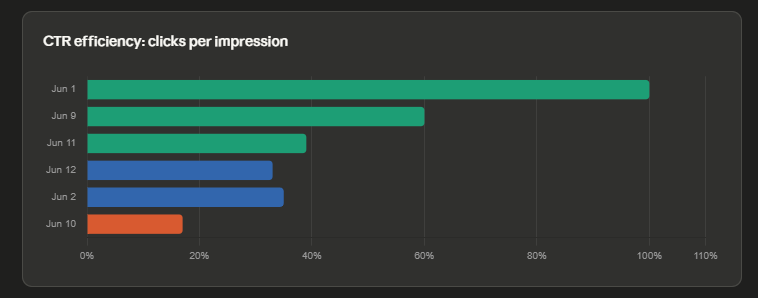
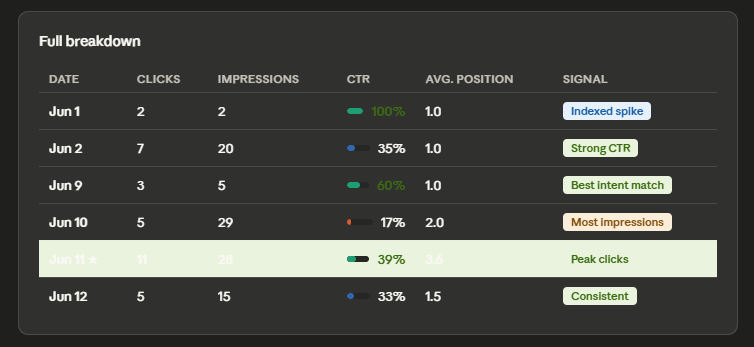
June 11 was the peak: 11 clicks, 28 impressions, 39.3% CTR at an average position of 3.6. That is what it looks like when content quality, topical authority, and intent alignment all click together at once.
The CTR on June 2 (35%) and June 9 (60%) at position 1 are especially interesting. A 60% CTR at position 1 means the title and description were extremely well-matched to what users wanted. This is also exactly the kind of click behavior that tells AI engines: this page is the right answer.
Phase 4: The Volatility Stretch (July 2025)
By July 4, impressions had climbed back to 90 in a single day — but at position 39.9. Zero clicks.
Then July 9: 119 impressions, 5 clicks, position 17.7. A meaningful recovery signal.
This is the typical pattern for a site building authority in a competitive niche. The trajectory is not linear. What matters is that the ceiling of the position-1 window has been proven. The task is to make it consistent.
What to Do With Keywords That Rank 11 to 30
The 11 to 30 position band is where most AI SEO gains happen. These pages are already indexed, already seen as relevant by Google, and already generating impressions. They just need a nudge.
Here is what I do with every page in this band:
Add a featured snippet block. Directly answer the primary keyword in 40 to 60 words at the top of the post. Make it a definition, a process, or a clear statement. AI engines pull from these blocks constantly.
Add or expand the FAQ section. Check GSC for question-format queries driving impressions to that page. Turn those exact questions into FAQ headings with direct answers. This directly improves AI Overview citation rates.
Tighten the introduction. The first 150 words need to deliver the answer, not build up to it. If a user or an AI engine scans the opening of your post and cannot extract a clear answer, the page loses.
Update the internal links. Add the page as a link target from your two or three highest-authority pages. Internal link equity is one of the clearest signals you can send to Google about which pages matter most.
Check the meta title. If the page is getting impressions but low CTR at position 15 to 25, the title is the problem. Rewrite it with a clear benefit or a specific outcome. Test two or three alternatives.
How AI Overviews Changed What GSC Data Means
This is the part most SEO guides skip.
Before AI Overviews, a page at position 1 with 35% CTR was doing well. That was the benchmark. Now, pages at position 1 can see CTR fall to 8 to 15% because the AI Overview above them answers the query before anyone clicks.
Does that mean GSC impressions are less valuable? No. It means the game has shifted.
A page that gets cited inside an AI Overview generates something more valuable than a click: it generates a citation. That citation builds brand recognition, drives direct searches, and signals to Google that your content is trusted enough to be referenced by its own AI layer.
So when I look at GSC data in 2026, I am looking for two things specifically:
Pages with high impressions and declining CTR at positions 1 to 5. These are candidates for AI Overview citation, not just traditional SEO.
Question-format queries driving impressions. These are the exact queries AI Overviews are built to answer. If your page ranks for them, a structured answer block can move you from "shown in results" to "cited in the AI answer."
The metric that matters most now is not CTR. It is impression share at high-relevance positions. Visibility is the new click.
The 4-Step AI SEO Audit Using GSC
Run this every 30 days. It takes about 45 minutes once you have the habit.
Step 1: Pull the 28-day view for all pages
Sort by impressions, descending. Ignore clicks for now. You want to know what Google is surfacing, not what is converting.
Step 2: Flag the gap pages
Any page with over 30 impressions and under 3% CTR is a gap page. Build a list. These are your immediate optimization targets.
Step 3: Run the query audit on gap pages
For each gap page, switch to the query view and filter by that page. Export the queries. You are looking for:
Question-format queries (great for FAQ schema and AI Overview targeting)
Informational queries where your page does not have a clear answer upfront
Queries that reveal a different intent than what you wrote for
Step 4: Build the update brief
For each gap page, write a one-paragraph brief:
What new information will you add?
Which FAQ questions will you answer?
What is the new featured snippet block?
Which internal links will you add or update?
Do not rewrite the post. Update it surgically. Google rewards fresh signals, not complete rewrites.
When to Refresh vs. When to Replace
This is one of the most practical decisions you will make as a content strategist. GSC data gives you a clear answer most of the time.
Refresh the content when:
The page has impressions but declining CTR. This is a title and meta description problem, not a content problem. Rewrite the first 150 words, add a featured snippet block, update the meta.
The page ranks for queries it was not written for. This means Google found a related intent in your content. Lean into it. Add a section that directly addresses those new queries.
The average position has stayed flat at 15 to 25 for more than 60 days. A targeted content update — new data, a new section, better internal links — is usually enough to trigger a re-evaluation.
Replace the content when:
The page has had 0 impressions for 90 or more days despite being indexed. Google has decided this page does not compete. A full rewrite with a new angle is needed.
The queries driving impressions are completely unrelated to the page's topic. This is a topical mismatch and usually means the page needs a different angle, not just a refresh.
Competitors have published significantly stronger content and your position has dropped more than 20 spots in 30 days.
One rule I follow without exception: never delete a page that still has impressions. Even 5 impressions a month means Google is connecting that URL to a search. Refresh it, redirect it to a stronger page, or expand it. Deletion should be a last resort.
Frequently Asked Questions
What is the difference between GSC data for traditional SEO and AI SEO?
In traditional SEO, the goal is clicks. In AI SEO, the goal is citation and impression share. GSC data is the same, but the signals you prioritize change. Focus on query coverage, position bands, and impression volume at positions 1 to 10 rather than raw click counts.
How often should I check GSC data for AI SEO optimization?
Once a month is the minimum. Weekly checks are useful for new content in the first 60 days after publishing. Use the 28-day comparison view to spot trends, not daily fluctuations.
Why does my page have high impressions but zero clicks?
Three most common reasons: your average position is too low (over 40), your title does not match the user's search intent, or an AI Overview is answering the query above your result. Fix the position through content depth and internal linking, and rewrite the title to be more specific.
Can GSC data tell me if my content is being cited in AI Overviews?
Not directly. GSC does not have a specific AI Overview report yet. However, a sudden drop in CTR at position 1 or 2 while impressions stay stable is a strong indicator that an AI Overview is intercepting traffic for that query.
What is the best GSC view for finding AI SEO opportunities?
Filter by Queries, sort by Impressions, and then filter to show only questions (queries starting with "what," "how," "why," "when," "can"). These are the exact query types that feed AI-generated answers. Any page ranking in the top 20 for these queries is a candidate for FAQ schema and featured snippet optimization.
Ready to run your first GSC audit for AI SEO? Start with the IQPA framework above. Pull your last 28 days, flag your gap pages, and build your update brief before you publish anything new