How to Rank in AI Search Results
The Problem: Most content creators are still writing for a 2019 version of Google. AI search engines like Google AI Overviews, Perplexity, and ChatGPT do not rank pages. They extract answers. If your content is not structured to be extracted, it will not be cited, regardless of how well it ranks in traditional search.
The Shift: AI engines are citation machines. They scan the web for clear, structured, credible answers. The content they pull from is almost always concise, authoritative, and directly answers a specific question within the first 150 words.
The Fix: Apply the SCAN framework — Structure, Credibility, Answer blocks, and Named entities. Build every piece of content around this and you give AI engines a reason to cite you.
Keep reading to learn:
The exact three signals that determine AI citation
Why high-ranking content still gets ignored by AI Overviews
The SCAN framework in full, with examples
A practical content checklist you can apply before every publish
To rank in AI search results, your content must be structured for extraction, not just optimized for keywords. AI engines pull answers from pages that include clear definitions, direct question-and-answer formatting, cited data, and short structured answer blocks within the first 150 words. Authority signals and consistent topical depth are required.
AI search is not search. Not the way we have understood it for the past 20 years.
Traditional search shows you a list of links. AI search shows you an answer. The difference sounds small. The implications are enormous.
When someone types a query into Google in 2026, they often get an AI Overview at the top of the results page. That overview is a synthesized answer pulled from multiple sources. Below it: the traditional blue links. The click goes to the overview. The traditional results sit there, mostly unclicked.
The same thing happens in Perplexity, ChatGPT, and every other AI-native search product. A user asks a question. The AI constructs an answer. It cites a handful of sources. Everything else is invisible.
So the question content creators need to ask is not "can my page rank on page one?" It is "will my page get cited in the AI answer?"
Those are two completely different problems.
Why Most Content Gets Ignored by AI Engines
I have audited dozens of content sites over the past year. Here is the single most common reason AI engines skip otherwise strong pages:
The answer is buried.
A blog post might be 2,500 words of genuinely useful content. But if the actual answer to the query does not appear until paragraph eight, an AI engine scanning for extractable answers will move on. It is not reading for comprehension. It is scanning for signal density.
Here are the most common content failures I see:
Long introductions that build context before giving the answer. AI engines want the answer in the first 150 words, not after a four-paragraph setup.
No clear definitions. If your content covers a topic without ever directly defining it in a clean sentence, AI engines struggle to extract a usable answer.
Missing question-format headings. Headings like "What is X?" or "How does X work?" are anchor points. Without them, AI engines cannot reliably match your content to the query.
Thin topical coverage. A single page on a topic is not enough. AI engines favor sources that demonstrate depth across a subject — multiple related pages, interlinked, covering a topic from multiple angles.
No data or citations. Content with statistics, referenced studies, or cited frameworks reads as more credible to both AI engines and human readers.
The fix is not a rewrite. It is a restructure.
The Three Signals AI Engines Actually Use
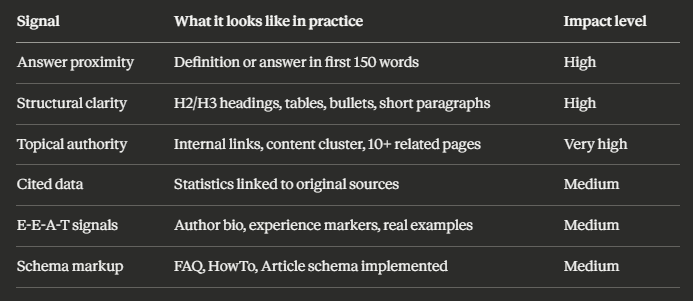
Forget the long list of ranking factors. When it comes to AI citation, three signals dominate everything else.
Signal 1: Answer proximity
How quickly does your content deliver a usable answer after the query is matched? AI engines extract from the top of the page first. Answers buried after 300 words get deprioritized.
Signal 2: Structural clarity
Can the AI engine parse the structure of your content? Clear H2 and H3 headings, bullet points, numbered lists, tables, and short paragraphs all signal to the AI that this content is organized and extractable.
Signal 3: Topical authority
Is this page part of a larger, coherent content cluster? A page that exists as an isolated post with no internal links, no related content, and no evidence of depth on the topic will lose to a page that sits inside a well-structured cluster, even if the isolated page is technically better written.
The SCAN Framework: My System for AI Ranking
I use a four-part framework for every piece of content I produce. I call it SCAN.
S — Structure
Every page must have a visible skeleton. That means an H1 that matches the target query, H2 sections that each answer a specific sub-question, and at least one table or list per 500 words. The structure is not decoration. It is the extraction map AI engines use to pull from your page.
C — Credibility
Every claim needs a signal. That could be a statistic with a source, a real example from your own work, a tool or workflow you have actually used, or a result you have personally seen. Vague authority claims ("I have years of experience in this field") do not register. Specific signals do ("in testing this across 40 SaaS content audits, I found...").
A — Answer blocks
Every H2 section should open with a 40 to 60 word direct answer. Not a teaser. Not a lead-in. The answer itself, stated plainly, immediately. This is the format AI engines are looking for. Featured snippets have trained both users and AI systems to expect this. Give them what they want.
N — Named entities
Named entities are the proper nouns your content references: tools, frameworks, people, companies, methods. AI engines use named entities as context anchors. If your content on AI search mentions Google AI Overviews, Perplexity, SearchGPT, and E-E-A-T, it is semantically richer than content that just says "AI search tools" and "ranking factors." Named entities tell AI engines exactly what space your content belongs in.
How to Structure Content for AI Extraction
Structure is the most actionable lever you have. Here is how I apply it.
The opening 150 words
This is the most valuable real estate on any page. In the first 150 words, I include:
A clear definition of the primary topic
A direct answer to the most obvious query this page will rank for
A statement of what the reader will know by the end
This is the TL;DR model. Not a summary — a value delivery. The reader (and the AI engine scanning the page) should know within 30 seconds whether this is the right source.
Heading architecture
Every H2 should be answerable as a standalone question. I test this by asking: if someone only read this heading and the paragraph beneath it, would they get a useful answer?
If the answer is no, the heading is a category, not an answer. Restructure it.
Tables over paragraphs for comparisons
Any time I am comparing two or more things — tools, approaches, signals, frameworks — I put it in a table. Tables are one of the highest-extraction formats for AI engines. They are clean, structured, and scannable.
Short answer blocks at the top of each section
This is the structural pattern I follow without exception. Each major section opens with 1 to 2 sentences directly answering the section's question. Then the explanation follows. Not the other way around.
The Role of E-E-A-T in AI Search Visibility
Google's E-E-A-T framework — Experience, Expertise, Authoritativeness, and Trustworthiness — was designed for human quality raters. But it has become directly relevant to AI citation.
AI engines do not just look at the content on a page. They look at the source. A page on AI SEO strategy from a site with a clear author, a real professional bio, linked social profiles, and a portfolio of consistent work in that space will outperform an equally well-written page from an anonymous or thin-authority source.
Here is what E-E-A-T signals look like in practice:
Experience: Specific examples from your own work. Real data from your own site. Case studies where you are the subject.
Expertise: Demonstrated depth. Content that goes past the surface of a topic. Frameworks you have built or tested.
Authoritativeness: Links from other credible sources. Mentions in industry publications. Consistent output on a defined topic over time.
Trustworthiness: Accurate information. Cited sources. An author bio that matches the content. A site that loads cleanly and has no spam signals.
None of these are quick wins. But every piece of content should be pushing these signals forward, not just targeting keywords.
Featured Snippet Blocks: The Shortcut to AI Citation
The featured snippet block is the single fastest structural change you can make to improve AI citation rates.
A featured snippet block is a 40 to 60 word passage that directly answers a query in plain, structured language. It does not tease. It does not summarize. It answers.
Here is the format I use:
Question (as an H3 heading): "What is [primary keyword]?"
Answer block (40 to 60 words immediately below): A clean definition or direct answer. No jargon. No qualifiers. Present tense. Short sentences.
Google pulls from these blocks for featured snippets. AI Overviews pull from them too. Perplexity and ChatGPT use them when constructing sourced answers. A page with three to five well-placed answer blocks has a significantly higher chance of citation than a page with the same information buried in long paragraphs.
Real Examples: What Gets Cited vs. What Gets Skipped
Here are two versions of the same content. Same topic. Same keyword. Completely different AI citation potential.
Version A (gets skipped):
"There are many factors that influence how AI search engines process and display content. Understanding the nuances of these systems requires a deep dive into how machine learning models are trained and what signals they prioritize when constructing generative answers for users..."
Version B (gets cited):
"AI search engines cite content that delivers a clear answer within the first 150 words, uses structured formatting (headings, tables, bullets), and demonstrates topical authority through a connected content cluster. Structure and answer proximity matter more than word count."
Version B is half the length. It will be cited. Version A reads like a setup that never delivers — AI engines move on.
The pattern holds across every niche I have worked in. Directness is not just a readability improvement. It is a citation signal.
The AI SEO Content Checklist
Before publishing any piece of content aimed at AI search visibility, I check every item on this list.
Structure
H1 matches the primary query exactly or near-exactly
H2 headings are answerable as standalone questions
At least one table included for any comparative section
Bullet points used for lists of three or more items
No heading followed immediately by another heading (always a paragraph between)
Answer blocks
Featured snippet block in the first 150 words (40 to 60 words, plain language)
Each major H2 section opens with a direct 1 to 2 sentence answer
FAQ section at the end with 5 real search queries as questions
Credibility
At least one statistic with a linked source
At least one real example, case study, or personal result
Author bio visible on the page
Internal links to at least one pillar page and two related cluster pages
Schema
Article or BlogPosting schema implemented
FAQ schema added if the page includes question-format sections
HowTo schema added if the page is a step-by-step guide
Schema validated before publishing
Distribution
Meta title under 56 characters
Meta description written as an ad pitch, under 155 characters
At least one LinkedIn post drafted before publishing
When to Refresh vs. When to Rebuild
Not every underperforming page needs a complete rewrite. Here is how I decide.
Refresh when:
The page has impressions in Google Search Console but low CTR — the structure and answer blocks need updating, not the research
The page ranks between position 11 and 30 — a featured snippet block and FAQ section can move it into page one
The content is less than 18 months old and the topic has not fundamentally changed
Rebuild when:
The page has had zero impressions for 90 days — Google has not found a query to match it, which means the angle is wrong
The page was written without a clear primary keyword or content cluster connection
Competitor pages have dramatically outpaced the page with new data, frameworks, or depth that cannot be added without a structural overhaul
One principle I follow: never delete a page with any impressions at all. Redirect it, update it, or expand it — but deletion removes a signal Google has already processed.
Quick Summary
AI search engines extract answers, they do not rank pages — the goal is citation, not position
The three core signals are answer proximity, structural clarity, and topical authority
The SCAN framework — Structure, Credibility, Answer blocks, Named entities — covers every element needed for AI citation
Featured snippet blocks (40 to 60 words, placed early) are the highest-leverage structural change
E-E-A-T signals matter for AI citation, not just traditional rankings
Content that gets cited is direct, structured, and answered at the top
Frequently Asked Questions
What does it mean to rank in AI search results?
Ranking in AI search means your content is cited inside AI-generated answers from tools like Google AI Overviews, Perplexity, and ChatGPT. Unlike traditional search, there is no position 1 through 10. Either your content is cited in the answer or it is not. Citation depends on structural clarity, answer proximity, and topical authority.
How is AI search different from traditional SEO?
Traditional SEO drives clicks to your page. AI search intercepts the query before the click happens and constructs an answer. The content you create still needs to rank in traditional search to be in the AI engine's index, but ranking alone is not enough. You also need to be structured for extraction. Clicks, impressions, and CTR all behave differently in an AI-first search environment.
How long does it take to rank in AI search?
There is no fixed timeline. Based on my work with early-stage content sites, pages that are well-structured for AI extraction can appear in AI Overviews within 4 to 8 weeks of indexing, assuming topical authority is established and the content directly answers a real query. Thin or poorly structured pages can sit unnoticed for months even with decent traditional rankings.
Does schema markup help with AI search rankings?
Yes, indirectly. Schema markup does not directly determine whether an AI engine cites your content, but it helps AI systems understand what your content is about, who wrote it, and what questions it answers. FAQ schema in particular aligns well with the question-answer format AI engines prefer when constructing generative responses.
What type of content ranks best in AI search?
Content that ranks best in AI search is direct, structured, and authoritative. Definitions, how-to guides, comparison frameworks, and FAQ-style content consistently outperform long-form opinion pieces or narrative essays for AI citation. The format that works best is: answer first, explanation second, supporting detail third — the inverse of how most blog content is traditionally written.
Ready to build content that gets cited, not just ranked? Start with the SCAN framework and run every page through the checklist before you publish.
For a deeper breakdown of how I use GSC data to identify which pages are closest to AI citation readiness.