Traditional SEO vs AI SEO: The Full Breakdown You Actually Need in 2026
“Traditional SEO optimises content for Google’s crawlers using keywords, backlinks, and technical structure. AI SEO optimises for language models and generative engines that retrieve, summarise, and cite content in AI-generated answers. Both require strong content — but AI SEO demands clarity, authority, and structured reasoning above all else.”
I had a blog ranking in position three. Decent traffic. Respectable impressions. Then I searched the same keyword on Perplexity and ChatGPT Search. My article was nowhere. A competitor with fewer backlinks and a newer domain was being cited instead — because their content was clearer, more structured, and easier for a language model to extract a confident answer from.
That moment changed how I think about SEO entirely.
Traditional SEO and AI SEO are not opposites. But they are not the same thing either. Treating them as interchangeable is one of the fastest ways to lose ground in 2026 — in Google and in every AI-powered search surface that is growing around it.
This is the full breakdown. I am going to walk you through what traditional SEO actually means, what AI SEO requires, where they overlap, where they diverge, and the exact framework I use to build content that is designed to rank and be retrieved across both.
If you are building content for a SaaS brand, a personal brand, or a content system that needs to perform — this is worth reading slowly.
What Traditional SEO Actually Means (And What Most People Get Wrong)
Traditional SEO is the practice of optimising content and technical infrastructure so that Google's crawlers can discover, index, and rank your pages for relevant queries.
It has three core pillars:
1. On-page optimisation — using target keywords in titles, headings, meta descriptions, and body content in a way that signals relevance to Google.
2. Technical SEO — ensuring your site is crawlable, fast, mobile-responsive, and structured correctly so Google can access and index your content without friction.
3. Off-page authority — earning backlinks from credible sources to signal to Google that your content is trustworthy and worth ranking.
These three things still matter. I want to be clear about that. Anyone telling you traditional SEO is dead is wrong — or selling you something. Google still processes over 8.5 billion searches per day. A significant portion of those result in a traditional blue-link click. Ranking in Google remains one of the highest-leverage organic distribution channels available.
But here is what most people get wrong about traditional SEO: they treat it as a keyword-matching exercise. Stuff the right terms in the right places, get enough links pointing at you, and wait for the algorithm to notice.
That worked in 2015. It barely works now. Google's algorithms have evolved to evaluate content quality, topical authority, user signals, and E-E-A-T (Experience, Expertise, Authoritativeness, and Trustworthiness). Thin content with the right keywords does not rank the way it once did.
Traditional SEO in 2026 is not about tricking the algorithm. It is about being genuinely useful — and structured in a way that makes your usefulness obvious to a machine.
📌 Related read: Why Your SaaS Blog Isn't Growing Organically — I break down the silent reasons your content is not compounding.
What AI SEO Actually Is (Beyond the Buzzword)
AI SEO — also referred to as generative engine optimisation or GEO — is the practice of structuring content so that AI-powered search systems (Perplexity, ChatGPT Search, Google's AI Overviews, Gemini, and others) can confidently retrieve, summarise, and cite your content in their generated answers.
This is fundamentally different from traditional SEO.
In traditional SEO, the goal is to rank in a list of ten blue links. The user sees your title and meta description, clicks through to your site, and reads your content.
In AI SEO, the goal is to be inside the answer. The AI reads your content, extracts what it needs, synthesises it with other sources, and presents a summary to the user — sometimes with a citation, sometimes without one.
The user may never visit your site. But if your content is the source the AI trusts most, you are the authority being quoted.
Here is what AI search engines prioritise when selecting sources to cite:
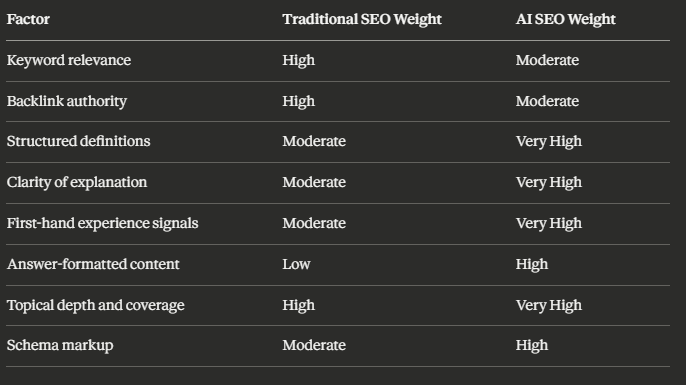
The shift is significant. AI search rewards clarity and authority over keyword density and link volume.
According to research on generative engine behaviour, content that includes clear definitions, direct answers, and structured formatting is significantly more likely to be cited in AI-generated responses than content optimised purely for keyword matching.
The Core Problem: Most Content Is Built for Neither
Here is the uncomfortable truth. Most blog content I audit is not truly optimised for traditional SEO or AI SEO. It sits in a middle zone — not technical enough for Google to confidently rank it, and not structured clearly enough for a language model to confidently cite it.
The three most common mistakes I see:
Mistake 1: Writing for word count, not intent depth. Publishing a 2,500-word article that circles the same point seventeen different ways does not help Google understand your authority. It dilutes your signal. Word count without information gain is noise.
Mistake 2: Ignoring the three layers of search intent. Surface intent is what someone types. Deep intent is what they actually want to achieve. Hidden intent is the fear, doubt, or risk behind the query. Most content addresses only surface intent. The rest of the user's real question goes unanswered — and they bounce back to Google.
Mistake 3: Treating AI search as a bonus, not a channel. Generative search is not a future consideration. It is a current distribution channel with a rapidly growing share of search behaviour. Ignoring AI SEO now is the equivalent of ignoring mobile optimisation in 2012.
📌 Related read: Why AI Content Does Not Rank — the specific structural reasons AI-generated drafts fail to earn Google's trust.
The T-A-R-G-E-T Framework: How I Approach Both Simultaneously
Over the past two years, I have built and refined a system for creating content that performs in both traditional search and generative AI search. I call it the T-A-R-G-E-T Framework.
Each letter represents a non-negotiable layer of every piece I publish.
T — Topical Authority First
Before I write anything, I map the full cluster. What is the pillar topic? What are the 10–15 supporting angles that need to exist before this blog has real authority weight?
Google and AI systems both reward topical completeness. A single well-optimised blog in an otherwise thin content environment will underperform. A blog that lives inside a structured cluster of related, interlinked content will compound far faster.
This is why I never publish a blog as a standalone piece. Every article has a defined relationship to the cluster, a pillar page, and at least two to three related posts it connects to. AI SEO in 2026: The Complete System to Rank in AI Search
A — Answer Architecture
Every blog must be structured to answer questions — not just state information. This means:
Clear definitions in the first 150 words
Featured snippet blocks (40–60 word direct answers)
FAQ sections with real search queries
Question-based H2 and H3 subheadings where appropriate
This structure serves two audiences simultaneously. Google sees well-organised, intent-matched content. AI systems see clearly extractable answer units that are easy to cite with confidence.
R — Real Experience Signals
Language models are trained on human-generated content. They have developed a sensitivity to the difference between content that describes something from observation versus content that describes something from a template.
Every blog I write includes at least one of the following: a real result with numbers, a specific workflow I have used, a mistake I made and what I learned, or a tool I tested with an honest opinion.
This is not just about E-E-A-T for Google. It is about passing the extraction quality check that AI systems apply when deciding whether a source is worth citing.
For a deeper look at how E-E-A-T signals affect AI-generated content retrieval, this breakdown from ArticleBiz is worth your time: Adding E-E-A-T to AI-Generated SaaS Content.
G — Gap-First Writing
Before I write, I look at the top three ranking pages for my target keyword. I ask one question: what have they missed, explained poorly, or not gone deep enough on?
That gap becomes the strongest section of my article.
This is where most content fails. Writers summarise what already exists. Strong content identifies what is missing and fills it — with original frameworks, specific examples, or perspectives that competing content does not offer.
📌 Related read:How to Use AI to Find Content Gaps Your Competitors Are Missing
E — Engagement Engineering
Attention is not automatic. Every 150–300 words, I include a pattern interrupt. This could be a short punchy sentence that reframes the argument. A bold claim that needs unpacking. A question that makes the reader pause. Or a table that breaks up the prose and delivers a chunk of structured value.
This matters for traditional SEO because dwell time and scroll depth are behavioural signals. It matters for AI SEO because structured, scannable content is easier for language models to parse and retrieve.
T — Trust Through Structure
Schema markup is the final layer. After the content is written and edited — never before — I implement the appropriate schema type. For an informational blog like this one: Article schema is mandatory. FAQ schema is added because this piece naturally answers questions. No schema is added that does not match visible content.
Schema does not directly improve rankings. But it improves click-through rate through rich results eligibility, and it significantly improves visibility in AI-generated answers by giving language models structured, machine-readable data to work from.
Traditional SEO vs AI SEO: A Real-World Comparison
Let me show you how these two approaches play out in practice using a real content scenario.
Target keyword: "content strategy for SaaS"
Traditional SEO approach:
Identify keyword volume and competition
Optimise title tag, meta description, H1 with the keyword
Build internal links from related pages
Earn backlinks from authoritative SaaS publications
Write 1,500–2,500 words targeting related secondary keywords
AI SEO approach:
Define the exact question the AI must answer: "What is a content strategy for SaaS and how do you build one?"
Include a clear 50-word definition in the opening
Structure the article with question-based headings
Include a named framework (not generic advice)
Add a case study with specific numbers
Include FAQ schema with three to five real search queries
The result when both are combined: The article ranks in Google for the primary and secondary keywords. It also appears in Perplexity as a cited source when users ask about SaaS content strategy. It gets extracted into ChatGPT Search responses because the structure is clear enough for the model to confidently pull from.
That is the compound effect of building for both channels simultaneously.
For a full system on this, I have documented the exact approach here: AI SEO 2026 System: Rank Content
What Still Works from Traditional SEO (And What Does Not)
Let me be direct here because there is a lot of misleading content on this topic.
Still works:
Keyword research and intent mapping — essential
Technical SEO (site speed, crawlability, mobile optimisation) — table stakes
Internal linking and content cluster architecture — more important than ever
Backlinks from genuinely authoritative sources — still a trust signal
Long-form content that goes deep — rewarded by both Google and AI systems
Declining in effectiveness:
Exact-match keyword stuffing — penalised
Thin content built purely for volume — not competitive
Backlink schemes and low-quality link building — actively harmful
Generic meta descriptions that do not drive curiosity — ignored
Publishing without a conversion strategy — waste of resource
This shift is not just about Google's algorithm updates. It reflects a broader change in how search surfaces present information. When AI Overviews answer a query directly on the SERP, the only way to earn a place in that answer is by being the most trustworthy, most clearly structured, most authoritative source on that topic. Keywords alone cannot get you there.
The Conversion Layer: Making SEO Actually Drive Business Outcomes
Here is something I genuinely believe gets overlooked in most SEO conversations: ranking is not the goal. Revenue is the goal.
Traditional SEO often treats conversion as someone else's problem — the job of the landing page team or the sales team. AI SEO, done correctly, cannot afford to separate content from conversion.
Every blog I publish includes three CTA layers:
Soft CTA (TOFU): A link to another blog in the cluster that goes deeper on a related question. The reader is not ready to buy — they are ready to learn more. I meet them there.
Mid CTA (MOFU): A case study, framework, or content upgrade. Something that demonstrates what I can actually do and begins building the trust required for a commercial conversation.
Hard CTA (BOFU): A direct prompt to enquire, consult, or access a service. Not aggressive. Not hidden. Simply clear about what the next step is for someone who is ready.
Read Why Your SaaS Content Isn't Converting and How AI Fixes It — this is where I break down the conversion gap that most content strategies ignore.
Key Takeaways
Traditional SEO and AI SEO are not opposites — they are layers of the same content system
Traditional SEO is still essential for Google rankings, but keyword matching alone is no longer enough
AI SEO requires clear definitions, structured answer blocks, first-hand experience signals, and FAQ-formatted content
The biggest content mistake is writing for word count instead of intent depth
The T-A-R-G-E-T Framework (Topical authority, Answer architecture, Real experience, Gap-first writing, Engagement engineering, Trust through structure) covers both channels simultaneously
Schema markup does not rank you — but it improves CTR and AI retrieval eligibility
Every piece of content must have a defined conversion path — ranking without conversion is vanity
Content must be reviewed every 60–90 days to prevent decay and maintain relevance
Publishing consistently (eight to twelve blogs per month within a single cluster) is more effective than publishing sporadically across disconnected topics
The goal is not to write a better version of existing content — the goal is to be the best result on the internet for your target keyword
If you are still building your content system from scratch, start here: How to Build an AI Content System for a SaaS Blog
Frequently Asked Questions
1. Is traditional SEO still relevant in 2026? Yes. Traditional SEO remains essential for Google rankings, which still drive the majority of organic search traffic. The core principles — keyword intent mapping, technical site health, internal linking, and authoritative backlinks — are still the foundation of any content strategy. What has changed is that keyword matching alone is no longer sufficient. Content must demonstrate genuine topical authority and user value.
2. What is the main difference between traditional SEO and AI SEO? Traditional SEO optimises for Google's ranking algorithm — focusing on keyword relevance, backlinks, and technical structure. AI SEO optimises for language models that power generative search — focusing on structured clarity, direct answers, first-hand experience signals, and content that can be easily extracted and cited. Both require strong content, but the structural requirements differ.
3. Can you do traditional SEO and AI SEO at the same time? Yes — and this is exactly the approach I recommend. The T-A-R-G-E-T Framework is designed to satisfy both channels simultaneously. Content that is structured for AI retrieval (clear definitions, question-based headings, FAQ schema) also performs well in traditional search because it demonstrates strong topical organisation and intent alignment.
4. Does AI search replace Google? Not yet, and likely not entirely. Google still processes billions of searches daily. AI-powered search surfaces (Perplexity, ChatGPT Search, Google AI Overviews) are growing in usage and capturing a meaningful share of informational queries. A content strategy that optimises only for Google is already leaving retrieval opportunities on the table.
5. How do I know if my content is AI SEO ready? Ask one question: could an AI language model confidently extract a direct, accurate answer from my content without needing to read the entire article? If the answer is no — because the content is too vague, too keyword-heavy, or lacks structured definitions and clear explanations — then it is not AI SEO ready. Start by adding a featured snippet block and FAQ section, then audit the structure of your H2 headings.
If you are building content for a SaaS brand and you are not sure whether your current strategy is built for traditional search, AI search, or neither — I can audit it.
I work with SaaS founders and content teams to build performance-driven content systems that rank in Google and get retrieved in AI-generated answers. The gap between a blog that exists and a blog that compounds is almost always structural, not creative.