AI Search vs Google Search: What's Actually Changing in 2026
“Google search returns a ranked list of links based on relevance, authority, and technical signals. AI search uses language models to generate synthesised answers by reading and extracting from multiple sources — often without requiring the user to click through to a website. Both are now active channels for content discovery in 2026.”
I remember refreshing Google Search Console one morning and noticing something odd. Impressions were up. Clicks were flat. CTR was dropping week on week, and nothing I had changed on my end explained it.
It took me longer than I would like to admit to understand what was happening. Google's AI Overviews were answering more of the queries I was targeting — directly on the search results page. Users were getting the answer without clicking. My content was being read. It just was not driving traffic the way it used to.
That was not a ranking problem. That was a search behaviour problem. And it required a completely different kind of response.
The shift from traditional Google search to AI-powered search is not a future scenario. It is a present reality that is changing how content gets discovered, how audiences consume information, and how businesses build visibility online. If you are still building a content strategy purely around blue-link rankings, you are optimising for a channel that is measurably shrinking — at least for informational queries.
This blog is my full breakdown. What is actually changing, what is staying the same, what the numbers tell us, and the exact system I use to stay visible across both Google search and AI search simultaneously.
What Google Search Is and How It Has Always Worked
Before I get into what is changing, it is worth being precise about what Google search actually is — because a lot of the AI search conversation relies on a vague understanding of the comparison.
Google is a document retrieval system. When you type a query, Google's algorithm evaluates billions of indexed pages, scores them across hundreds of ranking signals (including relevance, authority, technical performance, and user behaviour), and returns an ordered list of results it believes best match your intent.
The system is built on three foundational pillars:
Crawling and indexing — Google's bots discover and store web content continuously. If your content is not crawlable or indexable, it does not exist as far as Google is concerned.
Ranking signals — Google evaluates each page against a complex set of criteria including keyword relevance, backlink authority, page speed, mobile usability, structured data, user engagement signals, and E-E-A-T (Experience, Expertise, Authoritativeness, and Trustworthiness).
Results presentation — Google returns a SERP (Search Engine Results Page) that includes organic links, paid ads, featured snippets, People Also Ask boxes, knowledge panels, and increasingly, AI-generated overviews.
This is the system that has dominated search for over two decades. It is not broken. But it is being supplemented — and for certain query types, it is being partially replaced — by a fundamentally different approach to answering questions.
📌 Related read: What Is AI SEO and How It Works — the foundational explainer before going deeper.
What AI Search Is and How It Works Differently
AI search — in the form of Perplexity, ChatGPT Search, Google AI Overviews, Microsoft Copilot, and Gemini — works on a completely different logic.
Instead of retrieving a ranked list of documents and letting the user choose, AI search reads multiple sources, synthesises the information, generates a written answer, and presents it directly to the user. Citations are included — sometimes. The user may never leave the search interface.
The key distinction is this: Google returns documents. AI search returns answers.
This changes everything about what makes content valuable in a search context.
In Google search, your goal is to rank high enough that a user sees your title, finds it compelling, clicks through, and reads your content. The value exchange happens on your website.
In AI search, your goal is to be the source the AI trusts enough to extract from and cite. The value exchange happens inside the AI's response — and if your brand is associated with the best answer, you build authority even when the click does not happen.
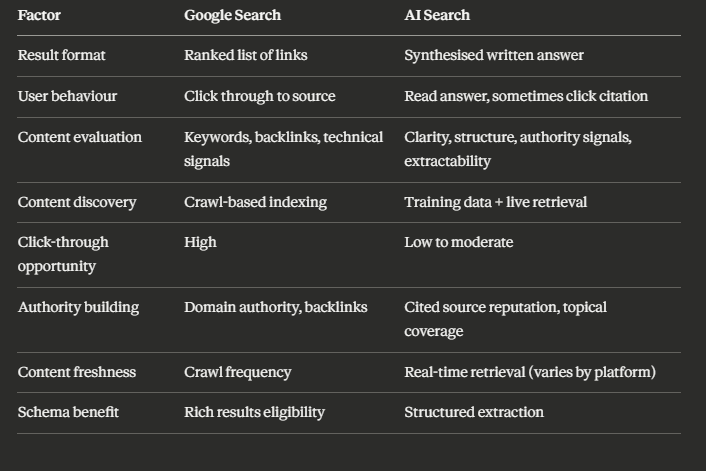
The implications of this table are significant. AI search rewards content that is easy to extract, clearly structured, and demonstrably authoritative — not content that is merely well-optimised for crawlers.
For a practical look at how AI assists in keyword research within this changing landscape: How AI Assists with Keyword Research
The Three Shifts That Are Actually Happening Right Now
I want to be specific here because the general conversation around "AI is changing search" tends to be vague in ways that make it difficult to act on.
These are the three shifts I am observing in real content performance data — on my own work and on content audits I conduct for SaaS brands.
Shift 1: Informational Queries Are Being Answered Without Clicks
The queries most affected by AI Overviews and generative search are informational ones — "what is X", "how does Y work", "difference between A and B". These are the queries that content marketers have historically used to drive top-of-funnel traffic.
Google's AI Overviews now answer a significant proportion of these queries directly on the SERP. Perplexity and ChatGPT Search do the same. The result: impressions may stay stable or even grow (because your content is being used as a source), but click-through rates for informational queries are declining.
This is not a reason to stop creating informational content. It is a reason to rethink what informational content is for. If a user is not going to click through, your goal shifts: you want to be the source that gets cited, the name that appears in the answer, and the authority that the reader associates with the topic.
Being cited in AI search is still distribution. It is just a different kind.
📌 Related read: AI SEO 2026 System: Rank Content — the full system for building content that gets retrieved in both channels.
Shift 2: Commercial and Transactional Queries Still Favour Traditional Search
Here is the nuance that a lot of AI search conversation misses: not all queries behave the same way.
For commercial and transactional queries — "best SaaS tools for X", "hire a content strategist", "pricing for Y software" — traditional Google search still dominates. Users performing these searches want to evaluate options, compare providers, and make decisions. They click through. They browse. They convert.
AI search is not yet a strong channel for these query types in the same way. Users asking Perplexity "best project management software" are often met with a generated list — but they still tend to click through to reviews, comparison pages, and vendor sites to make the actual decision.
This means a dual-channel content strategy is not just advisable — it is essential. Informational content must be optimised for AI retrieval. Commercial content must be optimised for Google ranking and click-through conversion.
Mixing up these priorities — treating all content the same regardless of intent — is one of the most common mistakes I see in SaaS content strategies.
📌 Related read:Why Your SaaS Blog Isn't Growing Organically — this often comes down to intent misalignment, not effort.
For context on how long-form content performs in Google specifically: How Long-Form Content Ranks on Google and Why Most People Get It Wrong
Shift 3: Authority Is Being Distributed Differently
In traditional Google search, authority flows through backlinks and domain rating. A high-DR site with strong link equity has a significant structural advantage.
In AI search, authority is evaluated differently. Language models assess content quality based on signals that include: clarity of explanation, presence of first-hand experience, structured formatting, topical coverage depth, and consistency of positioning across multiple pieces of content.
A newer domain with a smaller backlink profile but a well-structured, clearly authored, topically deep content cluster can outperform an older domain in AI search retrieval — even if it cannot outrank it in Google.
This is not wishful thinking. I have seen it happen on client work. And it changes the calculus for anyone building content authority from scratch.
The brands and creators who understand this shift and act on it early will build AI search authority now, while most competitors are still optimising for a single channel.
For the E-E-A-T framework that applies to both channels: Adding E-E-A-T to AI-Generated SaaS Content
The S-H-I-F-T System: How I Build Content for Both Channels
I developed this framework after spending several months rebuilding content strategies that were performing in Google but invisible in AI search — and diagnosing why. Every letter addresses a distinct gap between what traditional SEO optimises for and what AI search retrieval requires.
S — Search Intent Split
Before writing a single word, I categorise the query by intent: informational, commercial, or transactional. Then I decide which channel is the primary target.
Informational queries get structured for AI retrieval first — with clear definitions, featured snippet blocks, and FAQ schema — then optimised for Google ranking.
Commercial queries get optimised for Google click-through first — with compelling titles, strong meta descriptions, and conversion-focused content structure — then made scannable enough for AI extraction.
This prevents the most common mistake: writing informational content with commercial intent signals (or vice versa) and performing poorly in both channels.
H — Human Voice Architecture
AI systems are increasingly good at detecting the difference between content that reflects real experience and content that reflects template-following. I am not speculating about this — it shows up in retrieval patterns.
Content that includes specific observations, named tools, real results, and personal mistakes gets cited more consistently than content that describes the same concepts in abstract terms.
Every piece I write includes at least one of the following: a workflow I have tested, a result with a real number attached to it, a mistake I made and its actual consequence, or a tool I use with an honest opinion about its limitations.
This is not just about E-E-A-T. It is about the quality signal that makes an AI language model confident enough to extract and cite your content as a reliable source.
I — Intent Depth Coverage
Every search query has three layers of intent. Surface intent is what the user typed. Deep intent is what they are trying to achieve. Hidden intent is the fear, doubt, or risk sitting underneath the question.
"AI search vs Google search" — surface intent is understanding the comparison. Deep intent is likely deciding where to focus a content strategy. Hidden intent is probably fear of getting the strategy wrong and losing visibility.
Content that addresses only the surface layer is thin by definition. I structure every blog to explicitly answer all three layers — which is also why my content tends to rank for long-tail variations of a query I never directly targeted.
📌 Related read:How to Use AI to Find Content Gaps Your Competitors Are Missing
F — Format for Extraction
AI systems retrieve content by parsing structure. They look for clear headings, short paragraphs, definition blocks, comparison tables, and numbered lists that can be extracted cleanly into a generated answer.
Every blog I write follows this formatting protocol:
A 40–60 word featured snippet block at the top answering the primary keyword directly
H2 and H3 headings written as statements or questions (not vague category labels)
At least one comparison table per blog
Short paragraphs — two to four sentences maximum in most cases
Bullet point summaries in the key takeaways section
FAQ section with five questions written in natural language
This structure does not harm Google performance. In fact, it improves it — because Google's own featured snippet extraction follows similar logic.
For a practical breakdown of on-page optimisation that works for both: Content Optimisation with AI: On-Page SEO Refinement
T — Topical Cluster Completeness
Neither Google nor AI search treats a single blog in isolation. Both systems evaluate the depth and breadth of your topical coverage across an entire domain.
A blog about AI search vs Google search that lives inside a cluster of 10–15 well-linked, topically related articles will outperform the same blog published on a site with no surrounding content architecture — in both channels.
This is why I build in clusters, not individual posts. Every new piece I publish:
Links to the pillar page for the topic
Links to two to three cluster articles that address adjacent questions
Has older cluster articles updated to link back to it
Is documented in a content map so the full cluster structure is visible
A Real Example: The Same Query, Two Completely Different Results
Let me show you what the dual-channel gap looks like in practice.
I tested the query "how does AI search work differently from Google" across three surfaces: Google search, Perplexity, and ChatGPT Search.
Google search returned a list of articles from Search Engine Journal, Moz, and a few tech publications. Most were written in 2023–2024. Most explained the concept accurately but without a clear structural framework or original perspective.
Perplexity generated a synthesised answer citing three sources. Two of them were the same tech publications from Google. One was a newer, less authoritative domain — but its content was more clearly structured, included a comparison table, and had a 50-word definition block near the top of the article.
ChatGPT Search cited four sources. Three overlapped with Perplexity's citations. The fourth was a personal brand blog — again, lower domain authority, but with a first-person account of testing both platforms with real results and specific numbers.
The pattern was consistent across multiple queries I tested. AI search systems were not defaulting to the highest-authority domains. They were selecting for the most clearly structured, most extractable, most experience-signalling content — regardless of domain age or backlink profile.
This is the window of opportunity that exists right now for anyone willing to build their content with AI retrieval in mind.
📌 Related read: Why AI Content Does Not Rank — the structural reasons AI-generated drafts miss the retrieval bar.
What Google Is Doing in Response to AI Search
It would be incomplete to discuss this shift without acknowledging that Google is not a passive observer.
Google's AI Overviews (formerly Search Generative Experience) are Google's own generative search layer. They appear above organic results for a growing proportion of queries and provide a synthesised answer with cited sources — exactly as Perplexity and ChatGPT Search do.
The critical detail: Google is selecting sources for AI Overviews from pages it has already indexed and ranked. Strong Google performance is therefore still a prerequisite for appearing in Google's own AI answers.
This is why the dual-channel strategy is not a choice between one platform or another. Google performance feeds Google AI Overview visibility. Structural content quality feeds Perplexity and ChatGPT Search visibility. The two are complementary, not competing.
The brands winning in 2026 are the ones who understand that Google SEO and AI SEO are layers of the same content system — not separate strategies requiring separate resources.
For a comprehensive technical foundation that supports both: Technical SEO for SaaS Websites — the Complete Guide
The Content Strategy Response: What to Change Right Now
Based on everything above, here is how I recommend SaaS founders and content strategists adapt their approach.
1. Audit your informational content for AI extractability. Go through your top informational articles. Do they have a clear 50-word definition near the top? Are the headings structured as questions or direct statements? Is there a comparison table? A FAQ section? If not — these are the updates to prioritise in your next content review cycle.
2. Stop treating CTR as the only success metric for informational content. If your content is being cited in AI Overviews or generative answers, that is distribution. Track brand mentions, citation appearances, and assisted conversions — not just direct clicks. The attribution model for AI search is different, not absent.
3. Build the cluster before the individual post. Every informational blog you publish should have a clear home in a defined content cluster. Isolated posts — even well-optimised ones — perform below their potential in both Google and AI search.
4. Add first-person experience signals to existing content. Go back to your highest-traffic informational articles. Add a section with a real workflow, a real result, or a real mistake. This single change has improved AI retrieval rates on content I have audited more consistently than almost any other intervention.
5. Implement FAQ schema on every informational blog. Write five questions based on real search queries around your target keyword. Keep answers between 40 and 60 words. This is one of the highest-leverage technical changes for AI search visibility — and it takes less than 30 minutes per post.
📌 Related read: How to Build an AI Content System for a SaaS Blog — the full architecture behind a system that runs on both channels.
📌 Related read: Biggest Mistakes SaaS Founders Make with AI Content — most of these mistakes show up in exactly the scenarios described above.
For a practical look at common content mistakes that affect both channels: Common SaaS Content Mistakes Killing Your Organic Traffic —
The Conversion Question: Does AI Search Actually Drive Revenue?
This is the question I get asked most often when I discuss AI SEO with SaaS founders. And it is the right question to ask.
The honest answer is: the direct conversion attribution from AI search is still developing. AI-generated answers do not always drive immediate clicks. The user journey from AI search to conversion is often longer and less linear than the Google search → landing page → conversion path that SaaS teams are used to measuring.
But here is what I have observed: brands that show up consistently in AI-generated answers build recognition. When those same users return to Google with a commercial intent query — comparing vendors, looking for a specific tool, researching a service — they already have a name in mind. The awareness was built in AI search. The conversion happens in Google.
This is why informational content that earns AI search visibility is not separate from revenue. It is the beginning of a longer journey that ends in a click, an enquiry, or a purchase. The measurement is harder. The value is real.
Read Why Your SaaS Content Isn't Converting and How AI Fixes It — this is where the full picture of AI search attribution becomes a content strategy decision.
Key Takeaways
Google search returns ranked links. AI search generates synthesised answers. Both are active channels for content discovery in 2026.
Informational queries are increasingly answered directly by AI search, reducing click-through rates for top-of-funnel content — but creating a new citation-based visibility model.
Commercial and transactional queries still favour Google. The dual-channel strategy accounts for both.
AI search rewards content that is clearly structured, easily extractable, and demonstrates real experience — not just keyword relevance and backlink authority.
Google's own AI Overviews source from indexed and ranked content, meaning Google performance still matters for Google AI visibility.
The S-H-I-F-T System (Search Intent Split, Human Voice Architecture, Intent Depth Coverage, Format for Extraction, Topical Cluster Completeness) is the framework I use to optimise content for both channels simultaneously.
Adding first-person experience signals and FAQ schema to existing content is the highest-leverage improvement available for immediate AI retrieval gains.
Content published within a structured cluster will outperform isolated posts in both Google and AI search.
The conversion path from AI search is longer — but the awareness it builds feeds back into Google-based commercial conversions.
Every new blog published must address all three layers of search intent: surface, deep, and hidden.
Frequently Asked Questions
1. Is AI search replacing Google? Not currently, and likely not entirely. Google still processes billions of searches daily and remains the dominant search channel for commercial and transactional queries. AI-powered surfaces like Perplexity, ChatGPT Search, and Google's own AI Overviews are growing in share — particularly for informational queries — but they supplement rather than replace Google for most use cases in 2026.
2. How does AI search decide which sources to cite? AI search systems — including Perplexity and ChatGPT Search — evaluate sources based on content clarity, structural quality, topical authority, and experience signals. They prefer content with clear definitions, direct answers, structured formatting, and first-hand credibility markers. Backlink authority matters less than it does in traditional Google ranking.
3. Should I stop creating informational content if AI search is not driving clicks? No. Informational content that earns AI search citations builds brand authority and awareness that feeds commercial conversions over time. The metric to track shifts from direct CTR to citation frequency, brand recognition, and assisted conversion. The goal is to be the source the AI trusts — not just the link the user clicks.
4. Does optimising for AI search hurt my Google rankings? The opposite is more likely to be true. Content optimised for AI retrieval — with clear structure, featured snippet blocks, and FAQ schema — also performs better in Google search because these are quality signals Google already rewards. The two optimisation approaches are complementary, not competing.
5. How do I know if my content is being retrieved by AI search? Search your target keywords directly in Perplexity, ChatGPT Search, and Google with AI Overviews enabled. Check whether your domain appears in citations. Track brand mentions across these platforms. Note which structural elements the cited content has in common — then audit your own content against those patterns.
If your content is ranking in Google but invisible in AI search — or if you are not sure where your content currently stands across both channels — this is worth looking at before your competitors do.
I work with SaaS brands to build content systems that are designed to perform in Google and get retrieved in AI-generated answers. The gap between content that exists and content that compounds is almost always structural.