IT Recycling Glasgow
Most businesses in Glasgow have a drawer, a storage room, or a corner of the office that quietly fills up with old laptops, dead servers, and outdated desktops. Nobody quite knows what to do with them. So they sit there.
That stack of equipment is not just a space problem. It is a legal one.
In Scotland, businesses are legally required to dispose of IT equipment in accordance with the Waste Electrical and Electronic Equipment (WEEE) Directive. Get it wrong — skip a certificate, use the wrong provider, or hand equipment to an unlicensed collector — and the liability sits squarely with your organisation. Not the recycler.
I have spent time reviewing how Glasgow businesses handle end-of-life IT, and the pattern I see repeatedly is the same: organisations are not struggling with willingness to recycle. They are struggling with knowing how to do it correctly. This guide walks through exactly that. If you want to understand the full legal landscape across Scotland first, my guide on IT recycling for Scotland businesses covers the regulatory picture in detail.
The Real Problem With IT Disposal in Glasgow
Here is what I have noticed when reviewing how businesses actually handle old equipment. There are three common failure patterns.
Failure Pattern 1: The "Someone Will Deal With It Later" Approach
Equipment accumulates. Then one day there is an office move or an insurance audit, and suddenly 40 laptops need to go somewhere fast. Rushed decisions lead to non-compliant disposal. Certificates are either missing or never issued. Duty of care documentation does not exist.
Failure Pattern 2: Handing Equipment to an Unknown Collector
Someone finds a local man with a van who "does electronics". The equipment disappears. No paperwork. No WEEE documentation. No certificate of destruction. The business has just transferred its IT assets — and potentially sensitive data — to an unlicensed third party. The legal responsibility for that? It still sits with the original business.
Failure Pattern 3: Assuming Deletion Is Destruction
Deleting files, even formatting a drive, does not destroy the data on it. Standard deletion leaves data recoverable. GDPR requires that personal data is properly destroyed when no longer needed. This distinction matters enormously — especially for healthcare, legal, and financial businesses in Glasgow. My article on data destruction for SSDs goes into the technical detail of why SSD disposal is particularly complex.
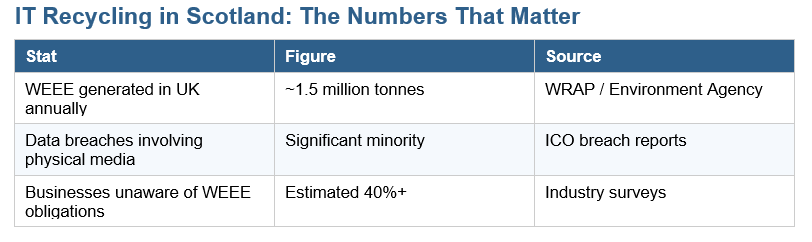
These are not abstract numbers. Every tonne of untracked WEEE is a potential enforcement risk. Every unwiped hard drive handed to an unlicensed collector is a potential data breach.
The CLEAR Framework: How I Think About IT Recycling for Glasgow Businesses
I use a five-step framework when advising on IT disposal. I call it CLEAR — not because it is clever branding, but because it is genuinely the clearest way I have found to explain a process that trips people up.

C — Catalogue Your Assets First
Before anything leaves your building, you need an asset register. Serial numbers, device types, conditions, storage capacities. This matters for three reasons.
• You need to know what you have before you can report on what was disposed of
• Your recycler needs this information to provide accurate certificates
• It protects you if there is ever a dispute about what happened to a specific device
I have seen businesses skip this step and then be unable to prove that a specific laptop containing HR data was wiped. Do not skip the catalogue.
L — Licence Check Your Provider
This is non-negotiable. Any IT recycling provider you use in Glasgow must hold:
• A valid Waste Carrier Licence (Environment Agency or SEPA in Scotland)
• AATF (Authorised Treatment Facility) registration for WEEE processing
• Evidence of secure data destruction capability with verifiable certificates
The difference between IT recycling and IT disposal is worth understanding before you make a decision. My comparison of IT recycling vs IT disposal in Scotland breaks this down in practical terms.
E — Erase Before Collection (or Confirm Certified Destruction)
There are two routes here. You either erase data in-house using certified software before collection, or you work with a provider who offers certified on-site or off-site erasure with documented evidence.
For SSDs specifically, overwriting is not always sufficient. Physical destruction — shredding — may be required for highly sensitive data. Your provider should be able to tell you exactly which erasure standard they use and provide a certificate for each device.
A — Authorised Collection and Chain of Custody
Once equipment leaves your building, you need a paper trail. The collection vehicle should be tracked and insured. Engineers should be identifiable. Consignment notes should be signed.
If your provider cannot explain their chain of custody process in plain language, that is a warning sign. The chain of custody is what allows you to demonstrate compliance if you are ever audited.
R — Reporting and Certification
At the end of the process, you should receive:
• A certificate of data destruction for each device (or batch)
• A WEEE compliance document / duty of care transfer note
• An asset disposal report listing serial numbers and outcomes
These documents are your evidence of compliance. File them. If you are in a regulated sector — healthcare, finance, legal — keep them for the minimum retention period required by your sector's data governance rules.
How IT Recycling Actually Works in Glasgow: Step by Step
If you want a more technical breakdown of the full recycling process, my piece on how IT recycling works step by step covers each stage in depth. Here is the condensed version specific to Glasgow businesses.
1. Request a collection or quote from an AATF-registered provider covering Glasgow
2. Provide your asset list — device types, quantities, condition
3. Schedule collection: tracked vehicles and trained engineers attend your site
4. Devices are logged, tagged, and transported securely to a licensed facility
5. Data erasure or physical destruction is carried out and documented
6. WEEE processing occurs at the facility — refurbishment, parts recovery, or certified recycling
7. You receive your certificates, duty of care documentation, and asset disposal report
GDPR, WEEE, and IT Recycling in Glasgow: What You Are Actually Responsible For
Compliance around IT recycling in Scotland sits at the intersection of two separate legal frameworks. My detailed guide on IT recycling GDPR compliance in Scotland covers this in full, but here is what you need to understand at a minimum.
WEEE Compliance
The WEEE Directive places a duty on businesses to ensure that electronic waste is treated by an authorised facility. If you hand equipment to an unlicensed collector, you — as the original holder — bear the legal risk.
In Scotland, SEPA (the Scottish Environment Protection Agency) enforces WEEE regulations. Breaches can result in significant fines. The duty of care transfer note is your primary evidence that you discharged your responsibility correctly.
GDPR and Data Destruction
Under UK GDPR, personal data must not be retained beyond its necessary purpose and must be securely destroyed when no longer needed. This includes data held on IT equipment.
Key point: the obligation to destroy data does not disappear when you hand equipment to a recycler. You need documented evidence that destruction actually occurred. A certificate of data destruction — listing the device serial number, the destruction method, and the engineer responsible — is that evidence.
Sector-Specific Considerations for Glasgow Businesses
Not all IT recycling needs are the same. Healthcare organisations have specific data handling obligations that go beyond standard GDPR. My guide on IT recycling for healthcare covers what NHS trusts and private healthcare providers in Scotland need to be aware of.
Healthcare
Devices may hold clinical records and patient-identifiable data. Physical destruction of storage media is typically the minimum acceptable standard. Certificates must reference specific destruction methods and standards.
Legal and Financial Services
Client confidentiality obligations exist alongside GDPR requirements. Firms should consider whether their professional indemnity insurance requirements extend to data disposal documentation.
Education
Schools and universities often deal with high volumes of devices with mixed data types. Bulk disposal programmes should still produce individual certificates where possible. See my small business IT recycling guide for practical guidance on managing smaller-scale disposals efficiently.
Public Sector
Scottish public sector bodies face additional scrutiny under public accountability frameworks. Documentation must be thorough and retained in line with sector-specific records management guidance.
IT Recycling vs E-Waste Disposal: Understanding the Difference
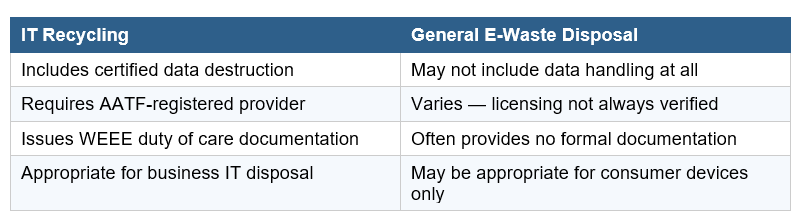
People often use these terms interchangeably, but they are not the same thing. My article on IT recycling vs e-waste disposal in Scotland covers the distinction in detail. The short version:
Five Questions to Ask Any IT Recycling Provider in Glasgow
I always recommend running any potential provider through these questions before signing anything.
1. Are you registered as an Authorised Treatment Facility (AATF) under WEEE regulations? Can I see your registration number?
2. Do you hold a valid Waste Carrier Licence from SEPA? Can you provide the licence number?
3. What erasure standard do you use? How is it verified, and does the certificate include the device serial number and engineer details?
4. What is your chain of custody process from the moment collection vehicles leave my site?
5. What documentation will I receive at the end of the process, and in what format?
A confident, detailed answer to all five tells you a lot. Vague or evasive answers tell you more.
Summary: Key Takeaways
• Glasgow businesses are legally required to use a licensed provider for IT equipment disposal under WEEE regulations enforced by SEPA
• GDPR requires documented evidence of data destruction — not just deletion — for every device containing personal data
• The CLEAR Framework (Catalogue, Licence Check, Erase, Authorised Collection, Reporting) is a practical way to structure your IT disposal process
• Documentation is everything: certificates of destruction, duty of care notes, and asset disposal reports are your legal protection
• Rushed or undocumented disposal creates liability that remains with your organisation, not the collector
• Different sectors — healthcare, legal, education — have additional obligations on top of standard WEEE and GDPR requirements
Frequently Asked Questions
Is IT recycling in Glasgow free for businesses?
It depends on the type, volume, and condition of the equipment. Some providers offer free collection for large volumes of functional equipment with residual value. For end-of-life equipment or small quantities, a collection fee typically applies. Always request a quote that includes all costs — collection, data erasure, and certification.
What is the difference between WEEE recycling and general computer recycling?
WEEE recycling is a legally defined process that must be carried out by an authorised facility. General computer recycling is a broad term that may or may not meet the legal requirements. For business IT disposal, WEEE-compliant recycling through an AATF-registered provider is the correct route.
Do I need a certificate of destruction for every device?
For devices that have held personal data, yes. GDPR requires evidence that data was destroyed, and a certificate of destruction is that evidence. For devices that have never held personal data (some specialised hardware, for example), a batch certificate may be acceptable. When in doubt, document at the device level.
Can I recycle IT equipment if some devices are broken or incomplete?
Yes. Broken and incomplete devices still contain recoverable materials and, potentially, recoverable data. A competent Glasgow IT recycling provider should be able to handle non-functional equipment. Be clear about the condition of devices when requesting a quote.
How long does the IT recycling process take in Glasgow?
For standard business collections in Glasgow, most AATF-registered providers can arrange collection within 5 to 10 business days. Same-day or next-day options may be available for urgent requirements at additional cost. Documentation — certificates and reports — is typically issued within 5 to 7 days of processing completion.
If your Glasgow business needs to arrange IT recycling with full WEEE compliance and certified data destruction, contact MGH Scotland. We provide AATF-registered collection services across Glasgow and Scotland, with full documentation, chain of custody tracking, and same-day certificate delivery. Request a quote or book a collection today.