IT Recycling vs IT Disposal: Which Is Better for Your Business in Scotland?
“IT recycling involves the structured recovery, refurbishment, and responsible processing of end-of-life IT equipment under WEEE regulations, with certified data destruction and documentation. IT disposal is the broader act of removing equipment — which may or may not include these safeguards. For businesses in Scotland, IT recycling is the legally compliant and safer option.”
I hear this question a lot. A business books what they call a "disposal" and assumes that covers everything — the data, the compliance, the paperwork. Three months later, they're scrambling because there's no destruction certificate, no audit trail, and no way to prove the hard drives were wiped.
This is not a niche problem. It happens regularly, and it happens because most people use "IT recycling" and "IT disposal" interchangeably. They are not the same thing.
This guide breaks down the real difference between the two, explains what each option actually includes, and helps you understand which one your business should be choosing — especially if you operate in Scotland and need to stay on the right side of WEEE regulations and GDPR.
Let's get into it.
Why Most Businesses Get This Wrong From the Start
The confusion is understandable. Both terms sound like they describe the same outcome: old IT equipment leaves your building and goes somewhere else.
But that "somewhere else" is where everything changes.
IT disposal is a broad term. It describes the act of removing equipment. It says nothing about what happens after. Equipment could end up in a skip, shipped abroad without proper documentation, or passed to a third party with no WEEE authorisation. Technically, it was "disposed of." Practically, your business is still exposed to liability.
IT recycling, when done properly, is a structured, documented process. Equipment is collected, assessed, data is destroyed to a certified standard, and what cannot be reused is broken down and processed under strict environmental regulations. You receive paperwork. You have an audit trail. You can prove compliance.
That distinction matters enormously — particularly for businesses handling customer data, working in regulated sectors like healthcare or finance, or operating under public sector procurement requirements.
The surface intent when someone searches "IT recycling vs IT disposal" is comparison. But the deeper intent — the real reason someone is asking — is usually risk. They want to know if they're doing something wrong, or if they're about to. That's the question I'm going to answer properly here.
What Is IT Disposal? (And Why It's Not Enough on Its Own)
IT disposal simply means getting rid of IT equipment. That's it. The term itself carries no compliance, no data security requirement, and no environmental obligation — unless those are explicitly built into the service you're using.
In practice, IT disposal can range from a fully managed, certified collection to someone turning up with a van and no documentation whatsoever.
The risk is that without the right questions, you cannot tell which service you're getting.
Some disposal services do include proper data destruction. Some include WEEE documentation. But the word "disposal" alone does not guarantee either of those things, and if your equipment contains sensitive data — personal data, employee records, financial information, client data — the responsibility for that data remains with your organisation even after the equipment leaves your premises.
That is a legal reality under UK GDPR, and it catches businesses off guard more often than it should.
The other problem with basic IT disposal is environmental. Equipment that is simply dumped or sent abroad without WEEE documentation creates legal exposure for the original business. You cannot offload that liability by using a courier or a clearance company that isn't properly authorised.
So disposal, as a standalone concept, is not enough. The question is always: what does it include?
What Is IT Recycling? (And Why It Goes Further)
IT recycling is a managed, structured end-of-life process. It goes significantly further than simple removal.
When IT recycling is handled by an authorised facility — an AATF (Authorised Treatment Facility) registered under UK WEEE regulations — the process includes asset collection, data destruction, equipment assessment, refurbishment where possible, and responsible breakdown of materials that cannot be reused.
You receive certified documentation. This typically includes a destruction certificate confirming that data has been wiped or destroyed to a verified standard, an asset report listing every piece of equipment collected, and duty of care documentation proving the chain of custody from your premises to the recycling facility.
This matters for three specific reasons:
GDPR compliance. If any device collected holds personal data, your business needs documented proof that it was destroyed. A destruction certificate is that proof. Without it, you cannot demonstrate compliance in the event of a data subject complaint or regulatory investigation.
WEEE compliance. Under UK WEEE regulations, businesses are legally required to ensure that electrical and electronic equipment is disposed of through authorised channels. IT recycling through a licensed facility satisfies this requirement. Basic disposal does not necessarily do so.
Environmental responsibility. Certified IT recycling prioritises reuse and responsible material recovery. Equipment that still has value is refurbished. Circuit boards are processed for precious metal recovery. Hazardous components are handled appropriately. Nothing goes to landfill unnecessarily.
If you want to understand the full step-by-step process of how professional IT recycling works — from collection through to certification — I recommend reading this detailed breakdown: How IT Recycling Works Step by Step. It covers the exact stages and what your business can expect at each point.
IT Recycling vs IT Disposal: A Direct Comparison
Here is a side-by-side breakdown of both options so you can see the difference at a glance.
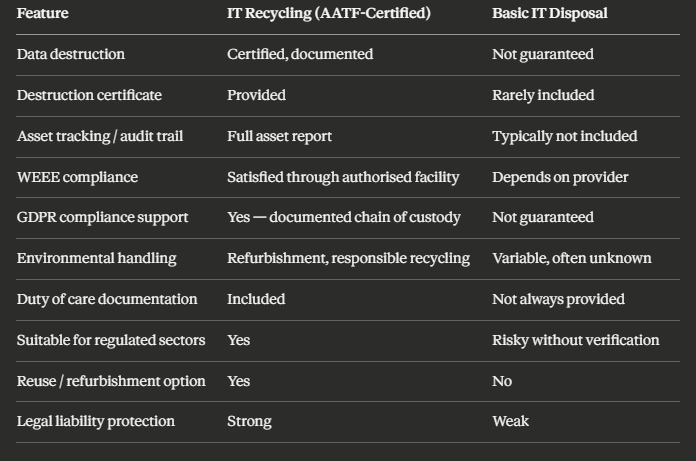
The table above is stark. But it reflects reality. When I look at the risks businesses actually face, the gap between these two options is not a minor technical distinction — it's the difference between documented compliance and genuine legal exposure.
The Legal Side: What Scottish Law Actually Requires
Scotland follows UK-wide regulations on WEEE (Waste Electrical and Electronic Equipment) and data protection under UK GDPR, both of which have direct implications for how businesses handle end-of-life IT equipment.
Under WEEE regulations, businesses — producers, distributors, and end users — have a legal duty to ensure that electrical and electronic equipment is treated through authorised channels. Sending IT equipment to a skip, a general waste collection, or an unauthorised third party breaches this duty. Penalties include fines and enforcement action from the relevant environmental agency, which in Scotland is SEPA (Scottish Environment Protection Agency).
Under UK GDPR, your organisation remains the data controller for any personal data held on devices until that data is provably destroyed. "We sent it to someone else" is not a sufficient answer if that destruction cannot be demonstrated. The ICO (Information Commissioner's Office) can and does investigate breaches arising from inadequate device disposal.
For businesses in Scotland — particularly those serving public sector clients, schools, NHS organisations, or financial institutions — demonstrating proper IT recycling through a certified facility is not optional. It is a procurement and compliance requirement.
For a detailed look at the specific GDPR obligations around IT equipment disposal in Scotland and how recycling satisfies them, this is worth reading: IT Recycling and GDPR Compliance Scotland. It goes into the specific data protection requirements and what documentation you need to retain.
The Data Risk Nobody Talks About
Here is something I find genuinely underappreciated in conversations about IT disposal: the moment a device leaves your premises without certified data destruction, the risk does not disappear. It compounds.
Old laptops, desktops, and servers frequently contain more than people think. Beyond the obvious — HR files, financial records, client data — there are often cached credentials, browser data, saved passwords, access tokens, and historical file copies that standard user deletion does not remove.
A factory reset does not destroy data. Reformatting a drive does not make data unrecoverable. Only certified erasure to recognised standards — or physical destruction such as shredding — achieves that outcome.
The risk scenario I come back to most often is this: a business upgrades 30 laptops, arranges a clearance collection, and receives no paperwork. Two years later, one of those laptops surfaces on a secondary market with recoverable data. The business now has a data breach — and no documentation to show they took reasonable steps to prevent it.
That scenario is preventable. Certified IT recycling with documented data destruction prevents it.
This is especially relevant for businesses dealing with employee data during redundancy cycles, organisations that have undergone mergers or acquisitions, and any business that processes sensitive client data as part of its operations.
The RDR Framework: Reclaim, Destroy, Report
I use a simple framework when advising organisations on end-of-life IT decisions. I call it RDR — Reclaim, Destroy, Report.
Reclaim. Before any device leaves your possession, assess whether it has residual value. Equipment less than five years old with functional components can often be refurbished and redeployed, either internally or through a recycling partner's resale channel. Some organisations receive a financial return on qualifying assets. Skipping this step is leaving money on the table.
Destroy. Every device that holds or may hold data must go through certified destruction. This means erasure to a verified standard or physical destruction. Both must be documented. There is no middle ground here if your business handles personal data.
Report. You need paperwork. Destruction certificates, asset reports, duty of care documentation. Not because auditors are exciting, but because your compliance posture depends on the ability to demonstrate, not just claim, that you handled equipment properly.
If the service you are considering does not clearly include all three stages — reclaim assessment, certified destruction, and documented reporting — it is not a complete IT recycling service. It may be disposal. It may be adequate for some situations. But it is not the same thing, and you should understand the difference before signing anything.
A Real-World Scenario: What Happens When You Choose Wrong
Let me walk through a realistic scenario. A mid-sized Scottish business with around 80 staff upgrades its IT infrastructure. They have roughly 60 laptops, 10 servers, and assorted networking equipment going out of service.
They engage a general clearance company rather than a certified IT recycling provider. The equipment is collected. The business receives no paperwork. The clearance company is not WEEE-registered and has no AATF authorisation.
Six months later, two things happen. First, one of the laptops — containing employee HR data — is found listed for sale online. Data is recoverable. The ICO opens an investigation. Second, the company receives a notice from SEPA regarding improper disposal of electrical equipment under WEEE regulations.
The business now faces potential fines under both GDPR and WEEE, reputational damage, and the cost of responding to regulatory investigations — all of which were avoidable for the price of a properly certified IT recycling service.
This is not a hypothetical constructed to frighten anyone. It reflects the types of incidents that arise from exactly this kind of decision.
The difference in cost between basic disposal and certified IT recycling is often marginal. The difference in risk exposure is not.
Who Should Choose IT Recycling vs IT Disposal?
To be direct about this: for most businesses handling any form of sensitive data, IT recycling through a certified provider is the right choice. Full stop.
But let me be specific about who should absolutely not use basic IT disposal without verified compliance built in.
Businesses handling personal data. If you process employee data, customer data, or any data covered by UK GDPR, you need certified destruction and documentation. No exceptions.
Regulated sectors. Healthcare, finance, legal, education, and public sector organisations face additional compliance requirements. IT recycling through an authorised facility satisfies those requirements in a way that basic disposal does not.
Businesses with enterprise clients. Many enterprise procurement processes now require supplier compliance documentation. An IT recycling certificate may be required as part of vendor assurance or due diligence.
Organisations replacing large volumes of equipment. The more equipment you are disposing of, the greater the risk surface. At scale, the documentation and chain of custody provided by certified IT recycling becomes even more important.
Any Scottish business subject to SEPA oversight. WEEE compliance is not optional. If you are in Scotland and disposing of electrical or electronic equipment, it must go through authorised channels.
For Scottish businesses specifically, I'd recommend reading this guide on IT recycling for businesses in Scotland, which covers the full obligations and what a compliant service looks like in practice: IT Recycling Scotland for Businesses.
How to Tell If a Provider Is Doing It Properly
This is where businesses trip up most often. They find a provider who uses the right language — "secure disposal," "data destruction," "WEEE compliant" — without verifying what those terms actually mean in practice.
Here is what to check before you engage any IT recycling or disposal provider in Scotland.
AATF registration. An Authorised Treatment Facility registration is the baseline requirement for legal WEEE recycling. Ask to see the licence. Check the registration number. A legitimate provider will share this without hesitation.
Data destruction standard. Ask specifically what erasure standard is used and what happens to drives that cannot be wiped. Are failed drives physically shredded? Is that destruction certified separately? These are not unreasonable questions.
Documentation package. What exactly will you receive? Ask for a sample destruction certificate and asset report before you commit. If a provider cannot show you what their paperwork looks like, that is a concern.
Chain of custody. How is equipment tracked from your premises to the facility? Is transport insured and secure? Are vehicles tracked? You should be able to trace every asset through the process.
Insurance and liability. Is the provider insured for data breaches occurring during transit? What happens if something goes wrong?
You also want to understand their e-waste disposal process specifically — how they handle the broader category of electronic waste and whether they distinguish it from standard IT asset recycling. This comparison is covered in detail here: IT Recycling vs E-Waste Disposal Scotland.
Key Takeaways: What You Actually Need to Remember
IT recycling and IT disposal are not the same. Recycling is a structured, documented, compliant process. Disposal is the act of removal — which may or may not include adequate safeguards.
Your GDPR obligations do not end when equipment leaves your building. They end when data destruction is certified and documented.
WEEE regulations in Scotland require disposal through authorised channels. An AATF-registered recycler satisfies this. A general clearance company typically does not.
The RDR framework — Reclaim, Destroy, Report — is a practical way to assess whether any end-of-life IT service is complete.
Always verify AATF registration, data destruction standards, and documentation before engaging a provider.
For most businesses, especially those in regulated sectors or handling personal data, certified IT recycling is not just the better option — it is the required option.
The cost difference between basic disposal and certified recycling is usually small. The risk difference is significant.
What Should You Do Next?
If your business is currently planning an IT refresh or equipment upgrade, the time to sort out your recycling and disposal approach is before the equipment goes out of service — not after.
Start by reviewing the IT recycling process guide to understand what a compliant service looks like from end to end: How IT Recycling Works Step by Step.
If your primary concern is GDPR and data security, the compliance-specific guide will be more useful: IT Recycling and GDPR Compliance Scotland.
And if you're ready to understand what a proper IT recycling service looks like for Scottish businesses, including what questions to ask providers and what documentation to expect, this is the place to start: IT Recycling Scotland for Businesses.
Ready to arrange certified IT recycling for your business? Request a quote, ask for a compliance pack, or book a collection to get started with a documented, WEEE-compliant, GDPR-safe process.
Frequently Asked Questions
1. What is the main difference between IT recycling and IT disposal?
IT recycling is a structured process that includes certified data destruction, WEEE-compliant equipment processing, and documented reporting. IT disposal is the broader act of removing equipment, which may or may not include these safeguards. For GDPR and WEEE compliance, IT recycling through an authorised facility is the appropriate choice for most businesses.
2. Is basic IT disposal legal in Scotland?
Disposing of electrical equipment through non-authorised channels breaches UK WEEE regulations, which apply in Scotland. Businesses must use WEEE-registered, authorised facilities for disposal of electronic equipment. Basic clearance services that are not AATF-registered do not satisfy this requirement.
3. Does IT recycling include data destruction?
A properly certified IT recycling service includes data destruction as a core component. This typically involves drive wiping to a verified standard or physical destruction, with a destruction certificate issued as proof. You should always confirm this is included and ask to see sample documentation before engaging a provider.
4. Who is responsible for data on old IT equipment after disposal?
Under UK GDPR, the original data controller — your organisation — remains responsible for personal data until destruction is certified and documented. Passing equipment to a third party does not transfer this legal responsibility unless you have verified destruction certificates as proof.
5. How do I know if an IT recycling provider in Scotland is legitimate?
Check for AATF registration (Authorised Treatment Facility under UK WEEE regulations). Ask to see the licence number. Request sample documentation including destruction certificates and asset reports. Verify that their process includes chain of custody tracking and that transport is insured and secure. A legitimate provider will be able to answer all of these questions clearly and provide evidence.