What Happens After Data Is Destroyed? The Full Journey of Your IT Equipment After Collection
“After data is destroyed, IT equipment goes through a structured recovery process. Devices in working condition are assessed for refurbishment and redeployment. Devices that cannot be reused are broken down for component and material recovery — including metals, plastics, and in some cases precious metals from circuit boards. All processing must comply with WEEE regulations, and a recycling certificate is issued to the client confirming compliant disposal.”
Most of the conversation around IT disposal focuses on data destruction. What method was used. What standard was applied. What documentation you receive. All of that is important — I have covered it in detail elsewhere — but it answers only the first question in a longer story.
The question I find almost nobody asks is: what happens after?
After the certificate arrives. After the engineer leaves your building. After the old laptops, servers, and hard drives disappear into the back of a tracked vehicle. Where do they go? What is done with them? Who ends up with what? And does any of it affect you?
The short answer is that there is a detailed, regulated process that happens between your old equipment leaving your premises and its materials eventually re-entering the supply chain. Understanding that process matters for three reasons.
First, it affects your environmental reporting. Businesses with ESG commitments, sustainability policies, or reporting obligations need to know what happened to their equipment — not just that it was "recycled". The difference between equipment that was refurbished and redeployed versus equipment that was shredded and sent for material recovery is a meaningful difference in environmental impact.
Second, it affects the quality of your compliance documentation. A recycling certificate that tells you what categories of WEEE were processed is different from one that tells you exactly what happened to each device. Understanding what to ask for means you end up with documentation that actually reflects the outcome.
Third, it is simply worth knowing. You signed a duty of care note transferring responsibility for your equipment. That transfer is real. The downstream journey of your equipment is a consequence of the choices you made when selecting a provider.
This guide walks through the complete post-destruction journey — from the moment your equipment arrives at a certified facility, through assessment, refurbishment, material recovery, and final reporting.
Who This Is For
This is for you if:
You are responsible for IT asset disposal in a UK business and want to understand the full process
You have ESG, sustainability, or environmental reporting responsibilities
You want to know what to expect in your recycling certificate and why the details matter
You are curious about where the materials from old IT equipment actually end up
This is not for you if:
You are looking for guidance on the data destruction process itself (that is covered separately)
You need guidance on how to select a certified provider
Step One: Arrival and Intake at the Recycling Facility
When your equipment arrives at a certified AATF (Authorised Treatment Facility), the first thing that happens is intake and inventory.
Every device is logged. Serial numbers are recorded. Asset types are categorised. The intake process creates the foundational audit trail that backs every piece of documentation you will later receive.
This step is more important than it sounds. A facility that does not log individual devices by serial number at intake cannot produce a per-device destruction certificate later. If your provider skips this step — or cannot show you how they do it — that is a signal that the documentation they will produce is likely to be insufficient for GDPR compliance purposes.
A well-run facility will produce an intake manifest that matches the duty of care note signed at collection. If the counts or categories do not match, that is flagged immediately. This is the chain-of-custody check that confirms your equipment arrived intact and has been correctly accounted for.
📌 Related read: How IT Recycling Works Step by Step — the full step-by-step process from collection through to certification, including what happens at each stage.
Step Two: Data Destruction (If Not Already Completed)
For most collections, data destruction happens at the facility rather than on-site. Drives are removed from devices, logged, and processed through certified erasure software or physical shredding — depending on the condition of the drive and the method specified.
Every drive is individually identified. The erasure software produces a per-drive verification report confirming that every sector was successfully overwritten. Failed drives — ones that cannot be read by the erasure software — go directly to physical destruction. There is no middle ground here in a well-run facility: if a drive cannot be certified as erased, it is shredded.
This is where the quality gap between certified providers and cheaper alternatives becomes visible. A lower-cost operator may bulk-process drives without individual verification, producing a batch certificate that covers a quantity of drives rather than a serial-number-specific report. That certificate looks the same on paper. The compliance protection it provides is significantly weaker.
The data destruction certificate you receive — which should arrive within a few days of processing — is the output of this step. Check it carefully. It should list device serial numbers, the method used, the standard applied, the date of processing, and a verification status for each item.
📌 Related read: IT Recycling and GDPR Compliance in Scotland — what the certificate needs to contain to satisfy GDPR requirements, and what to do if your provider's documentation falls short.
Step Three: Device Assessment and Triage
Once data has been destroyed, every device goes through a condition assessment. This is the triage stage — the point where equipment is sorted into categories based on what can be done with it.
The assessment considers: physical condition, age and specification, functional status, and market demand for that type of equipment.
The outcome of assessment typically produces three categories:
Category A — Refurbishable: The device is in good physical condition, functional or repairable, and of a specification that has current market value. These devices move into the refurbishment workflow.
Category B — Partial recovery: The device itself cannot be refurbished as a whole unit, but specific components have recovery value. A laptop with a cracked screen and failed motherboard might still yield a working battery, RAM, or storage controller that is worth recovering separately.
Category C — Material recovery only: The device is beyond component-level recovery. It goes to material recovery — broken down for the raw materials it contains.
The proportion of equipment that falls into each category varies considerably depending on the age and condition of what you have handed over. Newer equipment from a regular upgrade cycle will yield a higher proportion of Category A. Very old equipment, equipment from a facility clearance, or equipment that was in heavy use will skew toward Category C.
Understanding this helps set realistic expectations. If your equipment is eight or nine years old, do not expect a return from refurbishment. If it is three or four years old and in reasonable condition, there may be a commercial conversation worth having with your provider before collection.
Step Four: The Refurbishment Pathway
Equipment that passes assessment enters a structured refurbishment process. This is where the environmental benefit of good IT recycling becomes most tangible — a refurbished laptop that goes back into use avoids the manufacturing impact of a new device, which is considerable.
The refurbishment process typically includes:
Cleaning and physical restoration. Devices are cleaned inside and out. Cosmetic damage is assessed and repaired where cost-effective.
Component testing. Every component is tested — battery capacity, screen integrity, keyboard function, port function, memory, and storage. Failed components are replaced or the device is downgraded to Category B.
Software installation. A clean operating system is installed. This is a different step from data erasure — by this point, the drive has already been certified as erased. The reinstallation is about preparing the device for its next use.
Functional verification. The device goes through a final test cycle before being graded, priced, and prepared for resale or redeployment.
Refurbished equipment typically enters one of several downstream markets: resale through certified refurbished channels, donation to educational charities or community organisations, or redeployment within business upgrade programmes. Some IT recyclers have established partnerships with charities that provide IT equipment to schools, community groups, or disadvantaged individuals — which can add a social impact dimension to your disposal process worth capturing in your sustainability reporting.
Step Five: Component Recovery
Equipment in Category B — where the whole device cannot be refurbished but components have recovery value — is disassembled for parts.
This is a more granular process than it sounds. A skilled technician can extract usable components from a device that appears, at face value, to be end-of-life. Common recoverable components include: working RAM modules, solid-state drives in good condition, power adapters, batteries with remaining capacity, display assemblies, and keyboard assemblies.
These components enter secondary markets — either through direct sale as spare parts or through integration into refurbishment workflows for other devices. Component recovery extends the usable life of materials that would otherwise go directly to material recovery, reducing the overall environmental impact of the disposal process.
Step Six: Material Recovery
Equipment that cannot be refurbished or component-recovered reaches the material recovery stage. This is what most people picture when they think of "recycling" — but the reality is considerably more structured than the image of a crusher in a yard.
Material recovery from IT equipment is a specialist process. Devices are disassembled — manually or through automated shredding lines — and the resulting materials are separated by type. The recovery process typically produces streams including:
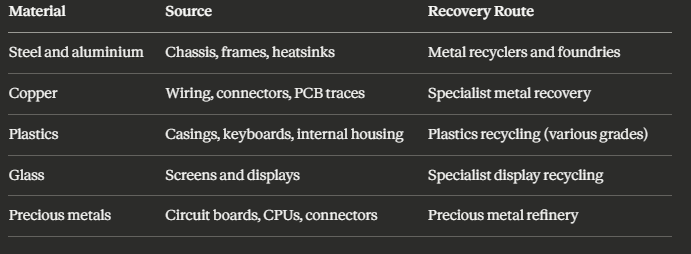
The precious metals element is worth understanding in more detail. Modern electronic components contain gold, silver, palladium, and platinum — used in connectors, plating, and component construction because of their conductivity and resistance to corrosion. The quantities per device are small (measured in milligrams), but at scale they are commercially significant.
Printed circuit boards — the green layered boards inside every electronic device — are particularly rich in recoverable precious metals. PCBs from servers, networking equipment, and telecommunications hardware tend to have higher precious metal content than consumer devices. This is part of why specialist facilities can offer competitive pricing or even returns on large volumes of PCB material.
📌 Related read: IT Recycling vs E-Waste Disposal in Scotland — why the choice of disposal route affects both your compliance position and the environmental outcome of your equipment.
Step Seven: WEEE Documentation and Recycling Certificate
Once processing is complete, the facility produces your recycling certificate. This document closes the loop on your WEEE compliance obligation and should be the final piece of documentation in your disposal file alongside the duty of care note and the data destruction certificate.
A recycling certificate should include: the name and AATF licence number of the processing facility, the categories and weights of WEEE processed, the date of processing, and confirmation of compliant disposal under WEEE regulations.
Here is what most businesses do not know to ask for: a breakdown by WEEE category. WEEE regulations classify electrical and electronic equipment into categories (IT and telecommunications equipment, consumer equipment, and so on). A certificate that identifies the categories — not just a total weight — is a more complete compliance record.
This matters if you are ever asked to demonstrate WEEE compliance in detail, for example as part of a supplier audit, a procurement qualification, or an environmental due diligence process.
The P-A-T-H Framework: Understanding Your Equipment's Post-Destruction Journey
To make the post-destruction journey easier to remember and communicate internally, I use a simple framework I call the P-A-T-H System. Each stage corresponds to a real phase in the recovery process.
P — Processing and Intake
Equipment arrives, is logged, and enters the certified facility's system. Serial numbers are recorded. The intake manifest is created. Chain of custody begins. This is the foundation of every document you will receive.
A — Assessment and Triage
Every device is assessed for condition and sorted into refurbishable, component-recoverable, or material-recovery streams. The proportion in each stream depends on the age and condition of your equipment.
T — Treatment (Refurbishment or Recovery)
Refurbishable devices go through cleaning, testing, restoration, and grading before entering secondary markets. Component-recoverable devices are disassembled for parts. Material-only devices go to shredding and material separation.
H — Handover Documentation
Processing complete. Your recycling certificate is issued. The documentation cycle closes. You now have: a duty of care note (from collection), a data destruction certificate (from processing), and a recycling certificate (from treatment). This is your complete WEEE and GDPR disposal record.
What the Environmental Impact Actually Looks Like
I want to be specific about the environmental dimension because it is often discussed in vague terms that make it difficult to connect to real business sustainability reporting.
Avoiding landfill is the baseline — WEEE regulations exist precisely to prevent electronic waste from entering general waste streams. But the environmental benefit of IT recycling goes considerably further depending on the outcome of assessment.
A laptop that is refurbished and reused for another three years avoids the manufacturing impact of a new device. Manufacturing a new laptop requires significant quantities of energy, water, and raw materials — including metals that are mined at environmental cost. Extending the useful life of existing equipment reduces demand for new manufacturing.
A laptop that cannot be refurbished but yields recoverable materials reduces the need to mine virgin raw materials. Recycled copper, aluminium, and steel require significantly less energy to process than newly extracted metals. Recovered precious metals reduce demand for primary mining operations.
A laptop that is processed through a certified facility — even if it ends up entirely in material recovery — avoids the hazardous waste exposure that comes from informal or unregulated disposal. Electronic waste contains lead, cadmium, mercury, and brominated flame retardants that cause serious environmental harm if they enter landfill or are incinerated without proper controls.
The specific environmental outcome for your equipment depends on what was handed over and the facility's processing capabilities. A reputable provider should be able to give you a breakdown — in their recycling certificate or an accompanying report — of how many devices were refurbished versus recovered, and in some cases an estimated CO₂ equivalent or landfill diversion figure for sustainability reporting purposes.
📌 Related read: Small Business IT Recycling Guide — the full practical guide covering everything from collection booking through to what documentation to keep on file.
What to Ask Your Provider About the Post-Destruction Process
Most businesses do not ask these questions. Asking them separates compliant, transparent providers from those who are simply moving equipment on without accountability.
1. What percentage of the equipment we hand over is typically refurbished versus recovered for materials? A transparent provider will have real figures. The answer varies by equipment type, but they should be able to give you a realistic expectation based on what you are sending.
2. Where does the material recovery happen? UK-based processing is preferable both for compliance certainty and for environmental impact. Vague answers about "approved partners" without named facilities or licence numbers are a concern.
3. Do you provide a breakdown of WEEE categories in the recycling certificate? As noted above — category-level detail is the more complete compliance record.
4. Is there a refurbishment pathway, and can equipment be donated to charity? If this matters to your sustainability reporting or your organisation's values, ask specifically. Not all providers have established donation partnerships.
5. Can you provide an environmental impact summary for our sustainability reporting? Some providers produce these as standard. Others can produce them on request. This is particularly relevant for businesses with formal ESG commitments or annual sustainability reporting obligations.
📌 Related read: IT Recycling for Scotland Businesses — how Scottish businesses are working with certified providers to meet both compliance and sustainability objectives.
Key Takeaways
After data is destroyed, equipment goes through intake and inventory, device assessment, refurbishment or component recovery, and material recovery — in that sequence
The intake and logging stage is critical: it is what makes per-device certificates possible
Assessment triage sorts equipment into three categories: refurbishable, component-recoverable, and material-recovery only
Refurbished equipment re-enters use through secondary markets, charity partnerships, or business redeployment programmes — this is the highest environmental value outcome
Component recovery extends the usable life of materials from devices that cannot be refurbished as whole units
Material recovery produces separate streams: metals, plastics, glass, and precious metals from circuit boards
The P-A-T-H Framework covers the four stages: Processing and intake, Assessment and triage, Treatment, and Handover documentation
Your complete disposal record should include three documents: duty of care note, data destruction certificate, and recycling certificate
Ask your provider for WEEE category-level breakdown in the recycling certificate — it is a more complete compliance record than a total weight figure
Environmental impact reporting (CO₂ equivalent, landfill diversion, refurbishment rate) is available from reputable providers and valuable for sustainability obligations
Frequently Asked Questions
1. Does refurbished equipment from my business get sold on? Yes, in most cases. Refurbishable equipment is cleaned, tested, restored, and graded before entering secondary markets. Depending on the provider and the condition of your equipment, this can mean resale, donation to educational or community charities, or redeployment in upgrade programmes. Some providers offer clients the option to direct where refurbished equipment goes — for example, to a specific charity — which can be a meaningful addition to sustainability reporting.
2. Can I get a report showing how much of my equipment was refurbished versus recycled? Yes, from a good provider. Some produce this automatically as part of their recycling certificate. Others produce it on request. If you have ESG or sustainability reporting requirements, ask for this explicitly when booking your collection. The report should ideally include device counts by outcome category, not just weights.
3. What happens to equipment that fails the refurbishment assessment? It enters either component recovery (where individual parts with remaining value are extracted) or material recovery (where the device is shredded and the resulting materials are separated by type for recycling). Nothing should go to general waste or landfill from a certified AATF. If you have any doubt, ask your provider for confirmation that zero landfill is their policy and that it applies to all equipment streams.
4. Is there any financial return from recycling old business equipment? It depends on the volume, type, and condition of equipment. Newer equipment in good condition may attract a return through refurbishment valuation. Large volumes of PCB material from servers and networking equipment may have precious metal value. For most standard business IT equipment collections, the financial exchange is more likely to be a competitive service pricing than a direct cash return — but it is always worth asking your provider.
5. How long does the full process take from collection to receiving my certificates? Typically between five and fifteen working days for most collections, depending on volume and the complexity of the job. Data destruction certificates are usually issued first, within a few days of processing. Recycling certificates may follow shortly after or be issued at the same time. Larger jobs — server room decommissioning, data centre clearances — may take longer, and a projected timeline should be discussed at the point of booking.
If you are preparing for an IT equipment disposal and want to understand exactly what will happen to your equipment — from data destruction through to materials recovery and final certification — speaking to a certified provider before you book gives you the clarity to ask the right questions and receive the right documentation.
The process is more thorough than most businesses expect. And the documentation it produces is considerably more useful than most businesses realise — until they need it.