What Is AI Visibility?
“AI visibility is the measure of how often, how accurately, and how prominently your brand shows up inside answers generated by AI tools like ChatGPT, Gemini, Perplexity, and Google’s AI Overviews. It is not a ranking on a page of links. It is whether you get named at all when someone asks a question your brand should be able to answer.”
AI visibility is the degree to which an AI system mentions, cites, or recommends your brand when someone asks a question your company is relevant to.
That sounds close to a search ranking. It is not the same thing, and the difference matters.
A traditional search engine hands back a list. You scan it, click a few, and decide for yourself which source to trust. Your brand's job was to earn a spot on that list.
An AI system does something different. It reads across many sources, synthesizes one answer, and names a small number of options directly inside that answer. Your brand's job is now to be one of the names it chooses.
If it does not choose you, you do not get a lower position. You get nothing. There is no page two to fall back on inside a single conversational answer.
Why this is not just a rebrand of SEO
A brand can rank first in Google's organic results for a given term and still be completely absent from the AI-generated answer to that same query.
AI engines retrieve information using their own logic, weighing entity clarity, source authority, structured content, and how consistently a claim shows up across the wider web, not simply which page currently holds the top organic spot.
The reverse also happens. A brand with modest search rankings but clean, well-structured, frequently cited content can outperform a page one competitor inside an AI answer.
This is why marketing teams are starting to track AI visibility as a distinct discipline, sitting alongside SEO rather than folded inside it.
A quick history: from keywords, to conversations, to citations
For most of the last two decades, being found online meant one thing. Rank on the first page of Google for the terms your buyers typed.
That model rewarded a fairly mechanical set of skills. Match the keyword, earn the backlink, structure the page, and a predictable amount of traffic followed.
The first crack in that model came when people started typing full questions into search boxes instead of fragments, and search engines got better at answering some of those questions directly on the results page itself, without a click.
The second, larger shift came with conversational AI tools. Instead of typing a query and reading a list, people started describing their actual problem and expecting a direct, synthesized answer back.
That is the moment AI visibility became its own concept. Once the answer itself became the destination, being included in that answer became the new version of ranking first.
The shift did not replace search behavior overnight. It layered on top of it. People still use traditional search constantly. But a growing share of the earliest, most decision-shaping questions now get asked in a conversation instead of a search box, and that conversation either includes your brand or it does not.
AI Visibility vs Traditional SEO Visibility
The mechanics are different enough that the two require separate strategies, even though they share some of the same underlying content.
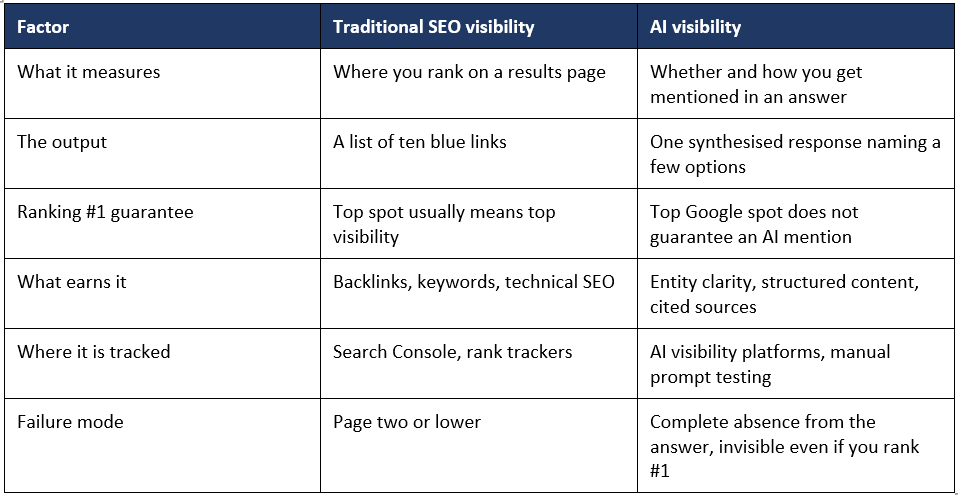
SEO visibility is about earning a spot on a page. AI visibility is about earning a mention inside a single answer. One is positional. The other is closer to a recommendation.
Why AI Visibility Matters in 2027
This is not a future concern. The shift toward AI-mediated answers has already changed how much traffic reaches a typical website.
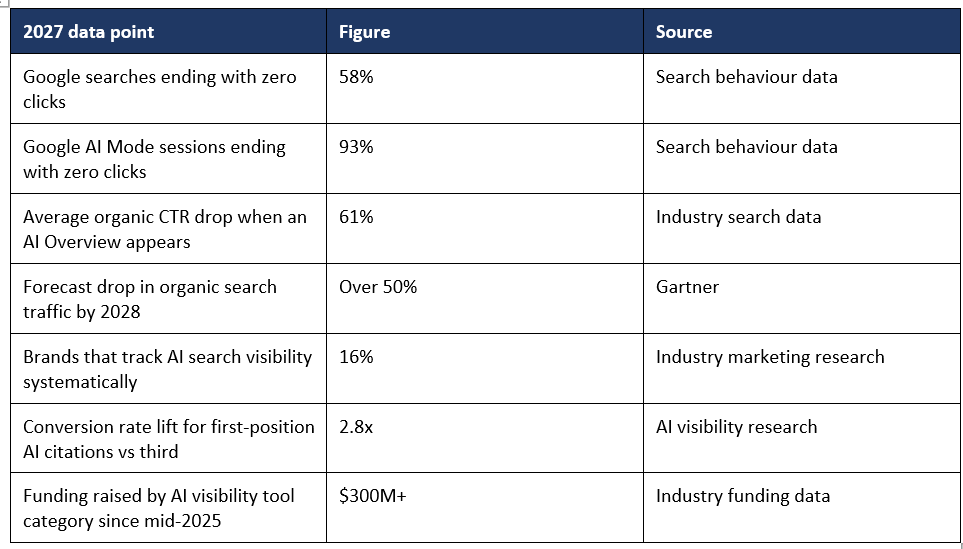
Read the top two rows together. More than half of all Google searches already end without a click. Inside Google's own AI Mode, that number climbs to 93%.
For a brand that depends on organic search traffic to fill a pipeline or a cart, this is not a minor drop in referral numbers. It is a structural change in where the buying decision actually happens.
It also means the traffic that does still arrive from a click has already been filtered by an AI system's summary. Visitors who reach your site through a traditional search click are, on average, earlier in their research. Visitors who reach you after an AI conversation are further along, and often just confirming a decision that was substantially made before they ever typed your name.
Why zero clicks does not mean zero value
It is tempting to read a zero-click search as a lost opportunity entirely. That is not quite right.
A zero-click session still delivers a decision. The person asking the question still walks away with an opinion about which options are worth considering. The only thing that changed is where that opinion formed.
If your brand was the one named in that answer, you just influenced a purchase decision without needing a click at all. If a competitor was named instead, you lost that same decision just as completely, and your analytics will never show it, because there was no visit to miss in the first place.
This is the core reason AI visibility needs its own tracking. Standard web analytics cannot see a channel that, by design, often ends before a click happens.
None of this is speculative. It is already showing up in conversion data, where AI-referred visitors convert at meaningfully higher rates than traditional search visitors, precisely because so much of the evaluation work happened before the click.
The gap most teams have not noticed yet
Only a small share of brands currently track their AI visibility in any systematic way. Most marketing dashboards still show clicks, impressions, and keyword rankings, and nothing about whether ChatGPT or Perplexity mentions the brand at all.
That gap is not permanent. It closes fast once competitors start measuring it, and the brands that start early tend to build a lead that compounds. Early citations generate more traffic, more reviews, and more brand mentions, all of which strengthen future AI visibility further.
A real-world example of the gap
Picture two competing project management tools. Both rank on page one of Google for "best project management software."
Brand A has invested years into backlinks and keyword-optimized landing pages. Its homepage leads with a hero image and a tagline, and the actual product details sit several scrolls down.
Brand B has fewer backlinks and a slightly lower search ranking. But its comparison pages open with a direct answer to the exact question a buyer would ask, back their claims with specific numbers, and keep the same product description consistent across their site, their G2 listing, and their press coverage.
When a buyer asks an AI assistant to recommend a project management tool for a ten-person team, Brand B is more likely to be the one it names, even sitting below Brand A on the search results page. The AI system is not reading rank position. It is reading which source answers the question most directly and consistently.
This is the gap AI visibility exists to measure. Search rank and AI citation are correlated, but they are not the same signal, and the businesses that only track one are only seeing half the picture.
Neither brand did anything unusual or expensive to get this outcome. Brand B simply treated the question a buyer would actually ask as the organizing principle for its page, instead of treating it as an afterthought below a marketing headline.
How AI Engines Actually Decide What to Cite
Understanding the mechanism helps explain why visibility can differ so much from search rankings.
Most AI systems combine two sources of knowledge. What they learned during training, and what they retrieve live from the web when a question requires current information.
For the live retrieval piece, the system is not just checking who ranks first. It is scanning multiple sources, looking for content that answers the specific question clearly, and weighing how consistently a claim about your brand appears across the web.
• Entity clarity: Does the system understand exactly what your brand is, what it does, and how it differs from similarly named companies?
• Structured content: Are your claims presented in a format the system can parse easily, such as clear headers, defined terms, and direct statements?
• Source consistency: Do independent sources across the web describe your brand the same way, or does the story change from site to site?
• Freshness: Has the page been updated recently? Pages updated within the past year are roughly twice as likely to earn a citation.
• Directness: Does the content answer the actual question asked, in plain language, near the top of the page?
None of this rewards keyword stuffing or backlink volume on their own. It rewards being an unambiguous, well-supported, easy-to-extract answer to a real question.
A plain-language look at retrieval and training data
It helps to separate the two ways an AI system can know about your brand.
The first is training data. During training, a model reads a huge amount of text from the public web, and it forms a general sense of what your brand is known for. This knowledge is broad but fixed at a point in time, and it does not update automatically.
The second is retrieval. For many questions, especially ones involving current information, the system searches the live web at the moment of the question, pulls back a set of relevant pages, and builds its answer from what it finds.
Retrieval is where most AI visibility work actually has leverage. You cannot rewrite a model's training data. You can absolutely control whether the page it retrieves during a live query answers the question clearly, cites real numbers, and matches what every other source says about you.
Some systems also lean on structured knowledge graphs, which connect an entity, your company, to attributes, like industry, founding year, and product category. Keeping this kind of structured data accurate wherever it appears, from your own schema markup to third-party business listings, makes it easier for a system to place you correctly instead of confusing you with a similarly named competitor.
The Core Metrics of AI Visibility
You cannot improve what you do not measure, and AI visibility has its own emerging measurement framework, separate from classic SEO reporting.
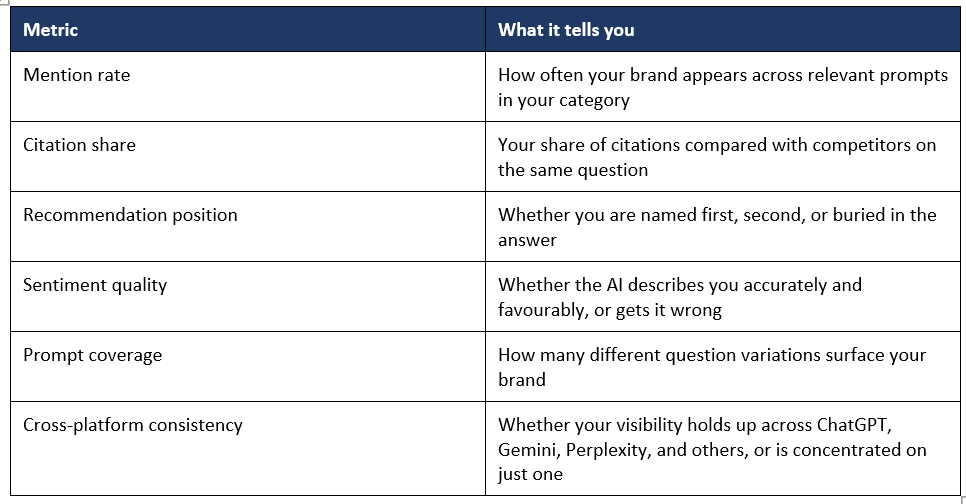
A good starting benchmark: an AI readiness score of 60 or higher is considered strong for most content categories, since recent broad-market studies put the median site closer to the mid-40s.
First-position citations also convert meaningfully better than lower mentions, roughly 2.8 times the rate of a third-position mention in the same answer. Where you appear inside the answer matters almost as much as whether you appear at all.
The Five Stages of AI Visibility Maturity
Most brands fall somewhere on a fairly predictable path, from not knowing where they stand to actively managing the channel.
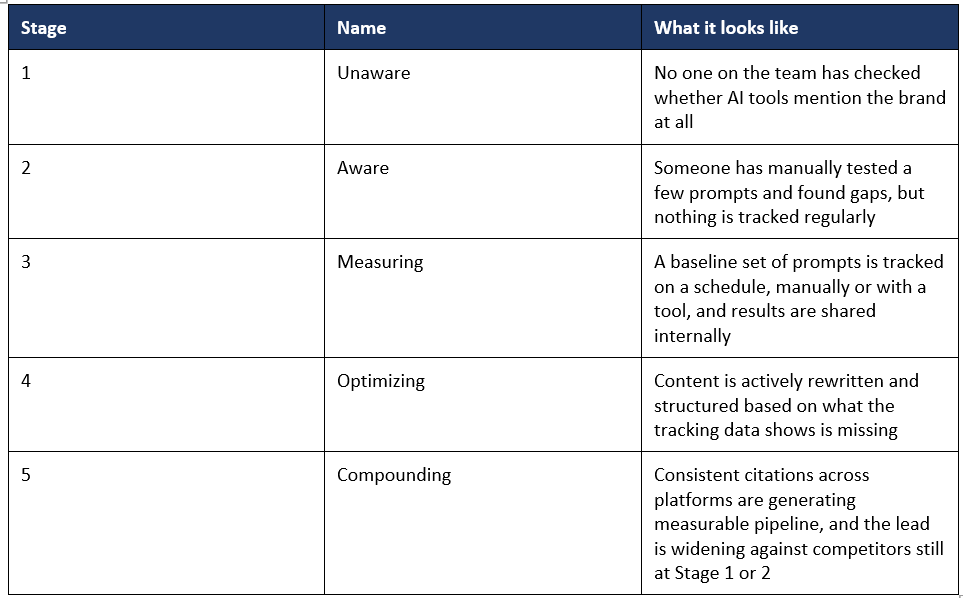
Most brands that commit real attention to this in 2027 can reach Stage 3 within six to twelve months. Reaching Stage 4 or 5 while competitors are still stuck at Stage 1 is the actual prize, and that window narrows every quarter more brands start paying attention.
AI Visibility by Industry: Where It Matters Most
The urgency varies by category, based on how much of the buying journey already involves research before a purchase decision.
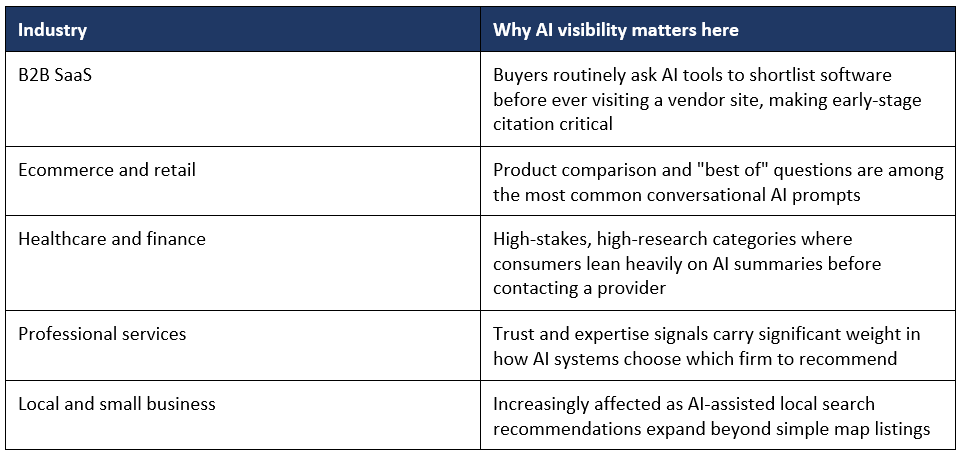
If your category involves genuine comparison shopping or research before a decision, AI visibility is already shaping which options a buyer even considers.
Which AI Platforms Actually Matter
Not every platform carries the same weight for every business. Coverage priorities should follow where your buyers already are.
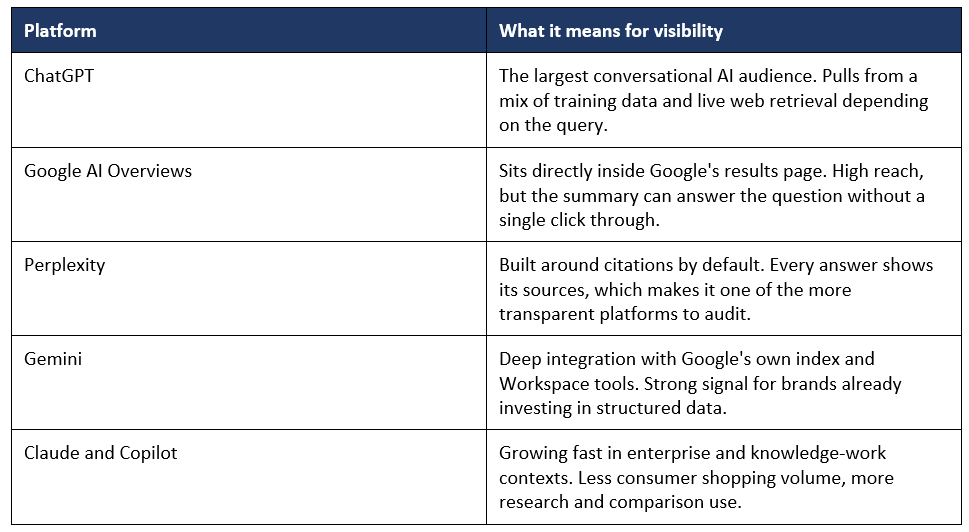
A brand can hold strong visibility on one platform and be nearly invisible on another, since each system trains on different data and applies different retrieval logic. Cross-platform tracking is the only way to see the full picture instead of a partial one.
Why the gaps between platforms happen
Each AI platform makes different choices about which sources it trusts, how often it refreshes its retrieval index, and how heavily it leans on live web results versus its own training data.
A platform that leans more on live retrieval will reflect a recently published comparison page within days. A platform that leans more heavily on fixed training data may take months to reflect the same change. Knowing which pattern applies to your priority platforms changes how quickly you should expect to see results.
How to Measure Your Own AI Visibility
You do not need an expensive platform on day one. You need a repeatable way to check where you currently stand.
Start manually
Write down the ten to fifteen questions a real buyer would ask if they were choosing between you and your closest competitors. Run each one through ChatGPT, Perplexity, and Gemini, and note whether you appear, where, and how accurately.
This manual pass alone will surface obvious gaps long before you need a paid tool to quantify them.
Move to dedicated tooling once the channel proves out
Once you know AI visibility genuinely affects your pipeline, a dedicated tracking tool saves the time of re-running manual checks every week.
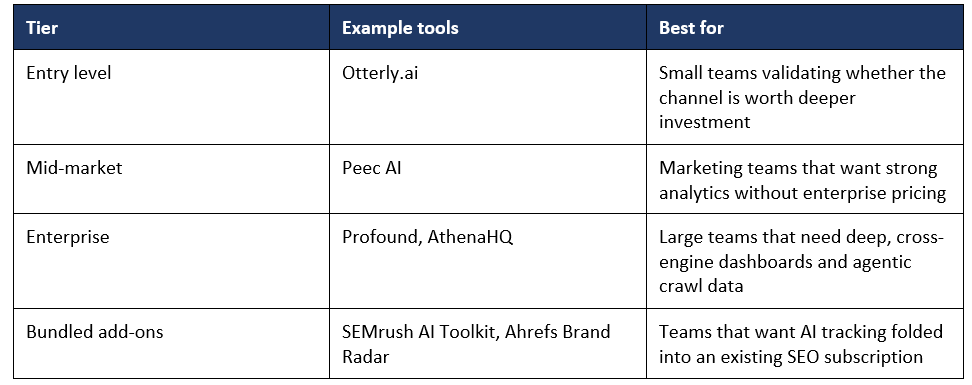
Pricing across this category runs from roughly $25 a month for entry-level monitoring to several hundred a month for enterprise dashboards with agentic crawl data. Choose based on how many prompts and platforms you actually need to track, not the longest feature list.
What each tier actually gives you
Entry-level tools are built for a single job: tell you, on a schedule, whether a defined list of prompts surfaces your brand. That is enough for most small teams to validate the channel.
Mid-market tools add competitor benchmarking, sentiment analysis, and broader language and engine coverage, which matters once you are managing visibility across several markets or product lines.
Enterprise tools add agentic crawl data, meaning they can show how AI crawlers themselves are reading and indexing your site, plus deeper integrations for teams that need to prove channel impact to leadership with hard numbers.
How to Improve AI Visibility
Most of the fix is not a separate content operation. It is making your existing content easier for an AI system to find, trust, and quote.
• Answer the specific question directly, near the top of the page, in one or two clear sentences before adding context.
• Use clear H2 and H3 headers that match how a real person would phrase the question, not just a short-tail keyword.
• Back every claim with a real number, a named source, or a date. Vague claims rarely get cited. Specific, checkable ones do.
• Keep your brand description consistent everywhere it appears: your site, review platforms, directories, and press coverage.
• Build genuine comparison and evaluation content. AI systems are frequently asked to compare options, and thin or absent comparison content is an easy gap to leave open.
• Earn mentions on third-party sites AI systems already trust, since independent confirmation of a claim carries more weight than a brand's own page repeating it.
• Refresh key pages at least once or twice a year. Stale pages are measurably less likely to be pulled into a current answer.
The two changes that matter most
If you can only prioritize two things from that list, prioritize the direct answer and the consistency check. A page that opens with a clear, direct answer to the actual question, backed by a brand description that matches word for word across your site, your review profiles, and your press mentions, covers the majority of what these systems are evaluating.
Everything else on the list, from comparison content to third-party mentions, compounds on top of that foundation. Skipping the foundation and jumping straight to advanced tactics rarely pays off.
Before and after: what a rewrite actually looks like
Before: a typical product page opens with a tagline, a hero image, and three paragraphs of brand story before it explains what the product actually does or who it is for.
After: the same page opens with a direct sentence answering the obvious question. What is this, who is it for, and what does it cost. The brand story moves further down the page, where a human reader who is already interested can still find it.
The content has not gotten shorter or less persuasive. It has simply moved the answer to the front, which is exactly where both a scanning human and a retrieving AI system are looking for it.
This same pattern applies to comparison pages, pricing pages, and FAQ sections. Lead with the answer. Support it after. That order rarely costs you anything with a human reader, and it is often the difference between being cited and being skipped.
Who should own this internally
AI visibility does not fit neatly into one existing team, which is part of why it gets missed.
Content and SEO teams usually have the closest existing skill set, since much of the work is rewriting and structuring content that already exists. But the reporting and strategic ownership often benefits from sitting with whoever already owns brand positioning, since consistency of description across the web is as much a brand discipline as a technical one.
For smaller teams, one person tracking a monthly baseline and flagging gaps is enough to start. For larger organizations, this increasingly sits as a defined function, sometimes inside SEO, sometimes as its own line item, reporting the same way paid search or organic traffic already does.
None of this requires abandoning your existing SEO content. It requires rewriting the parts that currently exist only to satisfy a keyword, not a question.
A 90-Day AI Visibility Roadmap
Teams that make real progress tend to follow a similar sequence, rather than trying to fix everything in the first week.
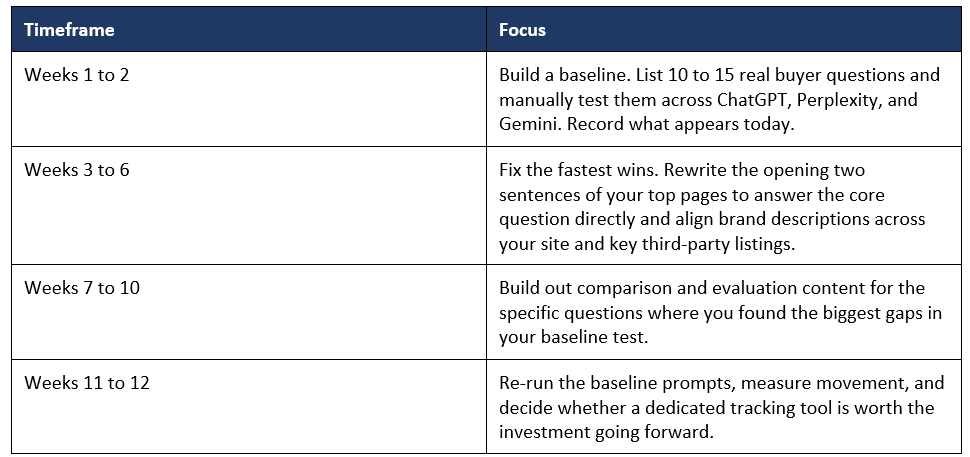
This is a starting cadence, not a rigid rulebook. The point is to measure before you change anything, then measure again after, so you know which fixes are actually working.
Reporting AI Visibility to Leadership
This channel is new enough that most leadership teams have not seen a report on it yet. A simple format works better than an exhaustive one.
• Show the baseline: which of your top buyer questions currently include your brand, and which do not.
• Show the competitive gap: which competitors are being named instead, and how consistently.
• Show movement over time: even small, steady gains in mention rate are worth reporting quarter over quarter.
• Tie it to a business outcome wherever you can, such as referral traffic from AI platforms or leads that mention finding you through an AI tool.
Leadership does not need the technical mechanics of retrieval and training data. They need to see whether the brand shows up when it matters, and whether that is improving.
Common Mistakes and Misconceptions
"If I rank first, I'm already covered"
Rankings and AI citations are measured by different systems, using different logic. Treating a page one search ranking as proof of AI visibility is one of the fastest ways to miss the gap entirely.
Teams that fall into this trap often only discover the gap after a competitor points it out, or after a prospect mentions during a sales call that an AI assistant recommended someone else first. By then, the competitor may already be several months into building the consistency and citation history that made that recommendation possible.
"This is just SEO with a new name"
The overlap is real, but the mechanics are not identical. Backlink volume and keyword density carry far less weight than entity clarity, source consistency, and direct, structured answers.
"AI citations are random, so there's nothing to optimize"
It can look random from the outside, especially early on, when a brand appears in one answer and disappears from a nearly identical one asked a day later. But the underlying signals, entity clarity, structured content, and source consistency, are consistent enough that deliberate changes reliably shift citation patterns over a few months, even if any single answer still looks unpredictable in isolation.
"One platform is enough to track"
Visibility on ChatGPT does not guarantee visibility on Gemini or Perplexity. Each platform trains differently and retrieves differently, so single-platform tracking shows you a partial picture at best.
"This will fix itself once my content is good enough"
Content quality helps, but structure and consistency matter just as much. A well-written page that buries the answer three paragraphs down, with no clear headers, is still hard for a system to extract cleanly.
"AI visibility work will hurt my regular SEO"
The two rarely conflict. Direct answers, clear structure, and well-supported claims tend to help traditional rankings as well, since search engines have been rewarding clarity and expertise signals for years. The overlap works in your favor.
"Only huge brands need to worry about this"
Smaller, specific brands often have an easier time earning a citation than large generalist ones, because AI systems favor a clear, specific answer to a narrow question over a broad brand with no direct answer to offer.
A Short Glossary of Terms You Will Run Into
This space has generated its own vocabulary fast. A quick reference helps when reading vendor pages or research reports.
• GEO (Generative Engine Optimization): The practice of improving how AI engines discover, understand, trust, and recommend a brand, roughly the AI-era counterpart to SEO.
• AEO (Answer Engine Optimization): A closely related term, often used interchangeably with GEO, focused specifically on earning placement inside direct-answer formats.
• Share of model: A brand's relative presence inside an AI system's output compared with competitors, similar in spirit to share of voice in traditional media.
• Citation: An instance where an AI system names a source, brand, or page while generating its answer.
• Prompt coverage: The range of different real-world questions that successfully surface a given brand in an AI answer.
• AI readiness score: A composite score, used by several tracking tools, describing how well a page is structured for AI extraction and citation.
• Agentic search: A newer pattern where an AI system does not just answer a question but takes an action on the user's behalf, such as comparing prices or completing part of a purchase.
• Zero-click search: A search session that ends with the user's question answered directly on the results page or inside a chat response, without a visit to any external website.
• Knowledge graph: A structured map connecting an entity, such as your company, to attributes like industry, founders, and products, which some AI systems use to place you correctly.
What This Means for Your Content and SEO Strategy
AI visibility is not a replacement for SEO. It is an additional layer that runs on some of the same content, judged by a different set of rules.
The practical shift is small but important. Write the direct answer first, support it with real evidence, structure it so a system can parse it cleanly, and keep your brand description consistent everywhere it appears.
Track it the same way you already track rankings and traffic. Pick a baseline set of prompts, check them on a regular schedule, and treat any gap you find as a normal, fixable content problem rather than a mystery.
The brands that start measuring this now are building a lead that gets harder to close every quarter they wait.
Key takeaways
• AI visibility measures whether you get named inside an AI-generated answer, not where you rank on a results page.
• You can rank first on Google and still be invisible to ChatGPT, Gemini, or Perplexity on the exact same question.
• The fix is mostly a rewrite, not a rebuild: direct answers, clear structure, consistent brand description, and real evidence.
• Start manually, with a baseline of real buyer questions, before paying for a dedicated tracking tool.
• The advantage compounds. Brands that start now are harder to catch a year from now.
The Cost of Doing Nothing
Skipping AI visibility does not freeze your position in place. It hands the decision to whichever competitor is already paying attention.
Consider a category with five real competitors. If none of them are tracking AI visibility, the AI system's choice of who to cite is essentially arbitrary from a marketing standpoint, based on whatever content happens to be clearest at that moment.
The first competitor to deliberately structure their content around real buyer questions usually becomes the default answer for that category, simply because they are the only one who showed up prepared. Once that pattern sets in, it tends to reinforce itself, since more citations lead to more mentions elsewhere on the web, which then feed back into future citations.
Waiting a year to start does not just cost you a year of visibility. It can cost you the default position in your category for years after that, since the compounding advantage goes to whoever established it first.
What Success Looks Like After a Year
Brands that commit to this consistently for a full year tend to describe a similar arc, rather than a single dramatic turning point.
The first quarter is mostly measurement and small fixes. Baseline prompts get tested, brand descriptions get aligned, and the worst offending pages get a direct-answer rewrite.
The second and third quarters are where movement becomes visible. Mention rate climbs on the priority prompts, comparison content starts pulling citations away from competitors who have not made the same changes, and referral traffic from AI platforms, while still small in absolute terms, starts showing a real upward trend in analytics.
By the fourth quarter, the brands that stayed consistent usually hold a visible lead over competitors who never started, and that lead keeps compounding on its own, since more citations tend to produce more of the signals, reviews, mentions, and consistent third-party descriptions, that earn future citations.
None of this requires a dramatic reinvention of your content strategy. It requires treating a new, measurable channel the same way you already treat the channels you track today.
Ready to See Where You Stand?
Get in touch, and we will run a free AI visibility check across ChatGPT, Perplexity, and Gemini for your brand's top ten buyer questions.
Quick Audit Checklist
Run through this before your next content or marketing planning cycle:
☐ List 10 to 15 real questions your buyers would ask when choosing between you and competitors
☐ Run each question through ChatGPT, Perplexity, and Gemini, and note whether and how you appear
☐ Check whether your brand description is consistent across your site, directories, and review platforms
☐ Rewrite at least one key page to answer its core question directly in the first two sentences
☐ Add or refresh comparison content for your top three competitors
☐ Set a quarterly review of AI visibility alongside your normal SEO reporting
Frequently Asked Questions
Is AI visibility the same thing as SEO?
No. SEO measures where you rank on a results page. AI visibility measures whether an AI system mentions, cites, or recommends you inside a synthesized answer, which follows a different set of rules entirely.
Can I have strong AI visibility without ranking first on Google?
Yes. AI engines retrieve and weigh information using their own logic, not just top search positions. A page ranking on page two of Google can still be the source an AI system chooses to cite.
Which AI platform should I prioritize first?
Start wherever your buyers already are. B2B audiences often research on ChatGPT and Perplexity, while broad consumer categories see more volume through Google's AI Overviews and Gemini.
How long does it take to improve AI visibility?
Most brands that invest consistent effort see measurable movement within three to six months, since AI systems need to encounter and re-index updated, structured content before citation patterns shift.
Do I need a dedicated AI visibility tool to get started?
Not immediately. You can manually test a set of relevant prompts across ChatGPT, Perplexity, and Gemini to get a baseline before committing budget to a dedicated tracking platform.
Does AI visibility work conflict with traditional SEO?
No. The two overlap more than they compete. Clear, well-structured, directly answered content tends to help both traditional rankings and AI citation at the same time.
What is the difference between AI visibility and share of voice?
Share of voice traditionally measures media and social mentions across the wider web. AI visibility measures a narrower, more specific thing, whether AI systems actively name your brand inside generated answers to real buyer questions.
Can a small business realistically compete with larger brands on AI visibility?
Yes. AI systems favor specific, direct, well-supported answers over broad brand recognition, so a smaller company with clear, accurate content can out-cite a larger competitor with thinner content on the exact question being asked.
How is AI visibility different from just monitoring brand mentions?
General brand monitoring tracks any mention of your name across the web, including social posts and news coverage. AI visibility tracks a narrower and more commercially specific event: whether an AI system actively names you inside an answer to a real buying question.
What is the single easiest first step for a team with no budget?
Manually test ten real buyer questions across two or three free AI tools and write down what comes back. That one afternoon of work will tell you more about your current standing than most teams currently know.