ChatGPT vs Claude vs Gemini for SaaS Content Teams in 2026: The Honest Comparison
“For SaaS content teams in 2026, Claude leads on long-form writing quality and instruction-following, ChatGPT leads on ecosystem breadth and short-form versatility, and Gemini leads on Google Workspace integration and research with real-time data. Most productive teams use two of the three, not one alone.”
Three tabs. Same question.
That is the reality for most SaaS content teams in 2026. ChatGPT is open because it has always been open. Claude is open because someone on the team said the writing was better. Gemini is open because the company runs on Google Workspace and it was just there.
The problem is that using three tools without a clear decision framework costs more than it saves. You get inconsistent output, duplicated effort, and no clear owner for which tool handles which job.
This guide solves that.
I have gone through the independent test data, benchmark scores, and real user reports across all three platforms. I will tell you what each tool is actually good at for content work specifically, where each one falls short, and how a SaaS content team should structure its stack to stop bouncing between tabs.
Who this guide is for:
SaaS content leads deciding which AI tool to standardise on
Founders building a content function and choosing their first tool
Marketing teams that have all three open and are not sure which one to close
Who this is NOT for:
Developers looking for coding comparisons (different priority set)
Enterprise teams comparing these tools for legal or compliance workflows
What Actually Changed in 2026
A year ago, this comparison was easier to write. ChatGPT was clearly ahead on ecosystem breadth, Claude was the writing quality pick, and Gemini was improving but still the weakest of the three.
The gap has compressed.
All three platforms now cost $20 per month at the standard paid tier. All three have free tiers. All three have enterprise options. All three have shipped significant model updates in the last six months.
The public conversation still treats this as a horse race with a single winner. The buying decision no longer works that way. ChatGPT, Claude, and Gemini have all crossed from "interesting chatbot" to multi-surface operating layer: web app, mobile app, APIs, coding agents, enterprise controls, and workflow automation.
The right question is not which tool is best. It is which tool is best for each task your content team actually runs.
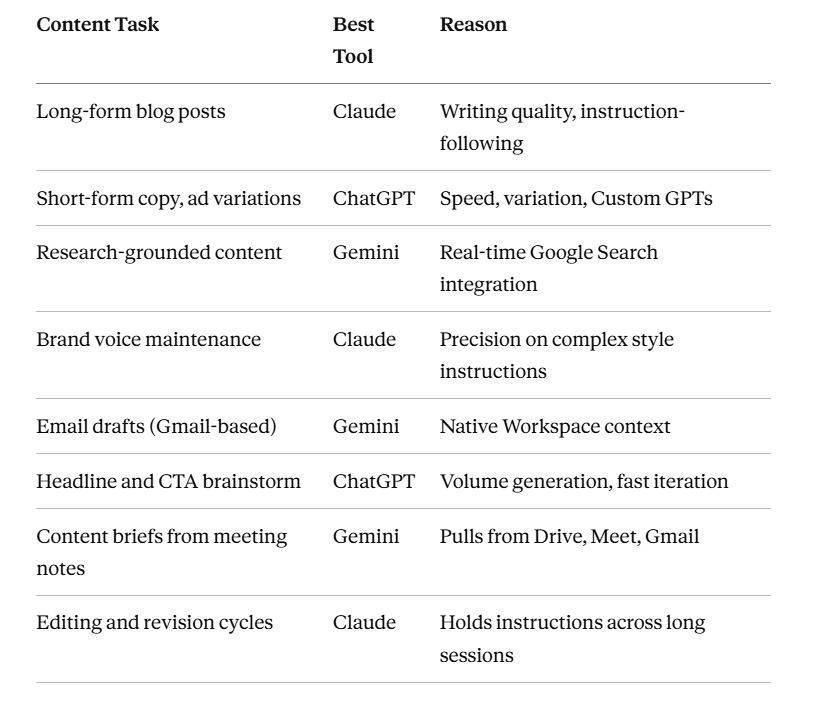
Here is the framework I use to answer that. I call it the TASK MATCH model.
ChatGPT in 2026: What It Does Well for Content Teams
ChatGPT remains the most-used AI assistant in the world. Weekly active users grew to 900 million by mid-2026, meaning over 10% of the global population uses the tool at least once a week. That install base matters for SaaS content teams because it means the largest library of tutorials, custom GPTs, integrations, and community knowledge is built around ChatGPT.
Where ChatGPT wins for content work:
Short-form output at speed. For anything under 500 words, including social media posts, email subject lines, ad copy variations, and product descriptions, ChatGPT is fast and capable. The ability to generate 10 headline variations in a single prompt and iterate quickly makes it the tool for the brainstorm phase of any campaign.
Custom GPTs for workflow templates. ChatGPT's GPT Store has a large and growing library of custom configurations for marketing content. Teams can build a brand-voice GPT that carries instructions for tone, terminology, and structure across every session, without re-prompting each time. This is a meaningful productivity advantage for content teams producing high volumes of similar content types.
Ecosystem integrations. ChatGPT's tool use framework connects to file management, web browsing, code execution, and third-party services within a single session. For a content team that needs to move between drafting, data analysis, and image generation in one workflow, ChatGPT's breadth reduces context switching. Native image generation through DALL-E means visual assets are available in the same interface.
The multimodal edge. On OSWorld, the computer use benchmark, GPT-5.4 scores 75%, a result that no Claude model currently matches. For content teams that need to automate browser-based tasks, drag assets across tools, or run repetitive platform-specific actions, this agentic capability is practical and tested.
Where ChatGPT falls short for SaaS content:
Instruction-following on complex briefs. For detailed, multi-part prompts with specific constraints, ChatGPT can drift or miss requirements set earlier in a conversation. Teams doing precision work, such as structured thought leadership pieces with specific formatting rules, will notice this. The output style can also vary more than expected between sessions with similar prompts, which creates brand voice inconsistency.
Long-form quality. ChatGPT tends toward a recognisable AI voice: competent, structured, and occasionally formulaic. For B2B SaaS content that needs to sound like a practitioner with genuine expertise, the output often requires more editing than the time saved in generation. The middle sections of longer posts are where this shows most clearly, with repetitive bullet points and generic phrasing appearing more often than in Claude's output.
Context window at the standard tier. ChatGPT's standard context window is 272,000 tokens, roughly a quarter of Claude's 1 million token window at the same price tier. For a content team working on long documents, series of related posts, or content that references months of existing work, ChatGPT is more likely to lose track of earlier instructions.
Pricing at power-user tiers. Claude Max costs $100 per month. ChatGPT Pro sits at $200 or more per month. For a content team that needs high usage across multiple team members, this price gap is significant.
Verdict on ChatGPT for SaaS content: The default choice for teams that need breadth, speed, and volume. Strongest at short-form, brainstorming, and workflows that need multiple tool types in one session. Weakest at sustained long-form quality and following complex brand voice instructions across long documents.
Claude in 2026: What It Does Well for Content Teams
Claude is the tool most often described by professional writers as the one that requires the least editing before publishing.
In a blind test run across 8 different prompt types, with 134 participants voting without knowing which model produced each output, Claude won 4 out of 8 rounds. ChatGPT won 1. The writing rounds were not close: Claude's margins were 35 to 54 points ahead.
That is not a Claude-commissioned study. It is a public test where participants voted blind. The results are consistent with what independent writers report across platforms.
Where Claude wins for content work:
Long-form writing quality. This is the clearest and most consistent finding across independent tests. Claude produces prose that sounds more human: varied sentence structures, natural paragraph breaks, and tonal consistency that holds across thousands of words.
In a practical test using the same brief given to both Claude and ChatGPT, a 1,500-word SEO blog post for a B2B SaaS company, Claude produced 1,487 words with 6 distinct headings, a clear problem-solution flow, and concrete examples per section with zero repeated phrases. ChatGPT's output had a stronger opener but padded the middle with repetitive bullet points and generic phrasing.
Instruction-following on complex briefs. Give Claude a detailed brief with specific word count, exact tone, specific phrases to avoid, and multiple constraints, and it tracks all of them. Ask both Claude and ChatGPT to "write a 600-word introduction for a B2B SaaS blog post targeting CTOs, use a consultative but direct tone, avoid buzzwords, and do not start with a question." Claude typically nails all constraints. ChatGPT often slips on one or two.
This matters practically. Content teams that have established brand voice documents, style guides, and terminology lists get more consistent output from Claude when those constraints are included in the prompt.
AI detection resistance. Claude's outputs scored 15 to 28% lower on AI-likelihood detection metrics in tests run across 6 business emails and 4 blog intros. On Reddit threads in SEO communities from 2025 to 2026, multiple content leads reported that Claude outputs require significantly less "humanising" before publishing, particularly for B2B thought leadership pieces.
This distinction matters because Google's quality raters now have specific AI-pattern guidelines, and readers have pattern-matched on the ChatGPT voice.
Context window at standard price. Claude Sonnet 4.6 provides a 1 million token context window at the $20 per month Pro tier. For a content team working on a series of related blog posts, a long-form resource, or maintaining brand voice consistency across a large document library, this is a practical advantage at no extra cost. The same depth of context requires the $200 per month ChatGPT Pro tier on the OpenAI side.
Collaborative editing and revision cycles. Where Claude particularly stands out is in iterative editing. If you are working through multiple drafts of a document, refining arguments, restructuring sections, or adjusting tone, Claude acts more like a skilled editor than a text generator. It understands revision instructions at a high level and preserves voice across edits. The difference between a Custom GPT and a Claude Project is the difference between a template and a collaborator.
Reasoning for technical content. Claude leads on GPQA Diamond, which tests PhD-level science questions, with a score of 91.3%, the widest margin of any major benchmark category. For SaaS companies writing about technical topics, product integrations, or complex category content, Claude's reasoning advantage is meaningful in reducing the number of factual errors that need to be caught in review.
Hallucination behaviour. Claude flags uncertainty more often rather than inventing confident but unverifiable figures. In long-form content tasks, Claude hallucinated less and, more importantly, signalled when it was uncertain. For business-facing content, that tendency to say "verify this" is preferable to producing plausible-sounding false data that gets caught after publishing.
Where Claude falls short for SaaS content:
No native image generation. Claude does not generate images. For a content team that needs visual assets as part of the same workflow, this requires switching to a different tool.
No native web search in standard use. While Claude can be connected to search, Gemini's integration with Google Search and real-time data is more seamless for research-grounded content.
Short-form is less differentiated. The quality gap between Claude and ChatGPT shows most clearly in longer pieces. For email subject lines, social posts, and quick drafts, either tool produces comparable results. The extra investment in learning Claude's prompt style pays off most on pieces over 1,000 words.
Verdict on Claude for SaaS content: The strongest choice for teams where output quality is the bottleneck. Particularly valuable for long-form thought leadership, brand voice maintenance, technical content, and revision-heavy workflows. Less valuable for quick short-form production and anything requiring native image generation or live web data.
Gemini in 2026: What It Does Well for Content Teams
Gemini is the tool that most content guides underrate, because they evaluate it as a standalone chat interface rather than what it actually is in 2026: a deeply embedded layer across the entire Google Workspace ecosystem.
The calculus changed in early 2025 when Google stopped selling Gemini as an expensive add-on and folded it directly into every paid Workspace plan. A customer previously paying $32 per user per month for Business Standard plus the Gemini add-on now pays $14 per user per month with AI included. For a SaaS content team already running on Google Workspace, the right question about Gemini is not "should we pay for it" but "why are we not using it yet."
Where Gemini wins for content work:
Real-time research with source grounding. Gemini's integration with Google Search gives it access to current information that neither Claude nor ChatGPT can match at the standard tier without additional configuration. For content teams writing about fast-moving categories, competitor news, or industry data, Gemini can pull live information and ground its output in verifiable current sources. This is the clearest functional advantage over the other two tools.
Google Workspace context awareness. This is Gemini's most underappreciated capability. In Docs, Gemini can pull context from your Drive files and email history before generating content. Ask it to "draft a newsletter based on the meeting minutes from last month's product review and the Q2 roadmap document" and it retrieves both files automatically. No other AI tool has this level of in-context awareness of your existing Google data.
For a SaaS content team where most assets live in Google Drive, this means Gemini already knows what you have written, what decisions were made in meetings, and what the product direction is, without you having to paste any of it into a prompt.
Gmail-native email drafting. Gemini in Gmail produces tone-appropriate email drafts from a few bullet points in seconds. Open any 40-reply client thread, click Summarize, and Gemini gives you the key decisions, action items, and unresolved questions in three to five sentences. For content teams that handle client communication alongside content production, this reduces a significant time sink.
Meeting-to-content pipelines. Gemini in Meet automatically captures notes, organises them in a Google Doc, and shares them with attendees. For content teams that run strategy calls, client interviews, or product briefings in Meet, this creates a ready-made source document for content without manual transcription. The meeting summary becomes a content brief with no additional step.
Multi-language capabilities. Gemini supports content creation and summarisation across multiple languages without configuration. For SaaS companies with international content programmes, this built-in multi-language layer is a meaningful operational advantage.
Pricing structure. At the Business Standard level, Gemini is now included in the Workspace plan cost. For a SaaS team of 5 to 15 people, standardising on Gemini for the Google Workspace layer costs effectively nothing extra, freeing budget for Claude or ChatGPT for the tasks where those tools are stronger.
Where Gemini falls short for SaaS content:
Standalone writing quality below Claude. In the same blind test where Claude won 4 of 8 rounds, Gemini was described as "the quiet all-rounder" who "never dominated a round the way Claude did." It never bombed either, but the ceiling on Gemini's prose quality is lower than Claude's on tasks that require voice, nuance, and sustained quality across long documents.
File context limitations in Docs. Gemini in Docs can only summarise text contained directly within the active Google Doc and cannot pull context from linked Drive files or external URLs in all scenarios. If a primary document references an appendix stored as a separate file, Gemini will exclude that appendix from its summary. This is an important limitation to understand before relying on document summaries that span multiple files.
Third-party tool adoption signals the gap. One counterintuitive finding from 2026 Workspace usage data: AI add-on installs in the Google Workspace Marketplace grew by over 200% between 2023 and 2025, even as Google expanded its own native AI features. Teams in larger organisations are running a two-tier AI strategy, using Gemini for broad general use and a specialised add-on for writing-heavy power users. This tells you that Gemini is not fully replacing other tools for content teams that care deeply about output quality.
Verdict on Gemini for SaaS content: The strongest choice for teams whose primary bottleneck is research, meeting-to-content conversion, and Gmail-based communication. Essential if your team runs on Google Workspace and underused if your team is not activating the features already included in your plan. Not the strongest standalone writing tool for long-form content production.
The Honest Side-by-Side: What Each Tool Costs
At the consumer level, pricing is nearly identical. All three platforms charge $20 per month for their primary paid tier. All three have free tiers.
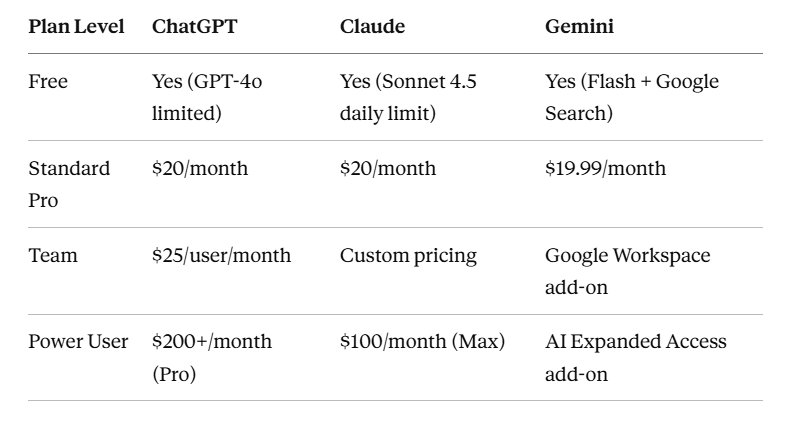
The price gap that matters for content teams is at the power-user tier. Claude Max at $100 per month versus ChatGPT Pro at $200 or more per month. For teams with high daily usage across multiple team members, Claude Max represents significantly better value for writing-intensive workflows.
Gemini's effective cost for teams already on Google Workspace Business Standard is included in the plan price, which has decreased since the 2025 rebundling. That makes it the lowest-friction entry point for a team that is not yet using AI tools at all.
The Task-by-Task Decision Framework
Here is how a SaaS content team should route specific tasks to specific tools.
Use Claude for:
Long-form blog posts and thought leadership pieces where editing time reduction matters
Any content piece with a complex brand voice brief, specific terminology rules, or multi-constraint instructions
Revision and editing cycles on existing drafts where consistency across sections is critical
Technical content on product functionality, integrations, or complex category topics
Content that feeds into AI-generated answers (GEO) where factual accuracy and coherent structure matter most
Use ChatGPT for:
Headline brainstorming and CTA variations where you want volume and diversity fast
Short-form social media posts, ad copy, and email subject lines
Workflows that require image generation in the same session
Custom GPT configurations for repeatable content templates your team runs frequently
Agentic tasks that require browser control or multi-application workflows
Use Gemini for:
Research-grounded content that needs current market data or competitor information
Meeting transcripts converted to content briefs (Meet to Docs pipeline)
Gmail-based client email drafting and thread summarisation
Any content where context from your existing Google Drive files is the starting point
Multi-language content for international programmes
Daily email and communication management that overlaps with content planning
What most SaaS content teams actually run:
The most common and most productive pattern is a two-tool approach.
Claude or Gemini for the daily internal workflow, including drafts, emails, and documents, with research and verification handled by Gemini or Perplexity. A single ChatGPT Pro subscription often cannot replace a targeted two-tool approach, especially when working across specialised workflows.
If budget is constrained, Claude Pro at $20 per month plus Gemini on your existing Workspace plan covers the most important use cases: writing quality plus Google integration plus real-time research. Add ChatGPT if short-form volume and custom GPT templates become a bottleneck.
The Governance Question Content Teams Avoid
There is a question most teams do not ask until it becomes a problem: who owns the prompt library?
Every AI tool your content team uses produces better output with better prompts. The team member who has figured out the right prompt structure for a product case study, a comparison post, or a customer story is sitting on institutional knowledge that walks out the door if they leave.
The answer is a shared prompt library, regardless of which tool you standardise on.
Claude Projects is the most structured solution for this: a shared space where system instructions, brand voice documents, and content templates can be stored and accessed by everyone on the team. This means a new hire picks up the team's prompt conventions from day one, not after six months of trial and error.
ChatGPT Custom GPTs serve a similar function but are more useful for single-task configurations than for sustained collaborative writing workflows.
Gemini in Google Workspace handles this implicitly through the shared Drive context: because Gemini can reference existing team documents, the collective knowledge base in Drive becomes the shared context for any AI-assisted content task.
The practical recommendation: whatever tool you standardise on, build a shared prompt library within the first month. It is the single highest-leverage investment in making AI tools work for a team rather than just for individuals.
The Brand Voice Problem All Three Tools Have
This section is for content teams that have worked hard to develop a distinctive brand voice and are worried about AI flattening it.
All three tools can replicate a brand voice if the brief is clear enough. None of them do it reliably across sessions without explicit prompt configuration.
The best test I know of for brand voice reliability is this: take a piece of content written by your best human writer, paste it into the tool without explaining it, and ask the tool to "write the next section in the same voice." Then look at how often it needs correction before the output matches.
Based on independent tests and community reports, Claude performs best on this test, particularly on pieces over 1,000 words where maintaining voice across sections is the hardest challenge. ChatGPT tends to regress to its default register, which is professional-generic, within a few paragraphs unless re-prompted. Gemini performs adequately but has a lower ceiling for the kind of editorial voice that distinguishes a strong SaaS brand.
The practical response is not to pick the best tool and hope it holds. It is to:
Write a brand voice document that explicitly describes sentence rhythm, vocabulary level, phrases to avoid, and what your voice is not
Include that document as context in every session
Use Claude Projects or ChatGPT Custom GPTs to make that context permanent rather than re-pasting it each time
Done properly, this gets all three tools to a level of consistency that reduces editing time significantly. The tools are not the bottleneck in brand voice maintenance. The absence of a clear brief is.
What the Benchmarks Actually Say
For those who want the numbers alongside the qualitative assessments:
Coding (SWE-bench Verified): Claude Opus 4.6 scores 80.8%, GPT-5.2 scores 80.0%. The gap is under one percentage point. For content teams this is mostly irrelevant, but it signals that the two tools are genuinely competitive at the frontier level.
Reasoning (GPQA Diamond, PhD-level science): Claude leads at 91.3%, the widest margin in any major benchmark category.
Computer use (OSWorld): GPT-5.4 scores 75%, which Claude does not currently match. Relevant for content teams automating browser-based workflows.
Writing quality (human preference tests): In blind tests, Claude wins most writing rounds by significant margins. ChatGPT wins on analytical and strategy prompts. Gemini is the consistent all-rounder without a dominant round.
Context window ($20 tier): Claude at 1 million tokens. ChatGPT at 272,000 tokens. Gemini varies by plan but offers extended context via the Google Workspace integration layer.
The honest summary on benchmarks: use them as tiebreakers, not as decision-makers. The differences that show up in daily content work are about workflow fit, not benchmark position.
FAQs: What SaaS Content Teams Are Searching For
1. Is Claude better than ChatGPT for writing blog posts?
Based on multiple independent tests in 2026, yes. Claude produces more natural, varied prose with better instruction-following on complex briefs. In blind tests, Claude won most writing rounds by significant margins. For B2B SaaS blog content specifically, Claude's output typically requires less editing before publishing. ChatGPT is faster for short-form output and brainstorming but produces more formulaic long-form content.
2. Should a SaaS content team use Gemini or Claude?
For teams running on Google Workspace, the answer is probably both. Gemini handles the research, email drafting, and meeting-to-content pipeline because it has native access to your existing Workspace files. Claude handles the long-form writing where output quality and brand voice precision matter. These two tools complement rather than duplicate each other.
3. Which AI tool is best for maintaining brand voice across a content team?
Claude, because of its superior instruction-following on complex style requirements and its Projects feature, which stores brand voice documents as permanent context for the whole team. ChatGPT Custom GPTs serve a similar function but are more suited to single-task configurations than to sustained collaborative writing. Gemini handles brand voice adequately for most tasks but has a lower ceiling for distinctive editorial voice.
4. Is ChatGPT still worth paying for in 2026 if you use Claude?
For most SaaS content teams focused on writing quality and brand voice, Claude Pro at $20 per month plus Gemini on an existing Workspace plan covers the primary use cases. Add ChatGPT if your content production includes significant volume of short-form copy, requires image generation in the same workflow, or relies on Custom GPTs your team has built. If budget is constrained, it is usually the third priority rather than the first.
5. Which AI tool gives the most accurate research for SaaS content?
Gemini, because of its native Google Search integration and real-time data access. For content that needs current statistics, competitor information, or recent industry events, Gemini's research output is more reliably current than ChatGPT or Claude at the standard tier. Always verify statistics independently before publishing, regardless of which tool produces them.
Summary: The Decisions That Actually Matter
There is no single winner in this comparison. That is not a hedge. It is the correct answer.
The teams that have built the most productive content operations in 2026 are not the ones that picked one tool and enforced it. They are the ones that built a task-matched workflow: Claude for the writing that needs to hold up to editorial scrutiny, Gemini for the research and Workspace integration that removes friction, and ChatGPT where speed and short-form volume matter.
The decisions that actually move content output quality are:
Which tool handles which task type, with the team aligned on it
Whether you have a shared prompt library, not just individual workarounds
Whether brand voice instructions are stored as permanent context, not repasted every time
Whether Gemini's Workspace features are actually activated, because many teams are leaving them idle in a plan they are already paying for
The tools are not the bottleneck. The absence of a system for using them is.