AI Tools That Replace Full-Time SaaS Hires in 2026: What the Data Actually Says
“AI tools in 2026 can replace or significantly reduce headcount in four SaaS roles: customer support agents (Intercom Fin, Decagon), SDRs (Artisan, AiSDR), content writers (Claude, Jasper), and data analysts (Amplitude, Obviously AI). The strongest results come from hybrid deployments where AI handles volume and humans handle judgment. Full replacement has consistently underperformed.”
At some point in the last 12 months, you have looked at your payroll and quietly asked yourself: could AI do this?
Not in a cold way. In a practical way. You are running a small team, cash is not infinite, and the tools available in 2026 are genuinely capable of things that required a full-time hire two years ago.
The problem is that the conversation around AI and headcount is full of noise. On one side, you have the breathless headlines. Klarna replaced 700 agents. AI SDRs will end the SDR role. Your content team is redundant.
On the other side, you have the backlash. Klarna had to reverse course. AI outreach sounds robotic. Quality collapses without human oversight.
Neither version is complete. And founders making hiring decisions based on either one are going to get it wrong.
This guide cuts through both. It looks at which SaaS roles AI tools genuinely replace, which ones they augment, which ones they cannot touch yet, and what the actual cost math looks like in 2026.
Who this is for:
SaaS founders deciding between hiring and buying a tool
Operators trying to extend runway without cutting quality
Team leads building the case for or against headcount reduction
Who this is NOT for:
Enterprise HR teams managing hundreds of employees
Founders who have not yet found product-market fit (hire people, talk to customers first)
Anyone looking for a way to justify cuts they have already decided to make
Why This Conversation Is Different in 2026
Before getting into specific roles, it is worth understanding what changed.
The shift is not that AI got smarter in a general sense. The shift is that AI got good enough at specific, high-volume, pattern-based tasks that these tasks now cost less to automate than to hire for.
A Databricks 2026 survey found multi-agent system usage spiked by 327% over four months. Gartner predicts that 35% of point-product SaaS tools will be replaced by AI agents by 2030.
The economic pressure is real. The SaaS industry is shifting from tools that support humans to AI-native apps and autonomous agents that execute work and own outcomes. Traditional per-seat pricing faces pressure as AI agents act as users.
For a SaaS founder, this translates into a concrete question: if one employee equipped with AI agents can do the work of five, you do not need five seats. What you need is to figure out which five jobs actually become one, and which ones require humans no matter what the pitch deck says.
Here is the framework I use. I call it the VOLUME vs JUDGMENT split.
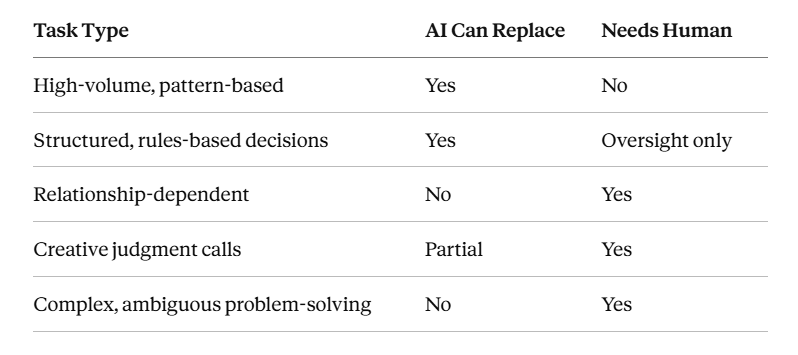
Every role you consider automating should be filtered through this split before you make a decision.
The Four SaaS Roles AI Tools Are Actually Replacing
Role 1: Customer Support Agents
This is the most documented and data-rich category. It is also the one with the most visible cautionary tale.
The Klarna story is now cited in every serious conversation about AI and support. In February 2024, Klarna launched an AI-powered customer service assistant built with OpenAI. Within 30 days, it handled 2.3 million customer chats, equivalent to the workload of 700 full-time agents, automating 67% of customer conversations.
That is a remarkable result. But the rest of the story matters.
By early 2026, Klarna was quietly reversing course. Customer satisfaction data had deteriorated on complex service interactions. The company shifted from full AI replacement to a hybrid model where AI handles routine, high-volume queries and human agents handle escalations, complex cases, and high-value interactions.
The Klarna walkback gave AI skeptics ammunition. But it actually teaches a more useful lesson than either camp acknowledges: the technology worked as advertised on the interactions it was designed for. The failure was the assumption that all customer service interactions were equivalent, and that full replacement was therefore safe.
What actually happened at Klarna is important to understand accurately. The "700 agents" figure refers to the additional agents Klarna would have needed to hire to handle volume during a growth phase. They avoided hiring, not laid off existing staff. That is an important distinction.
The practical lesson for a SaaS founder: AI customer support works extremely well on tier-1 queries. It fails, and fails visibly, on complex cases where judgment, context, and relationship matter.
The math on support automation:
If you have 50,000 tickets per month averaging 11 minutes each, that is 9,166 hours. At 67% automation, 6,141 hours are freed per month. At $25 per hour, that is $153,000 per month or $1.84 million per year in capacity freed up.
That is not a rounding error. That is a business-changing number if your support volume justifies it.
Tools that deliver this:
Intercom with Fin AI is the most widely deployed option for SaaS teams. Fin reads your help centre, documentation, and previous chat history to answer questions in natural language. It charges roughly $0.99 per resolved conversation, which means you pay only when the AI actually closes a ticket.
Decagon is the B2B-focused alternative, built for companies with complex technical products where support requires more domain-specific knowledge. It tends to have a higher quality floor for technical SaaS, at a higher price point.
Twig handles the same architecture but focuses on the knowledge-grounding layer, building on your existing documentation to reduce hallucination risk.
Most teams go from zero to 50% or more autonomous resolution in 4 to 8 weeks with off-the-shelf platforms, compared to the 6 months Klarna spent on a custom build.
Honest guidance:
If your support tickets are primarily structured, predictable, and answerable from your documentation, AI can handle 50 to 70% of them. If your product is complex, your users are technical, or your support interactions involve judgment calls and relationship management, expect to stay at 30 to 40% automation with human oversight required on everything else.
Deploy in human-review mode for the first 30 days. Track override rate. If it stays below 5%, you can expand autonomous scope. If it is consistently above 10%, your documentation is the problem, not the tool.
Role 2: Sales Development Representatives (SDRs)
This category has the most aggressive vendor claims and the most sobering data.
36% of B2B companies cut SDR teams in 2025, but most reductions came from attrition rather than layoffs. According to Bain Capital Ventures, the autonomous AI SDR narrative peaked in 2024 to 2025, and by early 2026, fully autonomous AI SDRs have not replaced human sales teams at any meaningful scale.
That is the reality check. Now here is the data that explains why founders are still buying these tools.
For a human SDR, the fully loaded cost is approximately $142,500 per year, covering compensation, benefits, tools, management overhead, recruiting, and turnover. For an AI SDR at mid-market pricing, the total is approximately $42,600 per year, covering platform subscription, email infrastructure, human oversight at 7.5 hours per week, and complementary tools. The AI SDR costs 70% less on a fully loaded basis.
That cost gap is structural, not marginal. The question is whether the output justifies accepting it.
AI SDRs average $39 per lead versus $262 for human SDRs, an 85% reduction. AI SDRs handle 1,000 or more contacts daily versus 50 to 80 for a human rep.
On volume and cost per contact, AI wins without argument.
On quality, the picture is more complicated.
In head-to-head tests, human SDRs generated 2.6 times more revenue and achieved 71% meeting show rates versus 52% for AI. The real opportunity is not replacement but augmentation. AI handles the 70% of SDR time consumed by research and admin, while humans handle the conversations and relationships that actually close deals. 45% of sales teams are already running this hybrid model.
The honest position on AI SDRs in 2026: they work best when your average contract value is low (under $20,000), your sales cycle is short (under 30 days), and your total addressable market is large enough that volume matters more than relationship quality on any individual account.
If you are selling to enterprise accounts, running account-based strategies with fewer than 200 targets, or closing deals where a procurement team is involved, an AI SDR will not replace your human SDR. It will help your human SDR cover 3 to 5 times more ground.
Tools in this category:
Artisan's Ava is the most marketed autonomous AI SDR. It claims access to over 300 million contacts and runs outreach in full autopilot mode. Its G2 rating of 3.8 out of 5 is the lowest of the major players, with multiple reviews flagging generic output at volume.
AiSDR starts at $900 per month billed quarterly with 1,200 lead search credits and 1,200 AI messages. It reported 12,000 meetings booked for clients in 2025. The most accessible entry point for testing the category.
11x.ai is enterprise-priced and best suited for large teams with a high-volume, undifferentiated total addressable market. It adds a voice agent (Julian) to email outreach, which is a meaningful differentiator for SDR replacement scenarios.
Clay sits in a different category entirely. It is not an autonomous AI SDR. It is a data enrichment and workflow automation platform that makes human SDRs dramatically more productive. If your problem is SDR efficiency rather than SDR replacement, Clay is the right answer.
The decision framework:
If your average deal size is under $15,000, try an AI SDR platform on a pilot. Run it for 90 days. Compare meeting quality and close rate against your human SDR baseline. If close rates are within 1.5 times of human performance, the math likely favours scaling AI.
If your average deal size is above $50,000, do not replace your SDRs. Augment them with Clay, AI research tools, and sequencing automation. One well-equipped human SDR with the right tools will outperform two without them.
Role 3: Content Writers and Copywriters
This is where the discourse is most confused, because the answer depends entirely on what type of content you need.
AI writing tools in 2026 are genuinely capable of producing first drafts of blog posts, email sequences, product descriptions, social copy, and ad variations at a fraction of the cost of a full-time writer.
They are not capable of producing content that requires lived expertise, industry credibility, genuine research synthesis, or the kind of writing that builds an audience through real voice and perspective.
The practical implication for a SaaS company: a dedicated content writer producing generic blog content at scale is a role AI can now do at significantly lower cost. A content strategist who knows the category, conducts original research, and builds topical authority is not replaceable. The distinction matters enormously and most companies are confusing the two.
What AI replaces concretely in content:
High-volume, templated content: Email sequences, meta descriptions, social media posts, product page variations, support documentation, and first drafts of standard blog posts. Tools like Claude, ChatGPT, Jasper, and Copy.ai handle all of this. The cost per piece drops from $200 to $500 for a freelance writer to pennies per output.
Content optimisation: Surfer SEO runs on-page analysis and tells you what a piece needs to rank. Writers who were being paid to do that analysis manually are now running an $89 per month tool instead.
What AI does not replace: original research, genuine expertise signals, interviews, data journalism, strategic content planning, brand voice development, and any content where your credibility as a practitioner is what makes someone trust it enough to act.
A realistic model for a bootstrapped SaaS team: one part-time content strategist who owns the editorial direction, keyword strategy, and quality review. AI tools for first-draft production. Surfer for optimisation. The human time is 8 to 10 hours per week instead of 40.
The mistake to avoid: Using AI to produce content faster than your strategy can support. Publishing 20 AI-generated blog posts per month with no keyword strategy, no topical depth, and no unique insight is worse than publishing 4 well-researched pieces. The volume without strategy creates content debt, not authority.
Role 4: Junior Data Analysts
This is the most underrated category in conversations about AI and hiring.
A significant portion of junior analyst work in SaaS companies involves pulling data from dashboards, building standard reports, identifying trends in metrics, and presenting findings to stakeholders. These tasks are pattern-based, structured, and high-volume. They are exactly what AI tools are built for.
Tools like Amplitude and Obviously AI now sit between raw data and actionable insight in ways that used to require a dedicated analyst.
Amplitude does not just show you what users do. Its machine learning layer explains why. Product managers can visualise user journeys, test hypotheses, and measure retention improvements without building custom queries. For a small SaaS team, this replaces the "give me a breakdown of who churned last month and what they had in common" request that used to require an analyst blocking out half a day.
Obviously AI takes a different approach. It connects to your data sources and lets non-technical team members ask business questions in plain language, getting back predictions and visualisations in minutes. For a founder who needs to answer "which customer segments are most likely to expand" without a data team, this is genuinely useful.
What these tools do not replace: data architecture, custom modelling for complex business questions, qualitative interpretation of anomalies, and any analysis that requires understanding the business context behind the numbers. A junior analyst who can do those things is a business analyst, not a data entry role, and that is not going away.
The Roles AI Cannot Replace in a SaaS Company
Being honest about this matters as much as being honest about what AI can do.
Founders and product leaders: The decisions that determine whether a SaaS company survives are strategic, ambiguous, and require understanding of customers, markets, competitors, and internal constraints simultaneously. AI is a useful thinking partner here. It is not a decision-maker.
Enterprise account executives: Complex selling requires trust, political navigation, creative deal structuring, and the ability to read a room for unspoken objections. Enterprise and consultative sales roles are safe for the foreseeable future.
Customer success managers for high-value accounts: Retention at the enterprise level is a relationship. The economics of a $100,000 per year contract justify a human who knows the account, the stakeholders, and the internal dynamics. AI can support that human. It cannot replace them.
Engineering leaders: AI can write code. Cursor and GitHub Copilot make individual engineers faster. But technical leadership, architecture decisions, hiring, team culture, and managing complexity across a codebase still require experienced humans.
Anything that requires genuine trust: Klarna CEO Sebastian Siemiatkowski put it plainly after the reversal: "From a brand perspective, I just think it is so critical that you are clear to your customer that there will always be a human if you want."
That applies beyond support. Wherever trust is the product, human presence is not optional.
The Real Cost Comparison: Hiring vs AI Tools in 2026
Here is the honest comparison across the four roles discussed above, using realistic fully-loaded costs versus tool costs:
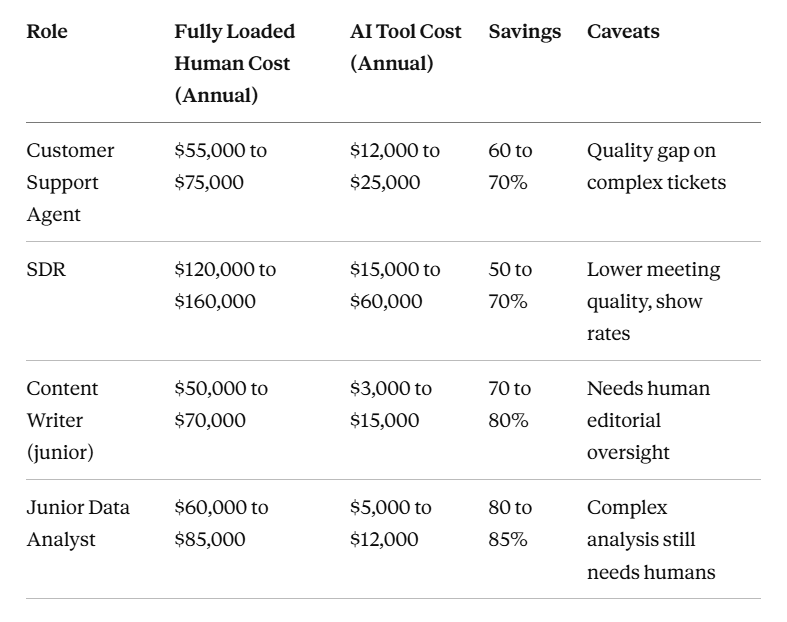
These numbers assume a US-based hire at market rate. For companies hiring internationally, the human cost drops significantly, which changes the math on whether the tools are worth the trade-off.
One number that deserves attention from the SDR data: AI SDR tools churn at 50 to 70% annually, roughly double the turnover rate of the human reps they are designed to replace. High tool churn means you are re-evaluating, re-onboarding, and re-training your AI stack constantly. That has a real operational cost that does not appear on the pricing page.
The Hybrid Model: What Actually Works in Practice
The cleanest lesson from 2026's data is that the binary choice between "hire humans" and "replace with AI" is a false one. The companies producing the best results are running hybrid models.
The highest-performing approach is human-in-the-loop AI, where AI handles research, signal monitoring, and draft generation while humans provide judgment, approval, and authentic engagement. Users of this model report productivity gains equivalent to 5 to 6 times, meaning one rep with AI produces the output of five or six reps without it, while maintaining quality.
That 5 to 6 times multiplier is the right framing for how to think about AI in your team. Not "how do I replace this person" but "how do I make this person worth five."
The roles where hybrid models work best:
One SDR with Clay, an AI sequencing tool, and a good ICP produces the pipeline that previously required three SDRs. The remaining two headcount budgets can go toward an AE who can close what the augmented SDR generates.
One support agent with Intercom Fin handling tier-1 queries can manage a ticket volume that previously required three agents. The freed capacity goes toward high-value accounts and complex escalations that actually move retention metrics.
One content strategist with Claude for first drafts and Surfer for optimisation produces 3 to 4 times the content output of one writer doing everything manually.
The principle is consistent: AI absorbs the volume, humans deliver the judgment.
The Governance Problem Nobody Talks About
There is a risk in aggressive AI deployment that most guides skim past.
As adoption of AI-enabled apps accelerates, risks around data exposure, compliance, and shadow AI grow. 84% of IT leaders trust AI agents as much as or more than humans for effective performance, but only 31% of employees are enthusiastic about it.
For a SaaS founder deploying AI into customer-facing roles, the governance questions are not optional:
Data handling: What customer data is the AI tool processing? Where does it go? Who can see it? For SaaS companies in regulated industries, finance, healthcare, legal, the cost of non-compliance with data protection rules dwarfs the cost of any tool.
Brand risk: AI agents operating under your domain and sending emails or chat messages as your company are brand touchpoints. A hallucinated product claim, a wrong price, an inappropriate tone at the wrong moment. These are incidents, not edge cases. They happen. You need review processes before you go fully autonomous.
Quality decay: AI-generated content and support responses degrade in quality if you stop reviewing them. Your documentation gets stale, your model starts hallucinating details that were true six months ago, and the quality problems are invisible until a customer complains loudly.
The answer is not to avoid AI tools. The answer is to build the governance layer before expanding scope. Set review checkpoints. Track quality metrics alongside efficiency metrics. Do not optimise only for ticket deflection rates or email send volume. Track customer satisfaction, repeat contact rates, and close rates on AI-influenced pipeline.
A Framework for Deciding What to Automate
Before you replace a hire with a tool, run this five-question check:
1. Is the work high-volume and pattern-based? If yes, AI is likely a strong fit. If it requires judgment case-by-case, AI is a partial fit at best.
2. Can quality be measured objectively? If you can define what "good" looks like with a clear metric (CSAT score, meetings booked, ranking position), you can manage AI quality. If quality is subjective, you need a human in the loop to evaluate it.
3. What is the blast radius if the AI makes a mistake? A wrong meta description costs you a few clicks. A wrong legal claim in an enterprise support ticket could cost you a customer. Calibrate your autonomy level to the consequence of failure.
4. Does your documentation or knowledge base support it? Every AI tool that touches customers runs on what you have built for it. If your help docs are sparse, your data is messy, or your process is undocumented, AI will produce poor output regardless of how good the model is.
5. Is there a human review step in the workflow? The companies that have failed at AI deployment went fully autonomous too fast. Start with human review on every AI output. Remove the review step category by category as confidence builds.
What the Broader Market Is Telling You
The data from 2026 is not ambiguous on direction. Deloitte predicts that up to half of organisations will put more than 50% of their digital transformation budgets toward AI automation in 2026.
The SaaS companies that will have a structural cost advantage in two years are the ones building hybrid models now, not the ones waiting for the tools to get better before trying.
The SaaS industry is shifting from tools that support humans to AI-native apps and autonomous agents that execute work and own outcomes. The companies gaining the most from this shift are building internal agent capabilities: prompt libraries, MCP server connections, workflow templates, and governance frameworks.
That last point is worth sitting with. The competitive advantage is not in which tool you buy. It is in how deeply you integrate it, how well you govern it, and how quickly you iterate on what it produces. Two companies can use the same Intercom Fin setup and get wildly different results based on documentation quality alone.
The Honest Summary: What AI Replaces, What It Does Not
Replaced or significantly reduced:
Tier-1 customer support (50 to 70% of tickets)
High-volume, low-ACV outbound prospecting
Junior content writing for templated formats
Standard reporting and dashboarding for data analysis
Augmented but not replaced:
Mid-market SDR prospecting (human does strategy, AI does volume)
Content strategy and editorial direction
Customer success management for any account that matters
Technical roles where AI assists but humans lead
Not replaced at all:
Enterprise sales and account management
Founders, product leaders, and general decision-making
Engineering leadership and architecture
Any role where customer trust is the product
The founder who understands this distinction will make better decisions than the one trying to replace every hire, and better decisions than the one refusing to use these tools at all.
The goal is not to have fewer people. The goal is to have the right people doing the right work, supported by tools that handle the volume they should not have to touch.
FAQs: What Founders Are Searching For
1. Can AI tools completely replace a full-time customer support team in SaaS?
Not completely. AI handles 50 to 70% of tier-1 support tickets well. Complex cases, high-value customers, and any interaction requiring real judgment still need human agents. Klarna's experience of reversing course after full replacement is the clearest evidence that full automation at the support level damages customer experience. The right model is hybrid: AI absorbs volume, humans manage escalations and high-value accounts.
2. Is an AI SDR worth buying instead of hiring a sales development rep?
For most SaaS companies, AI SDRs work best alongside humans rather than instead of them. The cost advantage is real: AI SDRs cost roughly 70% less than a fully loaded human SDR. But meeting show rates are lower (52% vs 71%) and revenue per meeting is lower. If your average deal value is below $15,000 and your market is large, run a 90-day pilot. Above $50,000 ACV, augment your human SDR rather than replacing them.
3. What is the biggest risk of using AI to replace full-time SaaS hires?
Brand risk and quality decay. AI tools operating under your brand name can hallucinate details, produce generic output at scale, and degrade in quality if your documentation is not maintained. The second risk is the tool churn rate: AI SDR tools churn at 50 to 70% annually, meaning you are frequently re-evaluating and re-onboarding. Build review processes before expanding autonomy.
4. Which SaaS roles are safest from AI replacement in 2026?
Enterprise account executives, customer success managers for high-value accounts, engineering leaders, and founders. These roles require relationship building, complex judgment, trust, and ambiguity tolerance. AI is a useful supporting tool in all of them. It is not a replacement for any of them.
5. How much can a SaaS startup save by using AI tools instead of making full-time hires? On support, $40,000 to $60,000 per agent per year avoided or freed up. On an SDR role, $80,000 to $120,000 per year at the fully loaded comparison. On content writing, $35,000 to $55,000 per writer replaced by AI-assisted production. Savings depend heavily on your volume, your documentation quality, and how well you build the oversight layer around the tools.
Summary: The Principles That Actually Matter
AI replaces volume. Humans deliver judgment. Build your stack around that split.
Hybrid models consistently outperform full replacement. The evidence is consistent enough that full replacement should require a strong argument, not the other way around.
Quality governance is the difference between AI deployment that works and AI deployment that damages your brand.
Start with human review on all AI outputs. Expand autonomy only where quality metrics are green.
The cost savings are real but they require investment: in documentation, in oversight, in iteration. Passive deployment produces passive results.