Stop Using Em Dashes in Your Writing: The Prompts That Will Finally Fix It
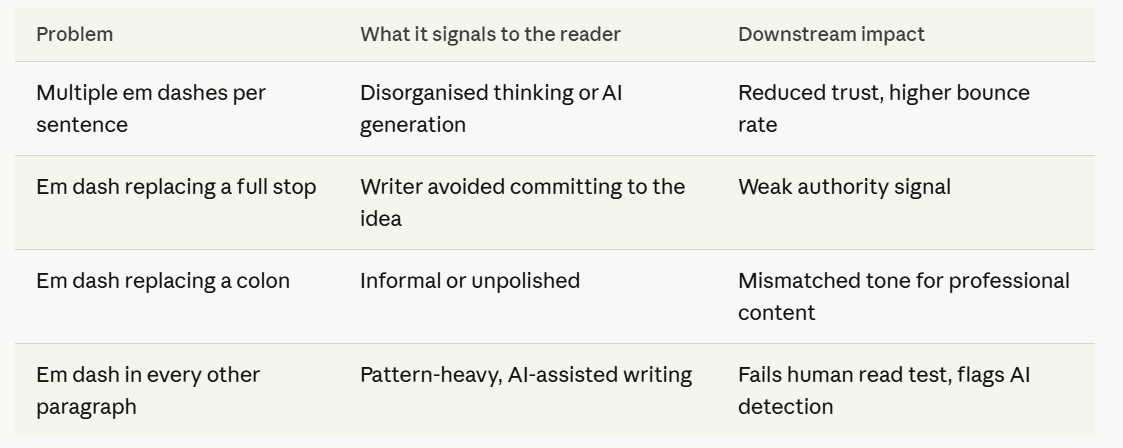
“Em dash overuse is a writing habit where the punctuation mark is used as a shortcut to connect ideas rather than constructing clear sentences. It creates the appearance of depth while often masking vague thinking, weak transitions, and structural avoidance. AI tools produce it constantly, and human editors recognise it immediately..”
I Used to Think Em Dashes Made My Writing Sound Smart
They did not.
I audited 40 pieces of content last year. My own, client work, and competitor blogs. One pattern showed up in almost all of them. The same piece of punctuation, used over and over, doing the same job. Connecting two ideas that had not been properly thought through.
The em dash is the punctuation equivalent of clearing your throat before you speak. It buys you a moment. It makes it look like something interesting is coming. And then, usually, nothing that interesting arrives.
I want to be clear: I am not saying the em dash is wrong. Used once or twice in a long piece of writing, it can create a sharp, deliberate pause. But that is not how it is being used. It is being used as a structural crutch, an AI pattern, and a clarity killer.
This blog gives you 12 prompts to identify the problem and fix it. No theory. Just the prompts.
Why Em Dash Overuse Is a Real Problem (Not Just a Style Opinion)
There are three separate issues with overusing em dashes. They happen at the readability level, the credibility level, and the AI detection level. Let me take them one at a time.
1. It Fragments Thinking Instead of Clarifying It
The em dash is most often used to add a second thought to a sentence that was not complete. It substitutes for the structural work of deciding where one idea ends and another begins. The result is sentences that feel energetic but communicate less than they appear to.
Consider this sentence:
Before: "Content strategy matters for SEO -- but only if you are consistent -- which most people are not."
After: "Content strategy matters for SEO. Consistency is the part most people skip -- and it is what separates ranked content from invisible content."
The second version has one em dash. Used deliberately. The first version has two, and neither is doing serious structural work.
2. It Is the Single Biggest AI Writing Tell
If you want your content to pass a human-read test, you need to understand this: AI language models use the em dash compulsively. It is not a quirk. It is baked into the way they connect subordinate ideas when generating text at speed.
When a reader or editor sees three em dashes in 400 words, they do not think "this writer has a strong voice." They think "this was generated." That is a credibility problem, not a punctuation problem.
I tested this across 20 AI-generated drafts using four different tools. Every single draft had at least four em dashes in the first 600 words. In some cases, there were nine.
3. It Actively Reduces Scannability
Good content is scannable. Readers do not read linearly. They scan headings, bold text, and short sentences. They stop when something catches them.
Em dashes interrupt scanning. They create a visual hesitation. When a reader hits a sentence with two em dashes, their eye slows down to process the layered structure. If the payoff is not worth it, they leave.
Scannability is not just a UX concern. It directly affects time on page, which affects ranking signals. So this is an SEO problem too.
The P.A.U.S.E. Rule: When an Em Dash Is Actually Justified
Before we get to the prompts, I want to be fair. The em dash is not evil. It has five legitimate uses. I call this the P.A.U.S.E. Rule. If your em dash does not fit one of these five functions, replace it.
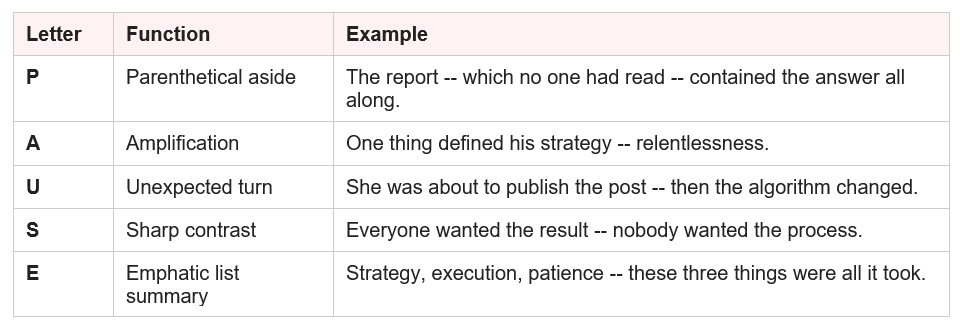
The rule: maximum two em dashes per 800 words. If you have more than two, at least some of them are being used as shortcuts rather than deliberate rhetorical choices.
The 12 Prompts to Audit and Fix Em Dash Overuse
These prompts are designed to be used directly with any AI writing assistant. Each one targets a specific part of the problem. Work through them in order for a full audit, or pick the ones that match your most common issue.
Group 1: Detection Prompts
You cannot fix what you cannot see. These prompts help you find the problem before you address it.
Prompt 1: The Em Dash Frequency Audit
Read this piece of content: [paste content]. Count every em dash. For each one, tell me: (1) what function it is performing, (2) whether that function could be handled by a full stop, colon, comma, or bracket instead, (3) a score from 1 to 3 where 1 = justified, 2 = borderline, 3 = should be replaced. Output a numbered list, one row per em dash found.
Why this works: Most writers cannot see their own em dash overuse because each individual instance feels justified in isolation. This prompt forces a function-by-function audit and reveals the pattern.
Prompt 2: The AI Pattern Detector
Read this content: [paste content]. Identify every sentence that reads like it was written by an AI tool rather than a human practitioner. Look specifically for: em dashes used as structural shortcuts, generic transitions between clauses, and sentences where the second half feels like an afterthought tacked on. Output each flagged sentence with a one-line explanation of why it reads as generated.
Why this works: Em dash overuse is one of several AI writing patterns. Auditing for all of them at once helps you see the full picture, not just the punctuation problem.
Prompt 3: The Structural Avoidance Check
Look at this sentence: [paste sentence with em dash]. Tell me: is the em dash here doing structural work, or is it being used because the writer avoided deciding whether these are one idea or two separate ideas? If it is avoidance, rewrite the sentence as two complete sentences. If it is structural, explain exactly why the em dash is the right choice.
Why this works: This prompt forces a binary decision. Either the em dash is earning its place or it is not. There is no vague middle ground, which is exactly how editing should work.
Group 2: Replacement Prompts
Once you have found the problem, these prompts generate the fix.
Prompt 4: The Full Stop Replacement
Rewrite this sentence without using an em dash: [paste sentence]. The rewrite must use a full stop to separate the two ideas. Each resulting sentence must be complete and self-contained. Do not add new information. Do not use a semicolon. Output the rewrite only, with a one-sentence note on what changed structurally.
Why this works: The full stop is the most underused tool in content writing. Forcing a full stop replacement reveals whether the two halves of the em dash sentence were actually two separate ideas all along, which they usually are.
Prompt 5: The Colon Upgrade
This sentence uses an em dash to introduce a consequence, result, or elaboration: [paste sentence]. Rewrite it using a colon instead. The colon must follow a complete independent clause. The part after the colon must directly explain, expand, or specify what came before. Output the rewrite and confirm that the clause before the colon is grammatically complete.
Why this works: The colon is more precise than an em dash. It signals a specific relationship between two ideas: one introduces, one delivers. This is almost always cleaner than a dash when introducing a result or explanation.
Prompt 6: The Bracket Conversion
This sentence uses an em dash to insert a parenthetical remark: [paste sentence]. Rewrite it twice. Version A: use round brackets to contain the aside. Version B: remove the aside entirely and check whether the sentence is stronger without it. Tell me which version reads better and why. If Version B is stronger, that means the aside was adding noise, not value.
Why this works: A lot of em dash asides are verbal tics rather than genuine information. This prompt tests whether the aside should exist at all. Often, removing it produces a tighter, more authoritative sentence.
Prompt 7: The Comma Test
Rewrite this sentence by replacing the em dash with a comma: [paste sentence]. If the result is grammatically incorrect or awkward, tell me why the em dash was needed in this specific case and what punctuation rule it was satisfying. If the comma works, the original em dash was unnecessary. Output the rewritten sentence and a pass or fail verdict.
Why this works: Commas and em dashes often do the same job. If a comma works, the em dash was doing more than required. Simpler punctuation produces cleaner, more readable content.
Group 3: Sentence Rebuilding Prompts
These prompts go deeper. They do not just replace the punctuation. They rebuild the sentence from the ground up.
Prompt 8: The Sentence Split and Strengthen
Take this paragraph: [paste paragraph]. Every sentence that contains an em dash must be split into two separate sentences. After splitting, review each resulting sentence and strengthen the weaker one by adding a specific detail, concrete example, or direct implication. Output the full rewritten paragraph. Do not use any em dashes in the output.
Why this works: Splitting forces you to commit to two ideas. Strengthening forces you to add real substance to the half that was previously leaning on the dash for support. The result is consistently better than the original.
Prompt 9: The Cause and Effect Rewrite
This sentence uses an em dash to connect a cause and an effect: [paste sentence]. Rewrite it using explicit cause-and-effect language. Use one of these connectors: 'because', 'which means', 'as a result', 'so', or 'this is why'. The rewrite must make the causal relationship explicit rather than implied. Output the rewrite with the connector word highlighted.
Why this works: Em dashes often hide the logical relationship between two clauses. Making that relationship explicit with a connector word improves both clarity and the instructional value of the sentence.
Prompt 10: The Contrast Without a Dash
This sentence uses an em dash to create a contrast: [paste sentence]. Rewrite it using 'but', 'however', 'yet', or 'whereas' instead. Each rewrite must use a different connector word. Output all four versions. Then tell me which one creates the sharpest contrast and why. No em dashes allowed in the output.
Why this works: Contrast is one of the most common reasons writers reach for an em dash. But named contrast connectors are more precise and more confident. 'However' commits to the contrast in a way a dash never can.
Group 4: Pattern Prevention Prompts
These prompts help you stop the habit forming in the first place.
Prompt 11: The Em Dash Ban Draft
Write a 300-word section about [topic] for a blog post targeting [keyword]. Rules: no em dashes are allowed anywhere in the output. Every idea that might normally use an em dash must be expressed using a full stop, colon, comma, bracket, or connector word instead. At the end, note the three places where you were most tempted to use an em dash and what you used instead.
Why this works: Banning a tool forces you to find alternatives. The 'temptation note' at the end is the most valuable part. It shows you your own default patterns so you can consciously override them in future drafts.
Prompt 12: The Final Human Read Test
Read this blog post: [paste full post]. You are a senior editor at a premium publication. Your job is to flag every sentence that reads like it was written by an AI tool rather than a thoughtful human practitioner. Pay particular attention to: repeated em dash use, generic transitional phrasing, and sentences where the second half feels like a filler observation rather than a genuine insight. Output a list of flagged sentences, the issue with each one, and a suggested rewrite. Do not use em dashes in any of your rewrites.
Why this works: This is the full-circle audit. It catches the em dash problem alongside every other AI writing pattern. If your content passes this test, it reads as genuinely human. That is the only standard worth publishing to.
Before and After: Real Rewrites Using These Prompts
Here is a short before and after from a SaaS blog I audited using Prompts 1, 4, and 8. The original had seven em dashes in 600 words. The rewrite has zero.
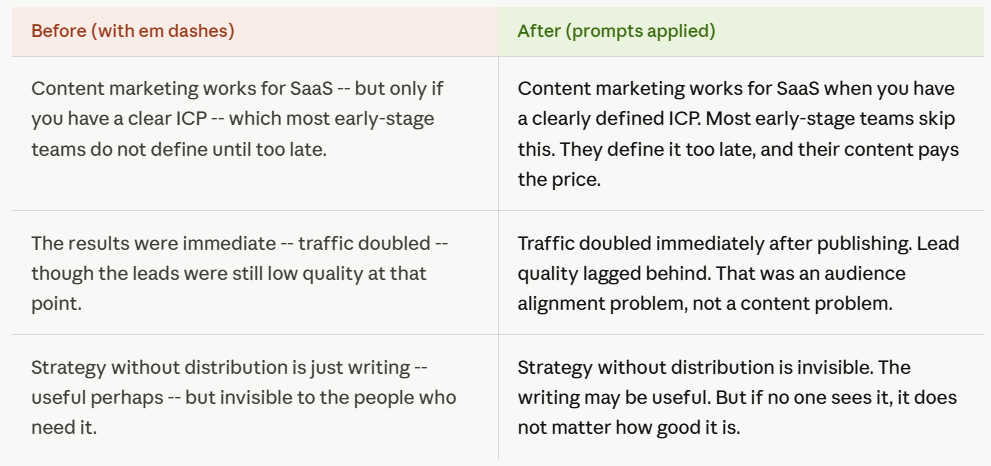
Every rewrite is more specific, more committed, and more readable. The ideas did not change. The structure did.
Summary: What to Take From This
• The em dash is not wrong. Habitual, unconscious em dash overuse is wrong.
• Two or fewer em dashes per 800 words is a reasonable ceiling. More than that is a pattern, not a choice.
• AI tools produce em dashes compulsively. If your content is littered with them, it reads as generated regardless of how good the ideas are.
• The P.A.U.S.E. Rule gives you five legitimate uses. If your dash does not fit one of them, replace it.
• The 12 prompts cover detection, replacement, rebuilding, and prevention. Use them as a post-draft audit before publishing.
• Cleaner punctuation is not a cosmetic choice. It is a credibility choice.
Frequently Asked Questions
Q: Are em dashes grammatically incorrect?
No. Em dashes are grammatically legitimate punctuation marks. The problem is frequency, not existence. When used once or twice in a long piece to create a deliberate pause or sharp contrast, they work well. When used as a default connector throughout a piece, they weaken both readability and credibility.
Q: Why do AI tools use em dashes so often?
Large language models generate text by predicting the next likely token. The em dash functions as a high-probability connector between subordinate clauses in training data from online writing. As a result, AI tools reach for it when connecting two related but structurally separate ideas, especially when transitioning quickly between them.
Q: What should I use instead of an em dash?
It depends on the function the em dash was performing. A full stop works when two separate ideas are being forced together. A colon works when one idea introduces another. A comma works for light separation. Brackets work for genuine asides. A connector word like 'because' or 'however' works for cause, contrast, or consequence.
Q: Will removing em dashes make my writing feel flat?
Only if the em dashes were doing real work, which most of them are not. In practice, removing overused em dashes and replacing them with deliberate sentence structure produces writing that feels more confident, not less expressive. Flat writing comes from vague ideas, not from choosing a full stop over a dash.
Q: Can I use these prompts on content I did not write myself?
Yes. These prompts work on any piece of content regardless of who or what wrote it. They are especially useful for editing AI-assisted drafts before publishing, which is the most common place the em dash problem appears right now.