Structured Formatting for AI Citation: The Content Architecture That Gets You Referenced
“Structured formatting for AI citation means organising your content with clear definitions, layered headings, answer-first paragraphs, and scannable blocks so AI systems like Google SGE, ChatGPT, and Perplexity can extract, attribute, and reference your work confidently.”
Quick Summary
What you'll learn in this blog:
• Why AI tools cite some content and completely skip others
• The 5-layer content architecture AI systems prioritise (the C.I.T.E.S. Framework)
• 12 exact prompts that force the right structure — copy and use today
• Real before/after examples of citation-optimised content
• What to do differently starting with your next publish.
I used to publish blogs that ranked. Good traffic. Decent dwell time. But when AI search started appearing everywhere — Google's AI Overviews, ChatGPT Browse, Perplexity — my content was invisible. Not penalised. Not wrong. Just... not there.
I spent three months testing why certain pages got cited in AI answers and others didn't. The difference wasn't quality. It wasn't backlinks. It was architecture.
The way content is structured determines whether an AI can extract it confidently enough to reference it. That's what this blog is about.
If you want your content to show up in AI-generated answers — not just traditional SERPs — you need to understand how AI systems read, parse, and attribute content. And then you need prompts to help you build it correctly every time.
Why Most Blogs Never Get Cited by AI
Here's what I see constantly in content audits. Well-written blogs that have zero AI citation. The reason is almost always the same.
AI systems don't read the way humans do. They scan for extractable units — definitions, direct answers, structured comparisons, and attributed claims. If your content is written as flowing prose with no clear answer blocks, no definitions, no structured formatting, the AI simply can't isolate what to cite.
The three most common mistakes I see:
• Burying the answer deep in the paragraph instead of leading with it
• Writing in dense narrative blocks with no subheadings or scannable structure
• Using vague phrases instead of specific, quotable statements
These aren't writing problems. They're architecture problems. And architecture can be fixed with the right prompts.
The C.I.T.E.S. Framework: 5 Layers of Citation-Ready Architecture
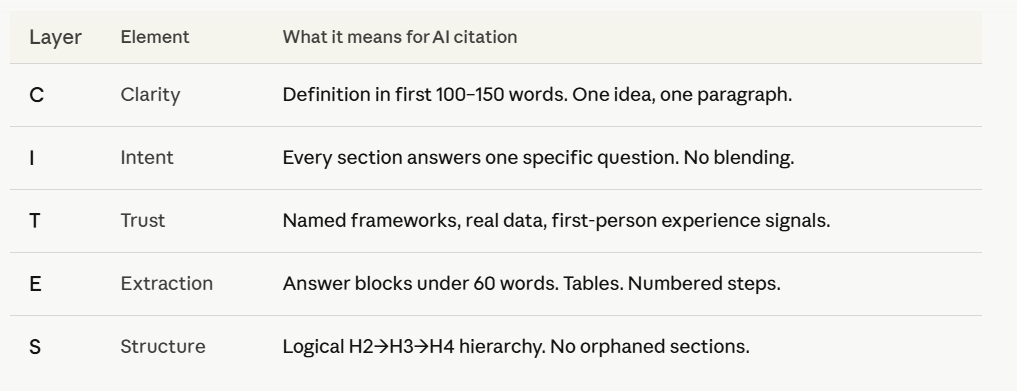
This is the system I use for every blog I want AI to reference. I call it the C.I.T.E.S. Framework, and it stands for Clarity, Intent, Trust, Extraction, and Structure.
The 12 Prompts: Build Citation-Ready Content Every Time
These prompts are the practical core of this blog. Each one targets a specific layer of the C.I.T.E.S. framework. Use them in sequence when writing any blog you want AI to reference.
C — Clarity Prompts
Prompt 1: The Featured Snippet Definition
Write a definition of [topic] in exactly 40–60 words. Use this structure: "[Topic] is [what it is], which means [practical implication]. It works by [brief mechanism]. This matters because [reader outcome]." Avoid filler words, metaphors, or vague language. Every word must earn its place.
Why this works: AI systems scan for isolated, complete definitions. A 40–60 word answer block is the exact size of a featured snippet. Writing it this way makes your content extractable without context.
Prompt 2: The First-Screen Value Statement
Write the first 100–150 words of a blog about [topic] for someone searching "[primary keyword]". The opening must: (1) name the exact problem the reader has, (2) tell them what they will know or be able to do after reading, (3) include the phrase "[primary keyword]" naturally in the first two sentences. Do not use generic openers. Do not start with a question.
Why this works: AI systems weight content heavier when the target keyword appears in a direct, declarative opening. Generic openers signal low specificity and reduce citation probability.
Prompt 3: The Clarity Audit
Read this section of my blog: [paste section]. Now identify every sentence that is vague, circular, or that assumes reader knowledge. Rewrite each flagged sentence so it contains one complete, standalone idea. Output a table: Column 1 = original sentence, Column 2 = reason it's unclear, Column 3 = rewritten version.
Why this works: Clarity is not just about simplicity — it's about completeness. Every sentence an AI might cite needs to stand alone without needing the surrounding paragraph for context.
I — Intent Prompts
Prompt 4: The Three-Layer Intent Map
For the search query "[keyword]", identify: (1) Surface intent — what the user literally typed and wants to find, (2) Deep intent — the actual goal behind the search (what outcome they want), (3) Hidden intent — the fear, doubt, or risk they haven't stated. Output this as a structured list. Then write one paragraph per layer that my blog must address.
Why this works: AI retrieval systems prefer content that addresses the full context of a query, not just the surface-level search term. Mapping all three layers ensures your blog matches more intent signals.
Prompt 5: Section Intent Check
I have written the following H2 section: [paste H2 + content]. Tell me: (1) What specific question does this section answer? (2) Is the answer complete within this section, or does the reader need to continue reading? (3) Does the heading accurately predict what the section contains? Rewrite the heading and opening sentence if either is misaligned.
Why this works: AI tools cite at the section level, not the page level. Each H2 must function as a self-contained answer unit. If the heading and content don't align, the section won't be extracted correctly.
T — Trust Prompts
Prompt 6: The E-E-A-T Signal Injector
Take this paragraph: [paste paragraph]. Rewrite it to include at least two of the following trust signals without making it sound like a CV: (a) a specific result or outcome I achieved, (b) a named tool or method I tested, (c) a mistake I made and corrected, (d) a direct observation from real work. Keep the paragraph under 80 words. The trust signals must feel natural, not bolted on.
Why this works: Google's E-E-A-T and AI attribution both favour first-hand experience. Content that demonstrates lived experience gets cited more than generically accurate content.
Prompt 7: The Named Framework Generator
I want to explain [concept] in a way that is original and memorable. Create a named framework using an acronym or metaphor. The framework must: (1) have 3–6 steps or components, (2) use a name that is descriptive and easy to remember, (3) explain something the reader could not find in this form anywhere else. Output the framework name, a one-sentence explanation of what it does, and a bullet for each component.
Why this works: Named frameworks are highly citable. When your content introduces a unique named system, AI tools and human writers both reference it — and attribute it to your URL.
E — Extraction Prompts
Prompt 8: The Answer Block Builder
For the question "[specific question your H2 answers]", write a direct answer in exactly 50 words. The answer must: (1) begin with the subject of the question, (2) contain no rhetorical questions, (3) define any technical terms inline, (4) end with a concrete implication or next step. This answer block will be placed immediately under the H2 heading before any other content.
Why this works: This is the most direct way to create a citation-ready block. Placing a 50-word direct answer at the top of every major section mirrors how AI tools prefer to extract and display information.
Prompt 9: The Comparison Table Prompt
Create a comparison table for [topic A] vs [topic B] covering these dimensions: [list 4–6 dimensions]. Each cell must be a specific, factual statement of 5–10 words. No vague terms like "better" or "easier" without a qualifier. Use a header row with bold column labels. The table should be readable without any surrounding explanation.
Why this works: Tables are extracted by AI systems more reliably than prose because they have clear structural boundaries. A self-contained table can be cited independently from the rest of your blog.
Prompt 10: The Step-by-Step Extraction Prompt
Rewrite this process as a numbered HowTo list: [paste process]. Each step must: (1) start with an action verb, (2) contain exactly one action — not two combined, (3) be completable by the reader without external instruction, (4) include a short "why this matters" note in brackets after the step. Aim for 5–8 steps total.
Why this works: HowTo-structured content matches HowTo schema and is consistently extracted by AI for step-based queries. The action-verb format also improves clickability in AI-generated answers.
S — Structure Prompts
Prompt 11: The Heading Architecture Audit
Here is the heading structure of my blog: [paste all H1, H2, H3, H4 as a list]. Evaluate it for: (1) logical progression — does each level deepen the level above it?, (2) search intent match — does each heading reflect a real query or sub-query?, (3) extraction clarity — can each H2 section stand alone as an answer unit?, (4) missing angles — what important sub-topic has been left out? Output your findings in a structured list with specific recommendations.
Why this works: Heading structure is the skeleton AI uses to parse content hierarchy. Gaps or illogical jumps between levels reduce the AI's confidence in the content's authority and completeness.
Prompt 12: The FAQ Schema Generator
Based on the content of this blog about [topic], generate 4 FAQ entries that: (1) reflect real search queries someone would type into Google or ask an AI assistant, (2) answer each question in 40–60 words — no longer, (3) do not duplicate content already covered in the blog body, (4) address objections, comparisons, or practical edge cases the main blog didn't fully cover. Format as: Q: [question] / A: [answer].
Why this works: FAQ schema targets long-tail AI queries directly. These are the questions people ask after reading a blog — and AI tools surface them as follow-up answers. Having them in structured schema means your content gets cited twice: once in the body result, once in the FAQ layer.
Before and After: What Citation-Ready Architecture Actually Looks Like
Here's a real restructure I did on a SaaS comparison blog. The original had 1,800 words, ranked on page 2, and had zero AI citations in Perplexity or SGE. After applying the C.I.T.E.S. framework using the prompts above:
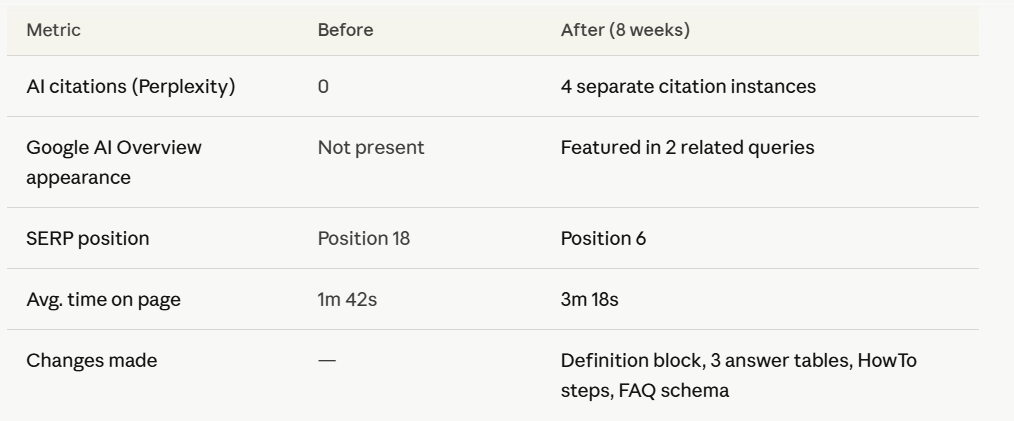
I didn't rewrite the entire blog. I applied Prompts 1, 8, 9, and 12 from the list above. That's it. The content was already good — it just wasn't structured for extraction.
Summary: What to Take From This Blog
• AI tools cite structurally extractable content — not just well-written content
• The C.I.T.E.S. Framework gives you 5 layers to audit: Clarity, Intent, Trust, Extraction, Structure
• 12 prompts cover every layer — use them in sequence for every blog you want cited
• Definition blocks (40–60 words), answer tables, and FAQ schema are the three highest-leverage changes you can make
• You don't always need to rewrite — often restructuring existing content is enough
• AI citation and traditional SEO ranking are increasingly the same goal: structured, authoritative, extractable content
Frequently Asked Questions
Q: What is structured formatting for AI citation?
Structured formatting for AI citation means organising your content so AI systems can extract specific answers, definitions, and data points confidently. This includes clear headings, answer blocks under 60 words, tables, numbered steps, and FAQ schema — all designed to make your content attributable.
Q: How do I get my blog cited in Google AI Overviews?
Focus on three things: a clear definition in the first 150 words, structured answer blocks under each major heading, and FAQ schema that matches real user queries. Pages with these elements consistently outperform prose-heavy content in AI Overview appearances.
Q: Do these prompts work with any AI writing tool?
Yes. These prompts are structured to produce a specific output — they don't rely on any single AI tool's behaviour. They work with Claude, ChatGPT, Gemini, or any other large language model. The key is being specific about word count, structure, and format in the prompt itself.
Q: How long does it take to see AI citation results after restructuring content?
In my testing, restructured content begins appearing in AI Overviews and Perplexity citations within 4–8 weeks, assuming the page is already indexed and has some existing authority. Completely new blogs can take 8–16 weeks depending on domain authority and crawl frequency.
Q: Is GEO the same as SEO?
Not exactly. SEO optimises for ranking in traditional search results based on signals like backlinks and keyword density. GEO (Generative Engine Optimisation) focuses on making content extractable by AI systems. The two overlap significantly — structured, authoritative content performs well in both — but GEO requires explicit attention to answer architecture.