The Invisible Search Layer: How AI Overviews, ChatGPT, and Perplexity Are Eating Your Traffic
Quick Summary
AI Overviews, ChatGPT, and Perplexity now intercept search traffic before users click. Zero-click results are increasing across informational and commercial queries. Most content fails to appear in AI-generated answers because it lacks structure and clarity. The fix is not more content; it is better-structured, prompt-optimised content.
This blog gives you ready-to-use prompts to audit, optimise, and track your AI search visibility.
You check Google Search Console on a Monday morning and notice something unsettling. Impressions are holding steady. Rankings look fine. But clicks? They have quietly fallen off a cliff.
No algorithm penalty. No technical fault. Nothing you did wrong.
What happened is something most SEOs and content marketers are still catching up to: there is now an invisible layer sitting between your content and your audience. It is called AI search, and it includes Google's AI Overviews, ChatGPT's browse and search features, and Perplexity's answer engine.
These tools do not send users to your website. They read your content, extract the answer, and deliver it directly without a click.
This is not a future problem. It is happening right now, and it is reshaping how search traffic works at a fundamental level.
What Is the Invisible Search Layer?
The invisible search layer is the collective ecosystem of AI-powered tools that intercept a user's query, generate a synthesised answer from multiple sources, and present it without requiring a click to any individual website.
The three primary players right now are:
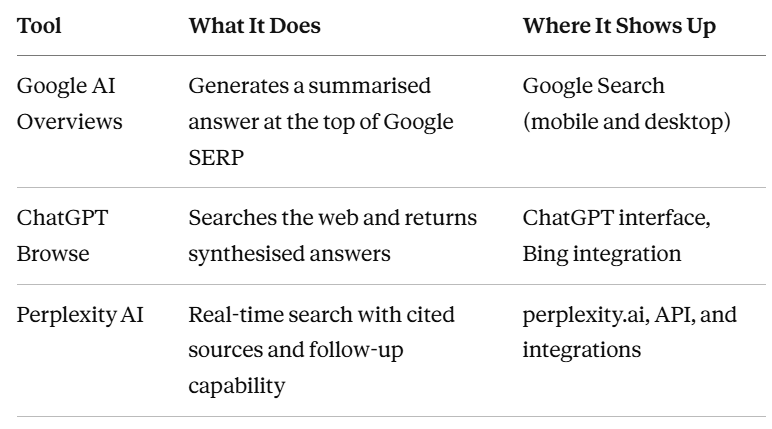
Each of these tools is pulling from your content and in many cases, giving away the answer you worked hard to produce.
Why Most Content Is Invisible to AI Search
Here is the uncomfortable truth I had to face when I audited my own content cluster last quarter: most content is written to rank on Google's ten blue links. It is not written to be extracted, cited, or surfaced by an AI system.
AI engines have a very different standard for what makes content useful. They are not looking for the longest post or the one with the most backlinks. They are looking for content that:
Answers a specific question clearly in the first 100–150 words
Uses structured formatting (definitions, lists, tables, headers)
Contains demonstrable expertise through first-person signals or cited data
Matches the exact language a user is likely to query in natural or conversational form
If your content does not meet these criteria, it will not be cited. It will not appear. And the traffic loss you are experiencing right now will continue to worsen as AI search adoption grows.
According to SparkToro and Datos research, zero-click searches on Google already account for nearly 60% of all queries. That number climbs higher when you factor in AI-generated answer layers on top of standard results.
The Three Layers of Search Intent You Must Address
Before I get into the prompts, there is a framework I use for every piece of content I create. I call it the Three-Layer Intent Stack.
Layer 1 — Surface Intent: What the user literally typed. Example: "AI Overviews traffic loss."
Layer 2 — Deep Intent: What they actually want to achieve. Example: They want to understand why their traffic dropped and what to do about it.
Layer 3 — Hidden Intent: The fear or doubt behind the query. Example: They are worried their entire SEO strategy is now obsolete and they have wasted months of work.
AI search engines are designed to satisfy all three layers simultaneously. Your content needs to do the same, or it will be outperformed by content that does.
The Prompt-First System for AI Search Visibility
This is the part most content guides skip entirely. Instead of giving you generic advice about "structured content" and "clear definitions," I am going to give you the exact prompts I use — and the ones you should be using — to diagnose, optimise, and track your visibility across AI search engines.
Think of this as the PROMPT → AUDIT → OPTIMISE → MONITOR framework.
Stage 1 — Discovery Prompts: Find Out What AI Is Already Saying About Your Topic
Before you write or rewrite anything, you need to know how AI is currently answering your target queries.
Use these prompts directly in ChatGPT, Perplexity, and Google's AI Overview (by searching the query and observing the result):
Prompt 1.1 — Baseline Answer Audit
"What is [your primary keyword]? Give me a clear, concise explanation with the key points a beginner needs to understand."
Use this to see what answer the AI surfaces by default. Compare it to your current content. If your content does not match the structure or depth of the AI's answer, that is your gap.
Prompt 1.2 — Source Attribution Check
"Which websites or sources are considered most authoritative on [your topic]? Why are they trusted?"
This prompt reveals which domains AI tools treat as credible. If your domain does not appear, that tells you something important about your authority signals.
Prompt 1.3 — Competitor Intelligence
"Summarise the main arguments made by the top articles on [your topic]. What do they agree on, and what are the gaps?"
Use this to identify exactly what AI is extracting from competing content — and where the gaps are that you can own.
Prompt 1.4 — Query Variant Discovery
"Give me 20 different ways someone might search for information about [your topic], ranging from beginner to advanced."
This surfaces long-tail variants, conversational queries, and question-based searches you may not have considered. These are the exact prompts your audience is using in ChatGPT and Perplexity.
Stage 2 — Content Audit Prompts: Find Out Why Your Content Is Not Being Cited
These prompts help you reverse-engineer the AI citation logic so you can identify what is preventing your content from appearing.
Prompt 2.1 — Clarity Stress Test
"Read this content and tell me: does it clearly answer [primary keyword] within the first 150 words? If not, what is missing or unclear?"
Paste your existing content directly into the prompt. This gives you an instant structural critique from the AI's own perspective.
Prompt 2.2 — Structured Answer Check
"Does this content include a clear definition, a step-by-step explanation, and a concise summary that could be used as a featured snippet answer? What would you improve?"
AI engines extract content that fits a specific format. This prompt tells you whether your content meets that format.
Prompt 2.3 — E-E-A-T Signal Review
"Does this content demonstrate first-hand experience, expertise, authoritativeness, and trustworthiness? What signals are present or missing?"
Google's AI Overview and other engines weight content with strong E-E-A-T signals more heavily. This prompt surfaces exactly where those signals are weak.
Prompt 2.4 — Semantic Gap Finder
"What related terms, entities, and subtopics would a comprehensive guide on [your topic] need to include that this content is missing?"
This is one of my most-used prompts. It identifies semantic gaps that prevent your content from being treated as a complete, authoritative resource on a topic.
Stage 3 — Optimisation Prompts: Rewrite and Restructure for AI Retrieval
Once you have your audit, use these prompts actually to improve the content.
Prompt 3.1 — Featured Snippet Block Generator
"Write a featured snippet answer for the query '[primary keyword]' in exactly 40–60 words. It must be clear, direct, and structured as a definition followed by a key point."
Use the output of this prompt as your blog's opening answer block — the paragraph that appears immediately after your H1. This is the highest-impact structural change you can make.
Prompt 3.2 — Introduction Rewrite for Time-to-Value
"Rewrite this introduction so that a reader gets a clear, useful insight or answer within the first 100 words. Maintain a first-person voice and avoid generic filler phrases."
Paste your current introduction. Use the rewrite as a foundation and then layer in your own voice and experience.
Prompt 3.3 — FAQ Schema Generator
"Generate 5 FAQ questions and answers for the topic '[your topic]'. Each answer must be 40–60 words, written in natural language, and address a real question a user would type into a search engine or AI tool."
These questions should go at the end of your blog under an FAQ section and be implemented using FAQ schema markup in JSON-LD format.
Prompt 3.4 — Table Builder for Structured Comparison
"Create a comparison table for [your topic] that covers [X variables]. Include columns for [insert relevant comparison points]. Make it scannable and easy to understand."
Tables are one of the most consistently extracted content formats across AI engines. Every blog should have at least one.
Prompt 3.5 — Semantic Coverage Expander
"I am writing a blog about [your topic]. List all the related entities, synonyms, subtopics, and supporting concepts that a semantically complete article on this topic should address."
Run through this list and identify which items are missing from your content. Add them naturally — not as a keyword dump, but as genuine extensions of the topic.
Prompt 3.6 — Engagement Hook Generator
"Write 5 pattern-interrupt lines I can use as subheadings or pull-quotes throughout a blog about [your topic]. Each should be surprising, direct, or challenge a common assumption."
These short, punchy lines improve time on page and serve as scroll triggers — structural signals that AI engines interpret as engagement indicators.
Stage 4 — Monitoring Prompts: Track Your AI Visibility Over Time
Ranking in AI search is not a one-time fix. These prompts help you monitor your position and respond to changes.
Prompt 4.1 — Citation Check
"If you were to answer the question '[your target query]' using web sources, which websites would you cite and why?"
Run this monthly in Perplexity and ChatGPT. Track whether your domain is cited, how frequently, and in what context.
Prompt 4.2 — Competitor Advancement Alert
"Compare the top three articles on [your topic]. Which one provides the most complete, trustworthy, and clearly structured answer? What makes it better than the others?"
If a competitor's content starts appearing in the AI's answer while yours does not, this prompt will tell you exactly what they are doing differently.
Prompt 4.3 — Content Decay Detector
"Is the information in this article about [your topic] still accurate and up to date? What has changed in the last 12 months that this content does not address?"
Run this every 60–90 days on your highest-traffic pages. Update based on the gaps identified.
A Real-World Example: What Happened When I Audited My AI SEO Cluster
Last year I ran a full audit of a content cluster I had built around AI SEO. The cluster had 14 blogs, solid backlinks, and reasonable rankings. But traffic was declining slowly despite no ranking drops.
When I ran Prompt 2.1 on my top-performing blog, the AI told me clearly: the first 150 words did not answer the primary query. They introduced the topic. They teased the answer. But they did not deliver it.
I rewrote the opening of six blogs in the cluster using Prompt 3.2. I added featured snippet blocks using Prompt 3.1. Within 45 days, two of those blogs were cited in Perplexity results, and one appeared in a Google AI Overview.
Traffic did not explode. But it stabilised — and more importantly, I started seeing referral traffic from Perplexity for the first time. That is a channel that did not exist in my analytics twelve months earlier.
The fix was not more content. It was better-structured content that AI engines could actually read, trust, and cite.
Who This Is For — and Who It Is Not
This is for you if:
You are a content strategist, SEO, or founder managing a content-led growth strategy
You have noticed declining click-through rates despite stable impressions
You want to build visibility in AI-generated answers, not just traditional search
You are already publishing consistently and want to optimise what you have
This is not for you if:
You are looking for a shortcut to avoid writing substantive content
You expect AI search to replace a proper keyword and cluster strategy
You want a one-time fix rather than a system you will maintain and improve
Key Takeaways
AI Overviews, ChatGPT, and Perplexity now intercept search traffic before the click happens
The invisible search layer is not coming — it is already here and affecting your analytics
Most content is invisible to AI engines because it lacks clear structure and upfront answers
The Three-Layer Intent Stack (surface, deep, hidden) must guide your content strategy
The PROMPT → AUDIT → OPTIMISE → MONITOR framework gives you a repeatable system
Discovery prompts reveal what AI is saying about your topic right now
Audit prompts identify exactly why your content is not being cited
Optimisation prompts generate featured snippets, FAQ schema, and semantic coverage
Monitoring prompts track your AI visibility over time so you can respond to changes
Better structure is more valuable than more volume in an AI-first search environment
FAQ
What are AI Overviews and how do they affect my website traffic?
AI Overviews are Google's AI-generated answer boxes that appear at the top of search results. They synthesise information from multiple sources and deliver an answer directly on the SERP. This reduces the need for users to click through to individual websites, which can lower your organic click-through rate even when your rankings remain stable.
Why is my Google Search Console showing impressions but fewer clicks?
This pattern — high impressions, declining clicks — is a classic indicator of zero-click search behaviour. It typically means your content is being seen in search results but users are getting their answer from an AI Overview, featured snippet, or other SERP feature before reaching your site.
How do I get my content cited in ChatGPT or Perplexity?
To be cited by AI tools, your content needs to answer questions clearly and early, use structured formatting such as definitions, tables, and lists, demonstrate expertise through first-person signals or cited data, and maintain a consistent presence on authoritative, crawlable pages with proper schema markup.
What is generative engine optimisation (GEO)?
Generative engine optimisation is the practice of structuring and writing content specifically to appear in AI-generated answers from tools like ChatGPT, Perplexity, and Google's AI Overviews. It builds on traditional SEO principles but prioritises clarity, structure, and semantic completeness over keyword density and link volume alone.
How often should I update my content for AI search visibility?
Content should be reviewed every 60–90 days. During each review, update any outdated statistics, improve underperforming sections, add new internal links, and use the monitoring prompts in this guide to check whether your content is still being cited in AI-generated answers.