What My Google Search Console Data Revealed About Content Intent
“Google Search Console reveals content intent mismatches through query reports, impression-to-click gaps, and position data. When queries driving impressions don’t match the content’s angle or depth, rankings plateau. Aligning your content to the real intent behind search queries — informational, commercial, or transactional — is the fix.”
For months, I told myself the same thing. The writing was good. The structure was solid. The keywords were in the right places. And yet, some posts sat at position 14 and never moved. Others climbed to position 6 and then just stopped — impressions but no clicks, traffic but no conversions.
I assumed it was a backlink problem. Then I assumed it was a technical issue. Then someone suggested I look more carefully at my query data in Google Search Console.
So I did. And what I found wasn't a backlink gap or a technical fault. It was a content intent problem — a systematic mismatch between what people were actually searching for and what my content was trying to do.
This post is a breakdown of exactly what I found, what it means, and the framework I built to fix it. If you've been producing content consistently and wondering why some pieces simply won't rank, this is likely the conversation you've been missing.
What Content Intent Actually Means
Let me define this clearly before we go any further.
Content intent — sometimes called search intent — is the underlying reason someone types a query into Google. It sounds straightforward, and in basic SEO tutorials it usually gets reduced to four boxes: informational, navigational, commercial, transactional.
But that's the surface version.
In practice, content intent has three layers, and most content writers are only working with the first one.
Layer 1 — Surface intent is what the user types. The query itself. "How to improve SEO rankings" is a surface intent signal.
Layer 2 — Deep intent is what they actually want to achieve. They don't just want to improve rankings. They want more organic traffic, more leads, more revenue. The query is a proxy for a real goal.
Layer 3 — Hidden intent is what they're afraid of, uncertain about, or trying to avoid. They might be worried they've already made mistakes. They might distrust advice that seems overly theoretical. They might be trying to decide whether to do this themselves or hire someone.
Most content addresses Layer 1. Some content addresses Layer 2. Very little content addresses all three — and that's exactly where the gap lives.
What Google Search Console showed me was that my content was answering Layer 1 questions with Layer 1 content, while the queries driving my impressions were signalling Layer 2 and Layer 3 needs. That's the mismatch. That's why the rankings were stuck.
Why Most Content Writers Get Intent Wrong
Here's the pattern I see consistently, and I say this as someone who has made this mistake repeatedly.
We pick a keyword. We check the search volume. We look at the top-ranking pages. Then we write something that broadly covers the same territory — maybe with a slightly different angle or a bit more depth.
The issue isn't the writing itself. The issue is that we're reverse-engineering the content that's already ranking without asking why it's ranking. We're copying the surface behaviour of successful content without understanding the intent it's genuinely serving.
There's also a second mistake that's subtler and harder to catch.
Intent can shift within a single keyword cluster. "Content intent" might be searched by someone who wants a definition, someone who wants to audit their existing blog, someone who is deciding between two content strategies, and someone who is trying to diagnose why their traffic dropped. Same keyword cluster. Completely different intent layers. One piece of content cannot serve all of those users equally well — and if you try to make it do everything, it often ends up doing nothing particularly well.
Google has become remarkably good at detecting this. A page that tries to serve too many intents, or the wrong intent, tends to get filtered out in favour of content that more precisely matches what the searcher actually needs.
This is what the data confirmed for me.
What I Found in My GSC Data
I want to be specific here because vague revelations are not useful.
I exported twelve months of data from Google Search Console across my core content cluster. I looked at three reports: the Performance report filtered by queries, the Performance report filtered by pages, and the query-to-page mapping that shows which queries a specific page is ranking for.
What I found fell into three clear patterns.
Pattern 1: The Impression-Click Gap
Several pages had strong impression counts — sitting between 800 and 2,400 impressions per month — but click-through rates below 1.5%. In raw terms, that meant pages that Google was actively showing to users, but that users were choosing not to click.
The usual explanation for a low CTR is a weak meta title or description. And yes, that's sometimes the cause. But when I looked more carefully at the specific queries driving those impressions, I noticed something else.
The queries were transactional or commercially investigative. Terms like "best content strategy for SaaS", "hire content strategist", "content writer SEO results". But the meta titles and descriptions I had written were informational in tone. Definitions, explanations, "how-to" framing.
The mismatch was visible in the snippet. Someone searching with buying intent was being shown a snippet that read like a guide. Of course they weren't clicking. The content was clearly not for them — at least, not in the way I had presented it.
Pattern 2: Query Clusters That Didn't Match My Content
This was the more uncomfortable finding.
When I looked at which queries individual pages were ranking for, several pages were ranking for queries that I had never intended to target — and doing reasonably well for them. Meanwhile, the primary keyword I had tried to rank for was barely registering.
One post I had written about AI search and landing pages was picking up ranking signals for queries about technical on-page SEO, schema implementation, and structured content for featured snippets. That was not the primary focus of the post. But those were the sections where I had gone deepest — specific examples, step-by-step explanations, real decisions and trade-offs.
The post I had tried to rank for "AI SEO for landing pages" was picking up traction for supporting queries I hadn't even thought about consciously.
What that told me was that Google was reading the actual depth and intent-alignment of each section of my content independently — and rewarding the sections where my intent-matching was strongest, even if they weren't the headline topic.
Pattern 3: Ranking Traffic With Zero Conversion Behaviour
The third pattern was the most useful one for understanding how BOFU intent was failing me.
Several posts were driving consistent, predictable monthly traffic. Not huge numbers, but stable. Yet when I looked at behaviour flow — the journey those readers were taking after landing on the page — almost none of them were moving to any further action. No CTA clicks, no enquiry form visits, no email sign-ups.
The content was serving informational intent. People came, read, got what they needed, and left. That's not a failure in isolation — informational content has genuine value in building awareness and trust. But it was a problem when I compared it to the posts where CTA engagement was notably higher.
The difference? In the higher-converting posts, I had naturally shifted from explaining a concept to helping the reader evaluate their own situation. I'd moved from teaching to consulting — even within the same piece of content. That shift triggered action. The purely informational posts never made that shift, and so they never triggered a decision.
The Intent Signal Method: A Framework for Reading GSC Data Correctly
After identifying these three patterns, I built a working process for myself. I call it the Intent Signal Method. It's a three-step framework for using GSC data not just to measure performance, but to diagnose and fix intent mismatches.
It works like this.
Step 1 — Map the Three Layers Before You Write
Before publishing any piece of content, define all three intent layers for your target keyword.
Write down the surface intent — the exact query and its obvious meaning. Then write down the deep intent — what the searcher genuinely wants to achieve, not just what they typed. Then identify the hidden intent — what risk, fear, or doubt is sitting underneath the query that the searcher hasn't explicitly stated.
For example, if someone searches "how does SEO actually work for content writers", the surface intent is a process explanation. The deep intent is likely to understand whether learning SEO is worth their time or whether they're approaching it correctly. The hidden intent might be uncertainty about whether they're wasting effort on content that will never be found, or a fear that SEO is too technical for a writer to grasp.
A post that only answers the surface question will rank. But a post that answers all three layers will rank and convert.
If you want to understand how search actually functions beneath the surface, I wrote about this in detail: How SEO Actually Works for Content Writers.
Step 2 — Read Your Query Report Differently
Most people open GSC and scan for their target keywords. That's the wrong starting point.
Start with pages, not queries. Open the Performance report, filter by page, and pick a page that is underperforming. Then look at every query it's currently ranking for — not just the primary keyword.
You're looking for three things.
First, which queries are generating impressions but no clicks? These are the misaligned snippets — your meta title and description are not matching the intent of people searching that term.
Second, which queries are you ranking for accidentally — where the position is decent but the term was never your focus? These are intent signals from Google telling you where your content actually has depth and relevance.
Third, which queries are sitting at positions 8 to 18 and stalling? These are almost always intent-alignment issues, not keyword or backlink gaps. The content is close but not quite matching what the user needs at that position.
Step 3 — Align or Rebuild
Once you've completed the query analysis, you have two options: align the existing content, or rebuild it with a different intent architecture.
Alignment is the right move when the content is fundamentally correct but the framing is off. You might need to change the angle of your introduction, rewrite your meta snippet to match transactional or commercial phrasing, or add a section that directly addresses the hidden intent layer.
Rebuilding is the right move when the content is serving the wrong intent at a structural level — when the whole article is written as an informational guide, but the queries driving traffic are from people in decision-making mode. Tweaking paragraphs won't fix a structural mismatch. You need to rethink the architecture.
Case Study: One Page, Three Intent Mismatches
Let me walk through a specific example.
I had a post targeting an informational keyword in the SEO content space. After twelve months, it had reached position 11 with around 1,100 monthly impressions and a CTR of 0.9%. On paper, that looks like a weak page waiting for more backlinks. In reality, the query data told a different story.
What the query report showed:
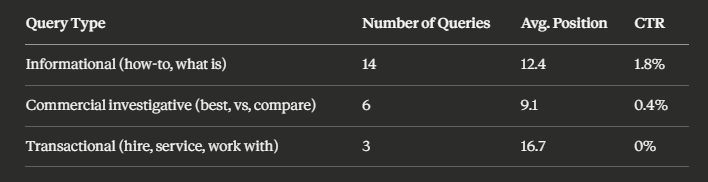
The page was primarily written as an informational guide. And predictably, it performed best for informational queries, despite also ranking for commercial and transactional ones.
But those commercial queries at position 9? They had nearly no CTR because the meta snippet read like an educational post, not a resource for someone evaluating options. And those transactional queries at 16.7 showed that real buying intent was trying to find me — and failing to get past the search results.
I made two changes.
First, I rewrote the meta title and description to speak to the commercial layer — someone evaluating options, not someone learning a concept for the first time.
Second, I added a 350-word section about one quarter of the way through the post that directly addressed the decision-making angle: what to do when you understand the concept but aren't sure what to prioritise first.
Within six weeks, the average position for commercial queries had moved from 9.1 to 6.8, and the CTR on those queries had increased to 2.1%.
The informational queries stayed stable. The transactional queries are still developing. But the intervention was targeted, low-effort relative to a full rewrite, and demonstrably effective.
This is what intent-aligned content adjustment actually looks like in practice.
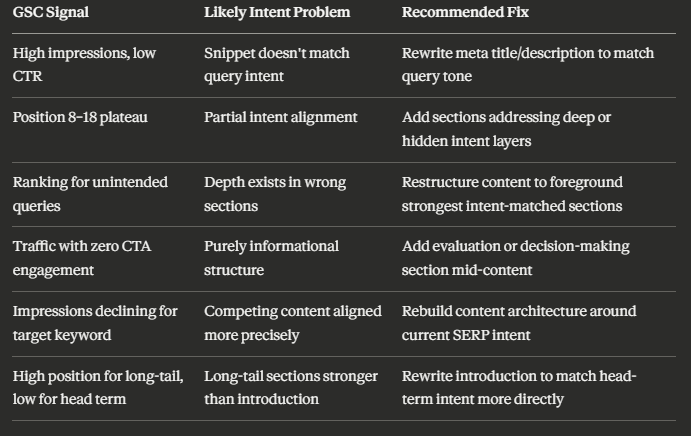
The Content Intent Mismatch Table
This is a quick reference I now use before publishing or updating any post. It maps common GSC signals to their likely intent problem and the recommended fix.
How to Fix Content Intent Without Rewriting Everything
One of the biggest mistakes I see is treating content intent as a reason to start from scratch. Most of the time, it isn't.
Here's a leaner process that I've used repeatedly with effective results.
Audit first, write second. Pull your GSC data for underperforming pages before you touch a single word. Identify the specific intent gap from the query report. Only then decide what kind of intervention is needed.
Fix the snippet before the content. In many cases — particularly the impression-click gap pattern — the content itself is fine. The meta snippet is failing. Rewriting the title and description to match the intent of the queries getting the most impressions is often the fastest improvement you can make.
Add a section, don't replace one. If your content is ranking for commercial queries but written for informational ones, you usually don't need to delete the informational content. Add a 250–400 word section that addresses the commercial layer explicitly. Use a subheading that mirrors the commercial query phrasing. This allows the content to serve multiple intent layers without losing what's already working.
Update internal links to reflect the new focus. If you've repositioned a page's intent angle, make sure the anchor text on links pointing to that page reflects the updated angle, not the original one. This is a small signal, but it's consistent with how I discuss the importance of anchor text precision in my SEO content writing guide.
Test the snippet with real query data. After updating your meta title and description, monitor the specific queries you targeted for changes in CTR over 30–45 days. GSC gives you this data clearly. If CTR improves, the alignment worked. If it doesn't, the intent mismatch is deeper than the snippet.
What GSC Data Also Taught Me About E-E-A-T
There's a secondary lesson in all of this that's worth naming directly.
Google's evaluation of content — specifically through the E-E-A-T framework — is not just about credentials or backlinks. It's about the degree to which the content reflects real, lived understanding of the topic.
When I look at the pages that rank consistently and attract the right kind of engagement, they share one characteristic: they don't just explain. They reveal. They include observations that only come from actually doing the thing, working with the data, making the mistakes, and adjusting.
The pages that plateau at position 10–16 tend to be competent. Well-structured. Accurate. But they read like someone who has studied the topic rather than someone who has practised it. That distinction matters to Google, and it matters enormously to real readers.
I've written about how Google's E-E-A-T framework functions in content strategy and what it means for writers who want to build credibility through content: Google E-E-A-T and SEO Content Strategy. If you're not building E-E-A-T signals into your content architecture, intent alignment alone won't be enough to hold top positions in competitive clusters.
The TOFU–MOFU–BOFU Layer in a Single Post
One of the things the GSC data made visually clear was the disconnect between how I was structuring content and how readers were actually moving through it.
TOFU content — awareness-level material — gets impressions from broad, informational queries. MOFU content — trust-building, deeper material — is what drives scroll depth and return visits. BOFU content — decision-level material — is what triggers clicks on CTAs and enquiries.
Most of my posts were TOFU all the way through. Which explained the traffic-without-conversion pattern. I was attracting the right people but releasing them before they had any reason to take an action.
The fix wasn't adding a hard sell at the end of every post. It was recognising that a single well-structured blog post can — and should — move through all three stages. The introduction earns attention. The middle builds trust. The final sections guide decision.
This progression is also where internal linking plays a structural role. A soft CTA that links to a related post — for example, guiding someone from a post about content intent to a post about technical vs SEO writing approach — isn't just a link. It's a continuation of the journey. It moves someone from awareness to consideration without a jarring transition.
If you're working through how to structure this kind of progression, this post on technical writing versus SEO writing is relevant — particularly for writers who are trying to understand when depth matters more than optimisation and vice versa.
What This Means for Content Writers and SEO Strategists
Let me be direct about the practical implication of all of this.
Writing good content is necessary. It is not sufficient.
Good writing that misaligns with search intent will rank below mediocre writing that aligns precisely. This is uncomfortable for writers who have invested heavily in craft, but it's what the data consistently shows.
The solution is not to write worse content. The solution is to build a workflow that places intent alignment at the beginning of the process — before the keyword is chosen, before the outline is written, before a single sentence is drafted.
This is what separates content that ranks from content that performs. Ranking is a technical outcome. Performance is a strategic one.
If you are producing content consistently but not seeing the compounding results you expect, the most likely explanation is not quantity and it's not quality in the writing sense. It's alignment. Specifically, intent alignment — the degree to which every section of every piece of content is genuinely serving the real reason someone searched for that topic.
I got my first eight posts to page one by applying a version of this thinking, and the full breakdown of that process is something I documented in detail: How I Ranked 8 Posts on Page One. The intent alignment principle runs through every one of those posts, even when I wasn't consciously naming it at the time.
Who This Is For — and Who It Isn't
This post is most useful for you if you are already producing content regularly and want to understand why some posts plateau while others grow steadily.
It's also useful if you manage content strategy for a brand or SaaS product and are trying to diagnose why your cluster isn't building the topical authority you expected.
It's less useful if you haven't yet published enough content to have meaningful GSC data. You need at least three to six months of indexed content and consistent publishing before query patterns become readable. If you're earlier in the process, focus first on understanding how SEO actually works as a system before you try to optimise for intent alignment.
The Difference Between Ranking and Ranking for the Right Thing
Here's a nuance that took me longer than it should have to absorb.
Ranking on page one for a keyword is not the goal. Ranking for a keyword in a way that attracts the right reader at the right moment in their decision journey is the goal.
There's a version of SEO success that looks impressive in a rankings report and produces almost nothing in terms of business outcomes. High position, high impressions, low CTR, zero conversions. The content is performing technically but failing commercially. And the GSC data, if you read it correctly, will tell you this is happening long before it becomes an obvious problem.
The query intent signals in your GSC report are a live map of what your audience actually wants from you. Not what they say they want in surveys. Not what keyword tools predict they want based on volume. What they demonstrably, provably want — right now, at scale.
Using that data to make editorial decisions is not just smart content strategy. It's the most direct path from content creation to business outcomes that I've found.
I've also seen how this plays out at a more technical level — where landing pages specifically need to be intent-aligned not just for organic traffic but for AI-generated search results. If you're working at the intersection of AI and SEO strategy, this post on AI SEO for landing pages covers how intent alignment functions differently in that context
Statistics Worth Knowing
To ground this in broader context:
According to Ahrefs, approximately 90.63% of pages receive zero organic search traffic from Google. Intent misalignment is one of the most cited structural reasons for this.
BrightEdge research found that search intent drives over 70% of content performance outcomes in competitive verticals — outweighing both content length and backlink count as a ranking factor.
A 2023 analysis by Semrush found that pages where the content type precisely matched the dominant search intent in the SERP were 3.5x more likely to rank in the top three positions than pages with partial intent alignment.
Summary
Here are the key points from this post:
Content intent has three layers — surface, deep, and hidden — and most content only addresses the first one
GSC query reports reveal intent mismatches through three patterns: impression-click gaps, unintended query rankings, and traffic-without-conversion behaviour
The Intent Signal Method is a three-step process: map intent before writing, read GSC queries by page rather than keyword, then align or rebuild based on the specific mismatch type
Snippet mismatch is often faster to fix than content mismatch — many intent problems can be resolved by rewriting the meta title and description before touching the content itself
A single blog post can and should serve TOFU, MOFU, and BOFU intent — the structure of the content determines whether readers are guided to an action or released without one
E-E-A-T and intent alignment are connected — content that reflects lived experience ranks and holds position more reliably than technically correct but experientially flat content
Content that ranks for the wrong intent is not a success — it produces traffic without outcomes, and GSC data will show you this if you know what to look for
What You Should Do Next
If you've been publishing content consistently but not seeing ranking progression, pull your GSC query data for your top five pages and apply Step 2 of the Intent Signal Method — look at what queries you're actually ranking for, not what you intended to rank for. That single exercise will tell you more about your content's real positioning than any keyword tool.
If you'd like to see how I structure a full content system from keyword research to distribution, the post on how I got global traffic as an SEO content writer covers the end-to-end approach I use — intent alignment included.
If you're ready to work with someone who builds content systems designed to rank and convert, get in touch here. I work with SaaS brands, independent consultants, and content teams building long-term organic search presence.
Frequently Asked Questions
1. How do I find content intent mismatches in Google Search Console?
Go to the Performance report in GSC, filter by individual pages, and look at the queries each page ranks for. Compare the tone and type of those queries to the angle of your content. If your content reads as informational but the ranking queries are commercial or transactional, that is a classic intent mismatch. Position 8–18 plateaus are the most common symptom.
2. Does fixing content intent actually improve rankings?
Yes, consistently. Adjusting content — particularly the meta snippet and adding intent-specific sections — has produced measurable ranking improvements within 30–60 days in my own work and in client content audits. The key is targeting the specific layer of intent that's misaligned, rather than making broad structural changes.
3. What is the difference between surface intent and deep intent in SEO?
Surface intent is the literal meaning of the search query — what someone appears to be asking for. Deep intent is the underlying goal behind the query — what they actually want to achieve. For example, searching "how to write SEO content" has surface intent of learning a skill, but deep intent might be to get their website to rank and generate leads. Content that addresses both layers performs better than content that only answers the surface question.
4. How often should I audit my content for intent alignment?
Every 60–90 days is the standard I follow. I review GSC data for ranking movements, CTR changes, and new query patterns. If a page drops more than three positions or CTR falls below benchmark for that cluster, it triggers an immediate intent audit rather than waiting for the scheduled review.
5. Can one blog post serve multiple types of search intent?
Yes, but it must be done structurally. A post can open with informational content for top-of-funnel readers, move to comparative or evaluative depth for middle-of-funnel readers, and close with decision-driving content for bottom-of-funnel readers. The mistake is trying to serve all intents simultaneously in every section, rather than guiding the reader through a sequential journey where each layer builds on the last.