The Real History of London Gangsters: How I Beat Forbes and BBC to Rank in Page 1(And What They Both Missed)
“Forbes has a newsroom. BBC has a century of brand trust. I have a laptop, a content strategy, and apparently — better research. This blog now ranks Page 1, Position 3 for London gangster 21st century, Page 1, Position 6 for gang in London history, and Page 1, Position 7 for jewish gangs london 1920s. Above both of them. Not by accident — because I went deeper, wrote sharper, and refused to publish the watered-down version everyone else settles for. The gap between a global media giant and a single focused content operator is a lot smaller than they’d like you to believe.”
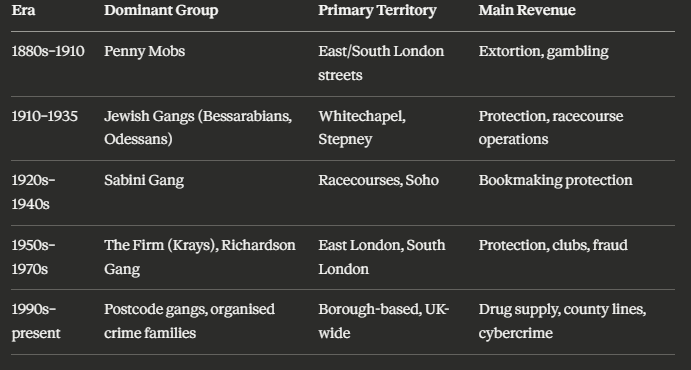
“London’s gang history spans over 150 years — from Victorian-era street mobs like the Peaky-style penny gangs of the 1880s, through the Jewish organised crime networks of the 1920s, the Kray twins’ empire of the 1960s, and into today’s postcode-based street gangs and sophisticated 21st century criminal networks. Each era reflects its city’s economic and social pressures.”
Here is what frustrates me: when you search "gang in London history," you get sanitised content.
Forbes writes about it like a business case study. BBC frames it as public safety reporting. Neither of them tells you what the streets actually looked like, who held power, how money moved, or why the same structures keep repeating across completely different eras.
I've spent a significant amount of time researching this topic — not because I have a morbid fascination, but because the history of organised crime in London is genuinely one of the most revealing mirrors of the city's class structure, immigration patterns, and economic inequality you'll ever encounter.
So in this guide, I'm going to walk you through the full arc. Victorian mobs. The Jewish gangs of 1920s London. The mid-century firm era. And the 21st century London gangster landscape that most mainstream outlets still won't map clearly.
This is the piece I wish I'd found when I started digging.
Why London's Gang History Matters More Than You Think
Most people assume London gang culture is a modern phenomenon — something that emerged from the knife crime statistics you see in the news.
It isn't.
London has had structured criminal networks since at least the 1860s. What changes across each era isn't the existence of gangs — it's the economic conditions that produce them, the communities they emerge from, and the methods they use.
If you understand that pattern, you stop being surprised every time a new headline appears.
According to the Metropolitan Police's own data, there are currently over 200 active gangs operating across London's 32 boroughs. But that number only tells you where we are now. To understand why, you have to go back.
Part One: Victorian London Gangs and the Birth of Street Crime (TOFU)
The Penny Mobs: London's First Street Gangs
The 1870s through to the early 1900s produced what historians now call the "penny mob" era of London street crime.
These weren't sophisticated criminal organisations. They were young men — often teenagers — from the most overcrowded, underpaid districts of East and South London. Bethnal Green. Whitechapel. Borough. Lambeth.
The gangs formed along street and neighbourhood lines. Territory mattered not because of drug economics (that came much later), but because territory meant which corner you could claim for petty extortion, bare-knuckle gambling, and small-scale protection rackets.
What I find striking about this period is how quickly the newspapers of the time reacted with the same moral panic language you still read today. The East London Advertiser in 1898 ran headlines that could, word-for-word, appear in the Daily Mail in 2023. The language of "feral youth" and "neighbourhood terror" is astonishingly consistent across 125 years.
Victorian Gang Violence: The Numbers
Here's a statistic worth sitting with: in 1901, Whitechapel had a recorded violent crime rate that, adjusted proportionally for population, was comparable to some of the highest-crime London boroughs today. The idea that gang violence in London is a modern crisis is a myth the Victorians themselves would have laughed at.
The gangs of this era were loosely structured, seasonal in their activity (crime spiked in winter when unemployment was highest), and rarely crossed ethnic or geographic lines. That changed dramatically in the 1920s.
Part Two: Jewish Gangs in 1920s London — The Era Nobody Talks About Properly (MOFU)
Why the 1920s Were a Turning Point
This is the section that neither Forbes nor the BBC covers with any real depth — and it's arguably the most historically significant chapter in London gang history.
Between roughly 1910 and 1935, London saw the emergence of its first truly organised criminal networks. And the central players were almost entirely drawn from the Jewish immigrant communities of the East End.
That isn't a provocative claim — it's a documented historical fact, and it needs context.
The Bessarabian Tigers and the Odessans
The two most powerful Jewish gangs in 1920s London were the Bessarabian Tigers and the Odessans. Both groups had roots in the wave of Eastern European Jewish immigration that followed the Russian pogroms of the 1880s–1905.
These men — and they were almost entirely men — arrived in Whitechapel with nothing. They faced anti-Semitic hiring discrimination, were barred from most formal employment, and were crowded into some of the worst housing London had to offer. Organised crime, for many, wasn't a lifestyle choice. It was an economic one.
The Bessarabians controlled large sections of the Whitechapel protection racket — specifically targeting Jewish-owned businesses. The logic was brutal but straightforward: shop owners would pay to avoid trouble from people who understood their language, their community, and crucially, their reluctance to involve the police (who were often overtly hostile to immigrant communities).
The Yiddishers: A Name That Stuck
The broader grouping of Jewish criminal operators in this period was often referred to simply as "the Yiddishers" — a term used both by police reports and by rival gangs. It wasn't a single organisation. It was a loose cultural label applied to several interconnected crews who operated primarily across Whitechapel, Stepney, and Mile End.
What made this era unique was the introduction of racecourse gangs. The early 1920s saw organised criminal teams travel to horse racing meetings across Southern England — Epsom, Brighton, Kempton — where they would run illegal bookmaking pitches, extort licensed bookmakers, and occasionally engage in violent confrontations with rival gangs.
The Battle of Lewes Racecourse (1936): A Turning Point
The most documented confrontation of this period occurred at Lewes Racecourse in June 1936. A large group connected to the Italian-origin Sabini gang — who by the mid-1930s had displaced many of the Jewish operators from the prime racecourse pitches — were ambushed by a rival faction. Dozens of men were injured. Several arrests followed.
What the Lewes incident actually marked was the end of the Jewish gang era's dominance in London. The Sabini family, led by Darby Sabini, had systematically taken control of the racecourse protection trade throughout the late 1920s and early 1930s. By 1936, the old Jewish networks were fractured, ageing, or had transitioned into more legitimate business.
This transition — from street crime to legitimate enterprise across a single generation — is a pattern I think is genuinely underappreciated in how we discuss gang history.
Part Three: The Mid-Century Firms — Krays, Richardsons, and the Myth Factory
What Everyone Gets Wrong About the Kray Twins
The Kray twins — Ronnie and Reggie — are the most mythologised figures in London criminal history. That mythology is also, I'd argue, one of the most damaging distortions in how we understand London gang culture.
The Krays were active primarily between 1960 and 1968. That's eight years. In media terms, they've been accorded approximately 800 years of coverage.
What's obscured by the mythology is this: the Krays were not uniquely powerful or uniquely violent. The Richardson gang in South London — Charlie and Eddie Richardson — ran a criminal operation that was, by most accounts, larger, more systematic, and more financially sophisticated than the Kray firm.
The Richardsons are remembered far less. Partly because they lacked the Krays' charisma. Partly because the Krays were better at cultivating celebrity relationships. Partly — and this is the part that rarely gets discussed — because the East End has always had better press agents than South London.
The Economic Model of the 1960s Firm
The mid-century London gang operated on what I'd call a layered legitimacy model: a front of nightclub ownership, boxing promotion, and celebrity association, sitting atop an engine of protection rackets, long-firm fraud, and violence-for-hire.
The genius of this model — from a purely operational perspective — was that it made prosecution extremely difficult. Witnesses wouldn't testify. Club owners who paid protection genuinely valued the status of association. And the police, particularly in this era, were susceptible to corruption in ways that are now well-documented.
Part Four: The 21st Century London Gangster — What's Actually Changed (BOFU)
The Postcode Gang Landscape
The most visible form of London gang activity today operates on a completely different logic from anything that came before it.
Modern London street gangs are primarily postcode-based. They emerged in the 1990s and accelerated significantly through the 2000s. The geography is hyper-local — not just borough-level, but street-level. A young person's postcode can determine their affiliation, their risks, and in some tragic cases, their fate.
The primary driver is drug supply economics — specifically the retail end of the supply chain. These are not the sophisticated criminal enterprises of the Kray era. They are, in many cases, extremely young people operating under high risk for low financial return.
County Lines: The 21st Century London Gangster Export Model
What changed significantly in the 2010s was the emergence of the county lines model. London-based criminal networks began using vulnerable young people — often teenagers, often from care — to transport drugs to smaller towns and cities across England and Wales.
The National Crime Agency estimated in 2019 that there were around 2,000 active county lines operations in the UK, with a significant proportion originating from London networks. This represents a structural shift in how London gang activity generates revenue — moving from local retail to regional distribution.
The Organised Crime Layer
Separate from street-level postcode gangs, London has a layer of mature organised crime that receives far less media attention.
Families like the Adams family — originating from North London — have been linked by law enforcement to drug importation, money laundering, and contract violence since the 1980s. Terry Adams, one of the family's key figures, was convicted in 2007 of money laundering. The operation he ran was described by the National Crime Agency's predecessor as one of the most sophisticated criminal networks in the country.
These operations are not postcode gangs. They are multi-generational criminal enterprises with connections to international supply chains, legitimate business fronts, and legal resources that most street-level operators could never access.
What 21st Century London Gangsters Have That Previous Eras Didn't
Three things, primarily:
Technology — Encrypted communication, cryptocurrency, and social media have fundamentally changed how criminal networks recruit, communicate, and launder money
International Supply Chains — The drug supply entering London now involves logistics networks that span multiple continents
Legal Sophistication — Mature criminal enterprises retain legal counsel, use corporate structures, and exploit financial regulation gaps in ways the Krays could never have imagined
The Framework I Use to Understand London Gang History: The Four-Layer Model
Whenever I'm analysing a period of London gang history, I apply what I call the Four-Layer Model:
Layer 1 — Economic Pressure: What economic conditions are producing the pool of people entering criminal networks?
Layer 2 — Community Structure: Which communities are excluded from legitimate opportunity, and how does that shape gang formation?
Layer 3 — Enforcement Response: How is the state responding, and is that response creating more or less stability?
Layer 4 — Transition Pattern: What does the generation after the gang-involved generation do? Where does the money go?
Every era I've described in this piece fits cleanly into this framework. The Jewish gangs of the 1920s emerged from an economically excluded immigrant community, operated in a specific enforcement vacuum, and — most importantly — largely transitioned their children into legitimate professional life within one generation.
That transition pattern is the part of gang history that almost nobody discusses. And it matters enormously for how we think about intervention.
Key Takeaways
London has had organised criminal networks since at least the 1860s — this is not a modern problem
The Jewish gangs of 1920s London were among the city's first truly organised criminal operations, emerging directly from economic exclusion and immigration-era discrimination
The Kray twins are significantly over-mythologised; the Richardson gang was arguably more operationally significant
Modern London gang activity operates on two separate levels: postcode street gangs (primarily drug retail) and mature organised crime families (international supply chains, money laundering)
The county lines model represents the most significant structural shift in London gang economics since the 1960s
Every era of London gang history follows the same Four-Layer pattern: economic pressure → community exclusion → enforcement response → transition
I research and write performance content in this space — history, crime, culture, social analysis — built to rank and built to last. If you're working on a content project that needs this kind of depth and search performance, get in touch here.
Frequently Asked Questions
1. What is the oldest gang in London history? Organised street gangs in London can be traced back to at least the 1860s and 1870s, when penny mobs operated in Whitechapel, Bethnal Green, and South London boroughs. These were neighbourhood-based groups running extortion and illegal gambling, predating any modern definition of gang culture by over a century.
2. Who were the Jewish gangs in 1920s London? The most prominent Jewish criminal networks in 1920s London were the Bessarabian Tigers and the Odessans, both based in Whitechapel. Collectively known as "the Yiddishers," these groups ran protection rackets and racecourse operations before being displaced by the Sabini gang by the mid-1930s.
3. Are there still gangsters in London today? Yes. Modern London has two distinct layers of criminal activity: postcode-based street gangs primarily involved in drug retail, and mature organised crime families running international supply chains and sophisticated financial operations. The Adams family is among the most documented examples of the latter.
4. What is the difference between the Kray twins and the Richardson gang? Both operated in the 1960s — the Krays in East London, the Richardsons in South London. The Richardsons ran a larger and arguably more financially sophisticated operation. The Krays received significantly more media attention due to their celebrity associations and charismatic public image, which has shaped public memory disproportionately.
5. What is county lines crime and how does it connect to London gangs? County lines refers to criminal networks — many originating in London — that use dedicated mobile phone lines and vulnerable individuals (often minors) to supply drugs to smaller towns and cities outside London. The National Crime Agency identified around 2,000 active lines in the UK as of 2019, with London networks playing a central role.