Why Your SaaS Isn't Getting Signups Even With Traffic
“A SaaS with traffic but no signups typically has a conversion architecture problem, not a traffic volume problem. The five most common causes are: misaligned traffic intent, no deliberate reader journey, missing trust signals, an invisible or poorly positioned offer, and a gap between what content promises and what the product delivers. Each is diagnosable and fixable.”
Traffic numbers feel like progress. They look like progress. They go up, the graph trends in the right direction, and for a brief moment it seems like the content strategy is working.
Then you look at signups. Nothing.
I've had this conversation with SaaS founders more times than I can count — and the frustration is always the same. They've built something real, they've invested in content, they've got people showing up. But showing up isn't the same as signing up. And somewhere between the click and the conversion, the whole thing falls apart.
Here's what I've found: in almost every case, the traffic itself is not the problem. The problem is what's waiting for it when it arrives.
This post is a breakdown of the five most common conversion failure points I've identified across SaaS content strategies — what I call the Traffic-Conversion Gap. I'll explain each one, show you how to diagnose it in your own funnel, and give you a practical path to fixing it.
By the end, you'll know exactly why your traffic isn't converting — and what to do about it.
Why This Problem Is So Common — and So Easy to Misread
The standard response to "traffic but no signups" is to assume the product needs work. Or the pricing is off. Or the landing page isn't converting.
Sometimes those things are true. But often, they're not the root cause — they're the visible symptoms of a deeper system failure.
The real issue is that most SaaS content strategies are built around generating traffic, not around converting it. Blog posts are written to rank. Distribution is focused on reach. SEO metrics — impressions, clicks, positions — become the success criteria. And conversions get treated as something that will naturally follow once the traffic numbers are high enough.
They won't. Not without deliberate architecture.
Traffic and conversion are not the same funnel stage. Attracting a reader requires one set of decisions. Converting that reader into a product user requires a completely different set — and those decisions need to be built into the content itself, not bolted on afterwards.
The five failure points I'm about to describe are all architecture failures. They're not writing failures, product failures, or marketing failures in isolation. They're gaps in the system that connects content to conversion.
The Traffic-Conversion Gap: Five Failure Points
I use this diagnostic framework — the Traffic-Conversion Gap — when auditing a SaaS content strategy that's generating impressions without outcomes. Each of the five points represents a specific place where the reader's path from discovery to signup breaks down.
Failure Point 1: You're Attracting the Wrong Intent
This is the most common failure point, and it's almost invisible until you look at the right data.
Not all traffic is equal. A visitor who found your SaaS blog through a search for "what is customer churn" is at a completely different stage of their journey than a visitor who searched "best SaaS for reducing customer churn." Both arrive on your site. The metrics look the same. But the probability of each converting to a signup is wildly different.
The problem happens when a SaaS content strategy is built primarily around informational keywords — broad educational queries that attract readers who are learning about a topic, not evaluating a solution. This makes sense from a volume perspective: informational queries tend to have higher search volume and lower competition. They're easier to rank for. The traffic looks impressive.
But informational traffic converts at low rates by design. People searching to learn something are not yet in the mindset of making a decision. They're gathering information. Signing up for a product is not the next logical step for them — reading another article is.
What converts are commercial investigative queries. "Best tool for [problem your product solves]." "Alternative to [competitor]." "[Your product category] for [specific use case]." These queries come from people who already understand the problem and are actively evaluating solutions.
Here's how to diagnose this in your own content:
Pull your Google Search Console query report. Filter by your top-traffic pages. Look at the specific queries driving impressions. Classify each query as informational, commercial investigative, or transactional. If your top-performing content is overwhelmingly informational, you have an intent mismatch — and that's why your traffic volume looks healthy but your signup rate doesn't.
The fix is not to abandon informational content. It's to ensure your content cluster includes enough commercial investigative and comparison content to serve readers who are ready to decide — not just ready to learn.
Failure Point 2: There Is No Reader Journey
This one runs deep, and it's the failure point most closely connected to why content feels productive without being effective.
Most SaaS blog posts are written as standalone documents. They cover a topic, explain it well, and end. Maybe with a vague CTA. Maybe with nothing at all. The reader reaches the final paragraph, has been mildly educated, and then decides what to do next on their own.
That decision usually involves going back to Google.
A reader journey is not a funnel trick. It's a structural design principle. Every blog post needs to know where the reader is coming from, what they know and don't know when they arrive, and where they should be going when they leave. Those three things should shape every decision about how the post is written, what it includes, and how it ends.
The framework I use to design reader journeys follows a three-stage progression within a single piece of content.
The first stage — awareness — is where the reader arrives. They have a problem or a question. The job of the first 300–400 words is to make them feel understood, establish that this post is going to resolve their specific situation, and give them a reason to keep reading. Not a promise of value in the abstract. A concrete indication that what they're about to read is exactly what they need.
The second stage — trust — is where the bulk of the post lives. This is where frameworks, examples, data, and depth do the work. The reader needs to move from "this person might know something" to "this person actually understands this problem at a level I haven't seen elsewhere." That shift is what creates the belief that the product behind the content might be worth trying.
The third stage — decision — is where most SaaS blog posts fail completely. After the trust has been built, the reader is ready to consider an action. But if there's no clear, specific, well-positioned next step waiting for them, that readiness dissipates. They leave. The trust you built dissolves before it converts.
Every post in a SaaS content cluster should map explicitly to this three-stage structure. If you read through your existing posts and can't identify where each stage begins and ends — the reader journey isn't there.
Failure Point 3: You Have Traffic but No Trust Architecture
Traffic tells you that people found you. It doesn't tell you that they believed you.
For a SaaS product — particularly one asking for a credit card, access to business data, or a significant time investment in onboarding — trust is the deciding variable. A reader who finds your content useful but doesn't trust the brand behind it won't sign up. They'll note that you exist, save the information you gave them, and eventually sign up for a product they trust more.
Trust in content is built through specific signals, not through good writing alone.
First-hand experience markers. Real numbers. Specific results. Named tools and workflows. "I tested this with 12 client accounts over 90 days and saw an average 34% improvement in organic impressions" is a trust signal. "Many businesses have seen significant improvements" is not. The reader can feel the difference immediately.
Topical consistency. A brand that has published 15 deeply relevant, high-quality pieces on a specific problem space signals expertise in a way that a brand with one excellent post and 14 unrelated ones simply doesn't. Google evaluates this. Readers evaluate it too, even if they don't consciously recognise it. When a visitor reads one post and finds five more on the same topic — all with the same depth and specificity — their confidence in the brand compounds.
Social proof embedded in content. Not a generic "trusted by 500 customers" badge. Specific outcomes, attributed where possible, that match the reader's situation. A case study that mirrors the reader's own context is worth more than any amount of brand copy.
Author credibility. Who wrote this? Why should I believe them? For SaaS content specifically, the author's demonstrated experience with the problem the product solves matters. A post written by someone who has clearly lived the problem converts better than a post written by a generalist, even if the writing quality is comparable.
If your content has traffic but weak trust architecture, readers are arriving, taking what they need, and leaving to make their decisions somewhere else.
Failure Point 4: The Offer Is Invisible
This is the failure point that makes me genuinely frustrated when I see it — because it's entirely preventable and it costs SaaS brands an enormous amount of conversion value every month.
The offer is invisible when the CTA is missing, buried, poorly positioned, or misaligned with where the reader is in their decision journey.
Here's the most common version: a well-written, genuinely useful SaaS blog post that covers a real problem in depth, builds real trust, and then ends with something like "If you found this useful, you might enjoy our other posts on content strategy." And that's it.
The reader who was ready to take a next step has been given a very small one. They click through to another blog post. They read it. They feel educated. They leave.
The layered CTA architecture I use fixes this. It operates on three levels.
The soft CTA appears early or mid-post, in the flow of the content. It's a natural, low-pressure link to a related resource that goes deeper on a specific subtopic. It serves readers who are still in learning mode and aren't ready for a product decision, while keeping them inside your content ecosystem.
The mid-level CTA sits in the middle section of the post — after enough trust has been built to justify an ask, but before the post has ended. It offers something tangible: a template, a checklist, a downloadable framework, a free audit. This is the lead capture moment. The reader isn't being asked to sign up for the product — they're being asked to take one step further into the relationship.
The hard CTA comes at the end, after the full trust journey has been completed. It's a direct, specific invitation to start a trial, book a call, or take a commercial action. It works because the reader has been guided here — they haven't been sold to prematurely.
The critical thing about this system is that it's sequential. A hard CTA that arrives before trust is established doesn't convert. A soft CTA that's the only CTA in the post wastes the conversion potential of readers who are ready for more. The architecture has to be deliberate.
If you open your current top five blog posts right now and look for all three CTA layers — I'd wager that most have one at most, and several have none.
Failure Point 5: The Product-Content Disconnect
This is the failure point that's hardest to diagnose from analytics alone, because it lives in the gap between what your content promises and what your product actually delivers.
Here's how it happens. A SaaS content strategy attracts readers by solving problems at the level of understanding — explaining, educating, illuminating. The content is good. It ranks. It gets clicks. But the product is built to solve the problem at a different level, or for a different type of user, or at a different stage of the customer journey than the content implies.
The reader arrives at the product expecting one thing. They find something different. They don't sign up.
This disconnect can take several forms.
The complexity gap. Content makes a complex problem seem manageable — the reader arrives at the product and discovers that using it effectively requires significantly more sophistication than the content implied.
The audience gap. Content attracts readers at the beginning of their learning journey — the product is built for experienced practitioners who already understand the fundamentals.
The use case gap. Content addresses a problem that the product only partially solves — the reader needs the full solution, not just the component the product handles.
The messaging gap. The language, framing, and positioning in the content doesn't match the language on the product landing page. The reader who felt understood by the blog feels confused by the product page. The trust built in the content doesn't transfer.
Diagnosing this requires looking at data beyond the content layer. Where in the signup flow are readers dropping off? What's the average time on page before they leave the landing page? Are there specific blog topics that drive traffic but consistently produce lower signup rates than others?
The fix often isn't a product change. It's a content alignment exercise — ensuring that the blogs attracting traffic and the product they're pointing toward are speaking the same language, to the same reader, about the same problem.
The S.A.R.C. System™ as the Structural Solution
Diagnosing the five failure points is the first step. But diagnosis without a system for correction just produces a list of problems.
The framework I use to rebuild SaaS content strategies around conversion — not just traffic — is the S.A.R.C. System™. It stands for Search, Authority, Reader, and Conversion. And it's specifically designed to address all five Traffic-Conversion Gap failure points within a single, integrated content architecture.
Search addresses Failure Point 1 directly. The S.A.R.C. System™ requires every piece of content to begin with a keyword that has defined intent alignment — ensuring that you're not just attracting readers, but attracting readers at the right stage of their decision journey. Informational, commercial investigative, and transactional content are all part of a balanced cluster — not an accident of whatever keywords happened to have decent search volume.
Authority addresses Failure Point 3. The system builds trust through cluster architecture — a group of 10–20 tightly connected posts that collectively signal deep expertise on the topic your product addresses. It also mandates first-hand experience signals throughout: real results, named tools, specific workflows. Not because it sounds impressive, but because trust is the variable that converts.
Reader addresses Failure Point 2. The Reader pillar of the S.A.R.C. System™ is about deliberate journey design — mapping the three stages of intent (surface, deep, hidden), designing the TOFU → MOFU → BOFU progression within each post, and placing engagement engineering elements at regular intervals to prevent reader drift before the conversion moment arrives.
Conversion addresses Failure Points 4 and 5 simultaneously. The layered CTA architecture ensures the offer is never invisible — soft, mid-level, and hard CTAs positioned at the appropriate stages of the reader journey. And the conversion psychology elements — objection handling, risk reduction, outcome clarity — close the product-content gap by making the post's promise and the product's delivery feel coherent.
The S.A.R.C. System™ doesn't require you to produce more content. It requires you to build what you produce with more intention. Most SaaS brands already have enough content to convert significantly better than they currently do — the architecture just isn't there yet.
Case Study: Rebuilding a SaaS Content Strategy Around Conversion
Let me walk through a specific example.
A B2B SaaS product in the project management space had been publishing two to three blog posts per week for 18 months. Traffic had grown consistently. Monthly blog visits had reached approximately 12,000. Signups from content were running at approximately 0.3% of blog visitors — around 36 signups per month.
The Traffic-Conversion Gap audit revealed the following:
Intent mismatch: 78% of blog content targeted broad informational queries. Less than 10% of the content cluster addressed commercial investigative queries — the posts most likely to attract readers evaluating project management solutions.
No reader journey: Posts ended without a clear next step in 21 of the 28 most recent posts. Three had a single CTA linking to a free trial. None had a mid-level CTA offering a downloadable resource.
Weak trust architecture: The blog had no author biography with demonstrated experience. No case studies were present in the content. Statistics were included but unattributed. Posts existed as isolated pieces with no internal linking structure — no cluster, no pillar page, no topical consistency signal.
Invisible offer: Free trial CTA was present on only 11 posts, and only in the footer. No post had a mid-level CTA. The trial CTA copy was generic: "Start your free trial."
Product-content disconnect: The blog's most popular posts addressed entry-level project management concepts. The product was positioned for mid-market teams with existing project management experience. The audience the content was attracting was not the audience the product was built for.
The intervention applied across 90 days:
Restructured the content cluster around three topic areas directly aligned with mid-market team use cases
Built one pillar page per cluster with explicit commercial intent framing
Published eight new posts targeting commercial investigative and comparison queries
Rewrote metadata and introductions for the top 15 existing posts to reflect the correct audience positioning
Added a mid-level CTA to 20 posts — a downloadable team productivity audit template
Built an internal linking architecture connecting all cluster posts
Added author biography with specific client results and named experience
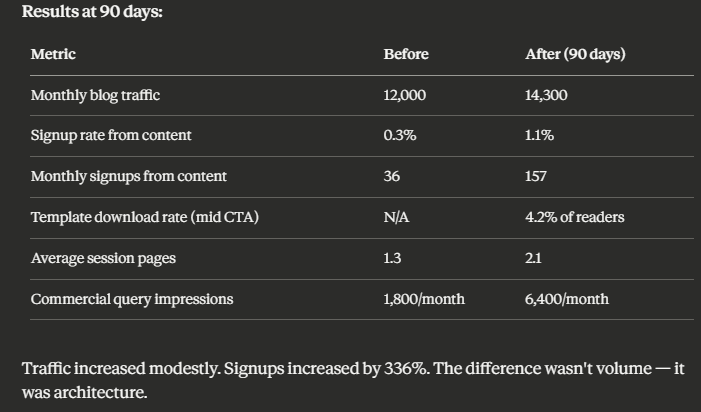
Traffic increased modestly. Signups increased by 336%. The difference wasn't volume — it was architecture.
The Traffic-Conversion Gap Diagnostic Checklist
Use this table to audit your own SaaS content strategy against each of the five failure points.
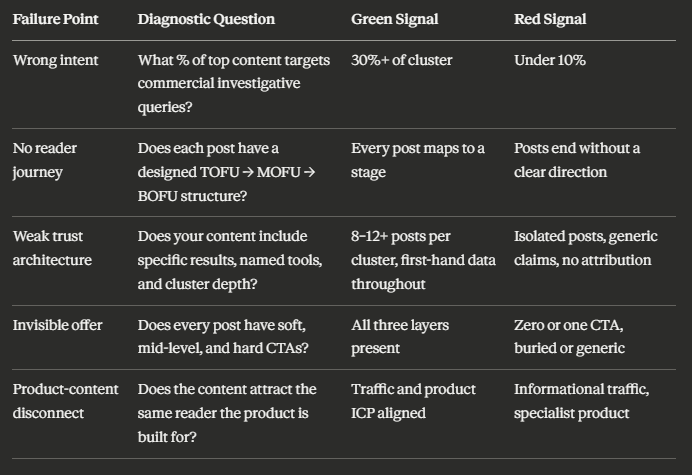
Run your top ten blog posts through this table. Any row that turns red is a fixable architecture problem — not a reason to rebuild the product or double the publishing frequency.
Statistics Worth Knowing
Three numbers that frame the scale of this problem across the SaaS space:
According to Unbounce's Conversion Benchmark Report, the median landing page conversion rate across SaaS products is 3.8% — but SaaS brands with unstructured content strategies typically see content-driven signup rates below 0.5%, indicating that architecture, not traffic volume, is the limiting variable.
HubSpot research found that companies with 10–15 landing pages generate 55% more leads than those with fewer than 10 — a finding that correlates with the cluster architecture principle: depth across a topic outperforms isolated excellence.
According to Demand Gen Report, 47% of B2B buyers consume 3–5 pieces of content before engaging with a sales representative — making the internal linking and content journey design that connects those pieces critical to conversion, not optional.
Who This Is For — and Who It Isn't
This post is directly relevant for SaaS founders, product marketers, and content strategists who are generating consistent blog traffic but not seeing that traffic translate into trials, demos, or signups.
It's also relevant if you've recently invested in SEO or content production and are trying to understand why the return on that investment isn't showing up in your growth metrics yet.
This post is less relevant if you're still in the process of building initial content volume. If you have fewer than 8–10 published pieces targeting your core topic, the priority is building the cluster before optimising for conversion — there isn't enough architecture to audit yet.
And if your product is genuinely not solving a real problem well enough, content architecture won't fix that. The approaches in this post assume a product that delivers on its promise. If the product itself has significant usability or value delivery problems, conversion architecture will surface those problems faster — but it won't resolve them.
Three Objections I Hear — and Why They're Wrong
"We just need more traffic." Volume without architecture produces more of the same outcome — more visitors who don't sign up. The conversion rate problem doesn't solve itself with traffic growth. I've seen SaaS brands with 50,000 monthly blog visits and 60 monthly signups because the architecture was never built. More traffic multiplied by a broken conversion system is just a larger broken number.
"Our product sells itself if people just try it." Maybe. But they have to get to the trial first. And between finding your content and starting a trial, there are multiple decision points where readers either continue or drop off. Each of those decision points needs to be designed — not left to chance.
"We don't want to be salesy in our content." Neither do I. The layered CTA architecture I've described is not aggressive selling. It's designed guidance. A soft CTA linking to a related resource isn't a sales push — it's a useful next step. A downloadable template isn't a hard sell — it's a value exchange. The hard CTA at the end of a trust-building post isn't intrusive — it's the natural conclusion of a journey the reader has chosen to take. There's a meaningful difference between designing a conversion path and inserting sales copy into educational content.
Summary
Here are the key points from this post:
Traffic without signups is a conversion architecture problem, not a traffic volume problem — diagnosing the right failure point is the first step
The Traffic-Conversion Gap framework identifies five specific failure points: wrong intent, no reader journey, weak trust architecture, invisible offer, and product-content disconnect
Intent mismatch is the most common and most invisible failure — informational traffic does not convert to SaaS signups at meaningful rates without commercial investigative content in the cluster
Reader journey design requires every post to have a deliberate TOFU → MOFU → BOFU structure — not just a CTA at the end
Trust architecture is built through cluster depth, first-hand experience signals, and topical consistency — not through individual post quality alone
The invisible offer is the most fixable failure point — a layered CTA system with soft, mid-level, and hard CTAs resolves it directly
Product-content disconnect requires alignment between the reader your content attracts and the user your product is built for — this is an audience strategy issue, not a writing issue
The S.A.R.C. System addresses all five failure points within a single, integrated content architecture — Search, Authority, Reader, Conversion
More content is not the answer — more architecture applied to existing content almost always produces faster results than publishing additional isolated posts
What You Should Do Next
If you recognise your situation in the five failure points, start with the diagnostic table. Run your top ten blog posts through each row. That exercise alone will tell you which failure point is costing you the most conversion value and where to focus first.
If intent mismatch is your primary issue, audit your current keyword strategy against your product's ICP. Map which queries your ideal customer is searching in evaluation mode — not learning mode — and identify the gaps in your cluster.
If you want to understand the full content system that fixes all five failure points simultaneously, the S.A.R.C. System™ is the framework I use across every SaaS content strategy I build. You can read the complete breakdown of how it works and how to apply it: What Is the S.A.R.C. System™ in Content Strategy?
If you're ready to build a content strategy that actually converts, book a discovery call here. I work with SaaS brands to build and rebuild content architectures that connect traffic to revenue — using the S.A.R.C. System™ as the foundation.
Frequently Asked Questions
1. How do I know if my SaaS traffic problem is an intent mismatch issue?
Export your Google Search Console query data for your top five blog posts. Classify every query as informational, commercial investigative, or transactional. If more than 70% of your impressions come from informational queries — "what is", "how does", "explain" — you have an intent mismatch. Your content is attracting learners, not buyers. The fix is adding commercial investigative content to the cluster, not replacing the informational content.
2. What conversion rate should SaaS blog content aim for?
Industry benchmarks vary significantly by product type, price point, and traffic quality — but a well-structured SaaS content strategy typically targets a 1–3% conversion rate from blog visitor to trial or lead magnet signup. Below 0.5% consistently indicates a conversion architecture problem. Above 3% suggests strong intent alignment and a well-designed CTA system. Start by improving architecture before comparing absolute numbers to benchmarks.
3. How long does it take to see conversion improvement after fixing content architecture?
In my experience, the first meaningful changes in conversion rate appear within 30–45 days of making structural interventions — particularly adding mid-level CTAs and rebuilding post endings. More substantial improvements in overall conversion volume, which depend on both architectural changes and ranking improvements, typically become visible at the 60–90 day mark. Clusters need time to build authority; individual post improvements can be faster.
4. Should I rewrite existing content or publish new posts to fix the conversion gap?
In most cases, restructuring existing content produces faster results than publishing new posts — because the content is already indexed and already driving traffic. Adding CTA layers, improving reader journey design, and fixing intent alignment in existing posts delivers conversion improvements without waiting for new posts to rank. New posts are most valuable for filling specific intent gaps — commercial investigative queries your existing cluster doesn't cover.
5. Is the product-content disconnect fixable through content changes, or does it require product changes?
Usually both. Content changes can address the messaging gap — aligning the language, positioning, and audience framing between your blog and your product. Content changes can also address the use case gap — shifting which problems you cover and which reader profile you attract. But if the complexity gap or audience gap is fundamental — if the product genuinely requires expertise the content can't build — the product onboarding experience needs to be part of the solution. Content and product are not separate systems.