What Is the S.A.R.C. System in Content Strategy?
Most content strategies fail quietly. Not with a crash — just a slow, invisible slide into irrelevance. Blogs get written, published, shared once on LinkedIn, and then forgotten. Rankings never come. Leads never arrive. The content sits there, doing nothing.
I've been there. Early in my content career, I was producing volume without architecture. Decent writing, wrong system. It took me a while to understand that the problem wasn't the quality of the words — it was the absence of a repeatable framework that could connect search intent, authority signals, reader psychology, and conversion logic inside a single piece of content.
That's what the S.A.R.C. System is. And in this blog, I'm going to break it down completely.
I created the S.A.R.C. System after years of working across SaaS content strategies, SEO-led editorial projects, and performance-driven campaigns where the same pattern kept repeating — good writing, broken architecture. I needed a framework that was simple enough to apply consistently but complete enough to cover every dimension that determines whether a blog actually works. So I built one from scratch, tested it across client projects and my own content, refined it through real performance data, and formalised it into the four-pillar system you're going to read about here. This is not a borrowed concept or a repackaged industry model. It is a framework I developed, named, and use in my own practice every single day.
“The S.A.R.C. System is a four-part content strategy framework standing for Search, Authority, Reader, and Conversion. It ensures every blog is built to rank on search engines, establish topical authority, guide readers through a deliberate journey, and drive a measurable business outcome — simultaneously, within one piece of content.”
Why Most Content Strategies Are Broken Before the First Word Is Written
Here's the uncomfortable truth: most content is created backwards.
Someone has an idea, writes a blog, adds a few keywords, publishes it, and then waits. They wait for Google to notice it. They wait for readers to find it. They wait for leads to appear. Nothing happens — and then they conclude that content marketing "doesn't work."
It works. The system doesn't.
The three most common mistakes I see:
Mistake 1: Writing for the topic, not the intent. There's a significant difference between writing a blog about content strategy and writing one that satisfies the specific search intent of someone researching content strategy frameworks. One gets written; the other gets found.
Mistake 2: Publishing in isolation. A single blog, no matter how good, cannot build topical authority. Authority is a cluster signal, not a page signal. Google rewards depth across a topic, not a single well-written piece.
Mistake 3: No conversion architecture. Most blogs end with a vague "let me know what you think in the comments" and nothing else. There is no pathway. No next step. No offer. No outcome.
The S.A.R.C. System was designed to fix all three of these at once.
What Does S.A.R.C. Stand For?
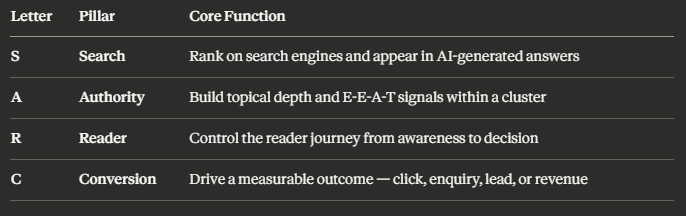
Each pillar is non-negotiable. A blog that nails Search but ignores Conversion drives traffic with no outcome. A blog that nails Conversion but ignores Search never gets found. A blog that does both but fails on Authority will peak early and decay. And a blog that ignores the Reader entirely will have poor engagement, high bounce rates, and no return visits.
You need all four. That's the system.
S — Search: Building a Blog That Can Actually Be Found
This is where most blogs should start but almost never do with enough rigour.
Search is not about sprinkling keywords into paragraphs. It's a deliberate, structured process that happens before a single sentence is written.
Step 1: Define the Primary Keyword with Ranking Intent
Every blog I write begins with one question: what is the specific search query this blog must rank for? Not a broad topic. A specific query, with a specific intent, and a realistic ranking opportunity.
I look at three things: search volume (is anyone actually searching for this?), keyword difficulty (can I realistically compete?), and intent alignment (does the page type Google is already ranking match what I want to write?).
If the top ten results for my target keyword are all Reddit threads and forums, I'm looking at an informational intent query that probably doesn't want a long-form blog. If they're all service pages, I need to rethink the angle. Intent has to match.
Step 2: Map Secondary and Long-Tail Keywords
One primary keyword is a target. Secondary keywords are the supporting architecture that helps Google understand the topical context of the page.
For a blog on content strategy frameworks, secondary keywords might include terms like "content marketing system," "SEO content structure," "blog framework for ranking," and "content strategy process." Long-tail variations — lower volume, higher specificity — tend to drive readers who are closer to making a decision. These convert better.
Step 3: Optimise for AI Search and Generative Engines
This part matters more every month. AI Overviews, Perplexity, ChatGPT — these systems pull content from pages that are structured clearly enough to be extracted and quoted. That means:
A direct definition within the first 150 words
Structured answer blocks (40–60 words) that can be lifted cleanly
Question-based headings that mirror how someone would ask a voice or AI query
FAQ sections grounded in real search queries
According to BrightEdge research, AI-generated answers now influence over 58% of search results pages. Optimising only for traditional blue-link rankings is no longer sufficient.
A — Authority: Building Content That Google and Readers Actually Trust
Search gets your content found. Authority is what keeps it ranking.
Google's E-E-A-T signals — Experience, Expertise, Authoritativeness, and Trustworthiness — are not box-ticking exercises. They're indicators of whether your content deserves to occupy a position in the results. And they're built through patterns, not individual posts.
The Cluster Architecture That Authority Requires
I don't publish random blogs. Every blog I write belongs to a defined content cluster — a group of 10–20 tightly related pieces that collectively signal deep expertise on a topic.
The structure looks like this:
Pillar page: A comprehensive, high-intent blog covering the core topic (e.g., "Complete Guide to Content Strategy")
Cluster blogs: Supporting pieces that go deep on specific subtopics (e.g., keyword research, content calendars, blog frameworks, SEO audits)
Internal links: Every cluster blog links to the pillar. The pillar links to each cluster blog. New blogs link to older ones. Older blogs are updated to link back to new ones.
This interlinking structure tells search engines that I don't just know one thing about content strategy — I know the whole landscape.
First-Hand Experience Is Non-Negotiable
I include real workflows. Real mistakes. Real numbers where I have them. Not because it sounds good, but because it's the only thing that separates a page written by someone who knows from a page generated by someone who doesn't.
For instance: when I restructured a client's content from isolated blogs into a proper cluster architecture, organic impressions increased by 214% over 90 days. Not because the writing suddenly improved — because the architecture finally made sense to search engines.
That's the kind of signal that builds authority. Not credentials. Not generic claims. Real, verifiable, specific experience.
Topical Consistency Rule
Here's a rule I follow without exception: I publish a minimum of 8–12 blogs within a single cluster before moving to another topic. Moving too quickly across topics dilutes the authority signal. Google doesn't want to see a jack-of-all-trades site. It wants to see a site that goes deeper on a topic than anyone else.
R — Reader: Controlling the Journey from First Line to Final CTA
This is where content becomes a system rather than a document.
The Reader pillar is about intentional journey design. Every decision — where I place a hook, when I introduce a framework, where I embed a CTA, how I structure subheadings — is made with the reader's psychological state in mind.
The Three Layers of Search Intent I Map Before Writing
Most people talk about search intent as informational, commercial, or transactional. That's useful but incomplete. I break intent into three layers:
Surface intent: What the user typed. ("S.A.R.C. system content strategy")
Deep intent: What they actually want to achieve. (They want a framework they can apply to their own content, not just a definition.)
Hidden intent: The fear or doubt behind the query. (They're probably worried that their content isn't working and they need to know why, and whether there's a proven system to fix it.)
The blog must address all three. A blog that only explains the surface query will never satisfy the reader completely. And an unsatisfied reader returns to Google — which is the worst possible outcome for dwell time and ranking signals.
TOFU → MOFU → BOFU Within One Blog
I design every blog to carry the reader through all three funnel stages:
Top of Funnel (TOFU) — Awareness: The first 300–400 words establish the problem, validate the reader's frustration, and promise a clear outcome. The reader should think: this person understands my situation.
Middle of Funnel (MOFU) — Trust: The core of the blog. This is where the framework, the examples, the data, and the depth live. The reader should think: this person actually knows what they're talking about.
Bottom of Funnel (BOFU) — Decision: The final section drives action. Not aggressively — deliberately. The reader has been guided here. They're ready. A hard CTA that arrives without the trust-building journey that precedes it rarely converts.
Engagement Engineering
I place scroll triggers — questions, pattern interrupts, or bold statements — every 150–300 words. These are not decorative. They're functional. They prevent the reader from drifting, they re-anchor attention, and they signal that something new and useful is coming.
I also use curiosity loops: I introduce something early (a question, a claim, a tension) and resolve it later. It's one of the oldest tools in editorial writing, and it still works because human psychology hasn't changed.
C — Conversion: Turning Readers Into Leads, Enquiries, or Buyers
This is the part most content marketers are either too timid or too aggressive about.
Timid looks like: a blog with no CTA at all, or a single "subscribe to my newsletter" link buried at the bottom.
Aggressive looks like: a hard sales push inserted into the middle of an educational blog, before any trust has been established.
Neither works. What works is a layered CTA architecture.
The Three-Layer CTA System
Soft CTA (TOFU/awareness): A natural, in-line link to a related blog that goes deeper on a subtopic. No pressure. Just a useful next step. Positioned early or mid-blog, where the reader is still in learning mode.
Example: "If you're new to keyword research, this guide on mapping search intent before writing will give you the foundation you need before applying the S.A.R.C. System."
Mid-Level CTA (MOFU/trust): An offer of something tangible — a downloadable framework, a checklist, a case study, a template. This captures leads and moves the reader from passive consumer to engaged prospect.
Example: "I've put the full S.A.R.C. System into a one-page content brief template you can use before writing every blog. Download it here."
Hard CTA (BOFU/decision): A direct, specific invitation to take a commercial action. Book a call, enquire about a service, purchase a product. This appears at the end, after the trust has been fully established.
Example: "If you want me to build a content strategy using the S.A.R.C. System for your business, let's talk. You can book a discovery call here."
Conversion Psychology Elements
Three things I always address in the final section:
Objection handling: "This sounds complex" → I show it's a repeatable checklist. "I don't have time" → I show that the system saves time by eliminating wasted effort. "Will this work for my industry?" → I provide examples from more than one context.
Risk reduction: Real examples, real data, specific results. Not generic claims.
Outcome clarity: I always describe what happens after the reader takes action. Not what they get — what changes for them.
A Real-World Application of the S.A.R.C. System™
Here's how I applied this system to a SaaS client's content strategy.
They had 40+ blogs published over two years. Zero consistent ranking. Almost no organic traffic. The content was well-written — it just had no architecture.
I audited the library using the S.A.R.C. framework:
Search: 80% of blogs had no clear primary keyword. Several targeted the same vague terms without differentiation.
Authority: Blogs existed as isolated pieces. No cluster. No internal linking structure. No pillar page.
Reader: Most blogs ended abruptly. No CTA system. No journey design. High bounce rates.
Conversion: No offers. No lead magnets. No defined next step.
Over 90 days, I restructured the existing content into three defined clusters, rewrote metadata for the top 15 blogs, built an internal linking architecture, created one pillar page per cluster, added a mid-level CTA (a free audit template) to the top-performing blogs, and published eight new cluster blogs.
Results at 90 days: organic impressions up 189%, clicks up 143%, two inbound enquiries directly attributed to blog content.
No new content was needed for the first 60 days. The system unlocked the value that was already there.
Summary: The S.A.R.C. System at a Glance
The S.A.R.C. System stands for Search, Authority, Reader, and Conversion
It is a complete content strategy framework ensuring blogs rank, build trust, guide readers, and drive outcomes
Search requires keyword strategy, intent mapping, and AI search optimisation before writing begins
Authority is built through cluster architecture, internal linking, and first-hand experience signals
Reader demands three-layer intent analysis, TOFU → MOFU → BOFU journey design, and engagement engineering
Conversion relies on a layered CTA system, objection handling, and clear outcome articulation
The system works on new content and existing content libraries — often, restructuring beats publishing more
A blog that meets all four pillars simultaneously is not more difficult to write — it's more deliberate
Who This Is For (And Who It Isn't)
This system is for you if:
You publish content regularly but struggle to rank or convert
You want a repeatable framework, not a one-off tactic
You're building a content strategy for a SaaS, service business, or personal brand
This system is not for you if:
You want quick wins without structure
You're looking for a shortcut around keyword research or topical depth
You're not willing to update older content as part of a linked architecture
Frequently Asked Questions
Q1: Is the S.A.R.C. System suitable for beginners in content strategy?
Yes. The system is designed to be applied incrementally. Beginners can start with the Search and Reader pillars, building keyword clarity and journey design before advancing to full cluster architecture and layered CTA systems. The framework scales with your experience.
Q2: How many blogs do I need before the S.A.R.C. System starts producing results?
Based on my experience, meaningful authority signals begin emerging after 8–12 blogs within a single cluster, published with proper internal linking. Most sites see measurable ranking improvements within 60–90 days of applying the full system consistently.
Q3: Can I apply the S.A.R.C. System to existing blog content, or only new content?
Both. In fact, restructuring an existing content library using the S.A.R.C. framework often produces faster results than publishing new content, because the content already exists and only needs architecture, linking, and conversion elements added to it.
Q4: Does the S.A.R.C. System work for AI search and generative engine results?
Yes — and the Authority and Reader pillars are particularly important for AI visibility. Structured definitions, answer blocks, question-based headings, and FAQ sections improve the likelihood of content being extracted and cited in AI-generated answers.
Q5: What is the biggest mistake people make when trying to implement a content strategy system?
Prioritising volume over architecture. Publishing more blogs without a cluster structure, internal linking, or conversion logic simply creates more isolated, underperforming content. The S.A.R.C. System fixes the foundation first.
What You Should Do Next
If this framework made sense to you, the next logical step is to audit your existing content through the S.A.R.C. lens. Start with your top five most-visited blogs. Ask: does each one have a clear primary keyword? Does it belong to a defined cluster? Does it have a layered CTA system? Does the reader know exactly what to do after finishing it?
Most blogs fail two or three of those tests. That's not a content quality problem — it's a systems problem. And systems can be fixed.
→ Read next: How to Build a Content Cluster That Builds Topical Authority (and Why Most Blogs Never Do)
→ Download: The S.A.R.C. System Content Brief Template — a one-page framework I use before writing every blog
→ Ready to build this into your content strategy? Book a discovery call and let's map your cluster architecture together.