Why First-Person Credibility Signals Are Now an AI Ranking Factor
First-person credibility signals are content elements that demonstrate genuine lived experience with a topic. They include specific results, named tools, acknowledged mistakes, real timelines, and observations from direct practice. AI search systems use these signals to distinguish authoritative human content from generically accurate but unverified text.
QUICK SUMMARY
What this blog covers:
- Why AI search systems have started weighting first-person experience as a ranking input
- The difference between claimed expertise and demonstrated expertise, and why AI can detect the gap
- The F.I.R.S.T. Signal Framework: five credibility layers every blog needs
- Where to embed credibility signals in your content structure, not just your author bio
- What to audit and change starting with your next piece
I publish in the AI SEO and SaaS content space. I have been tracking what gets cited in AI-generated answers and what gets skipped for about a year. The pattern that keeps showing up is not what I expected.
It is not the best-optimised page that gets cited. It is not the page with the most backlinks. It is the page where a real person clearly did the thing they are writing about.
AI systems are becoming increasingly capable of detecting the difference between content that describes a topic and content that demonstrates firsthand knowledge of it. That difference is now affecting rankings. And most content teams have not adjusted.
This blog explains why that shift is happening, what it means structurally for your content, and exactly where to embed the signals that tell AI you are the real thing.
Why AI Search Started Caring About Human Experience
To understand this, you need to understand what AI search is trying to solve. The problem is not ranking pages. The problem is identifying which pages a real person would trust enough to act on.
Google's E-E-A-T update introduced Experience as the first letter in the acronym for exactly this reason. The additional E stands for Experience, added specifically to reward first-hand knowledge over second-hand summarisation. That was a signal of where search was heading.
Generative AI search engines take this further. When an AI tool like Perplexity or Google SGE selects content to cite, it is making a trust decision. It is asking: does this source demonstrate that a real person engaged with this topic in a real context? If the answer is unclear, the content gets skipped in favour of a source where the answer is obvious.
The challenge is that most content written in the past three years does not pass this test. It is accurate. It is well-structured. But it is written at a distance from the topic. It tells you what something is. It does not tell you what it is like. That distinction is now a ranking variable.
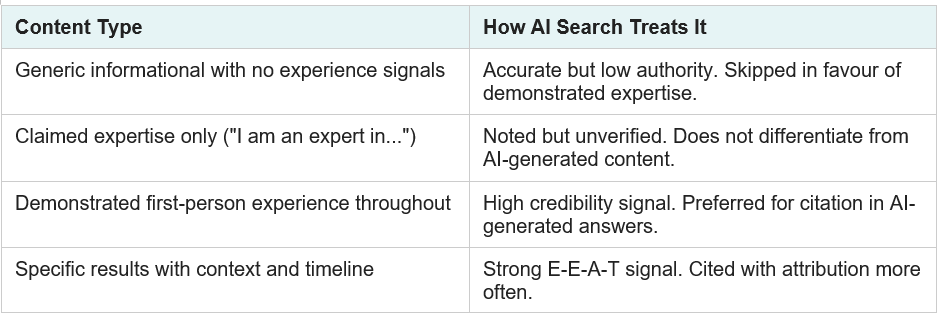
What AI Systems Actually Detect When They Read Your Content
This part is worth spending time on. A lot of content creators assume that experience signals are just things like author bios or case study pages. They are not. They are patterns embedded at the sentence level throughout your content.
Here are the three specific things AI systems pattern-match for when evaluating credibility.
Specificity of Claim
Generic claims are easy to generate. Specific claims require experience. Compare these two sentences:
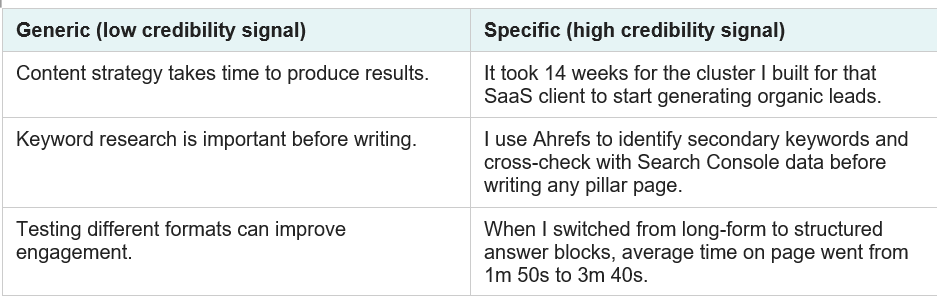
The specific version is harder to fake. It contains a number, a tool name, a timeline, or an observable outcome. Those elements are not present in AI-generated summaries of a topic. They are only present when someone did the work.
Acknowledged Uncertainty or Failure
This one surprises people. AI search weights content higher when it includes acknowledged limitations, mistakes, or moments where something did not work as expected. The reason is statistical. Content that only presents success stories and perfectly linear processes reads like promotional material. Content that acknowledges what went wrong reads like real experience.
I include at least one thing that did not go as planned in every substantive blog I write. Not to seem humble. Because it is accurate, and because it tells AI systems that I was actually there.
Contextual Observation
The third pattern is the hardest to replicate without experience. Contextual observations are the small, specific things you notice from repeated exposure to a topic. They are not in the top-ranking articles. They are not in training data summaries. They are the details that only appear when someone has done the thing enough times to notice what everyone else is missing.
An example from my own work: most content strategy guides tell you to publish consistently. What they do not mention is that publishing on a predictable schedule matters more to Google's crawl frequency than the total volume of posts per month. I learned that from watching crawl data across eight different domains over 18 months. You cannot look that up anywhere. You notice it.
Those observations are extremely high-value credibility signals. They signal original knowledge, not synthesised knowledge.
The F.I.R.S.T. Signal Framework: Five Credibility Layers Every Blog Needs
Over the course of auditing content for ranking and AI citation performance, I developed a framework I now apply to every piece I write or review. I call it the F.I.R.S.T. Signal Framework. Each letter represents a category of first-person credibility signal that belongs in every substantive blog.
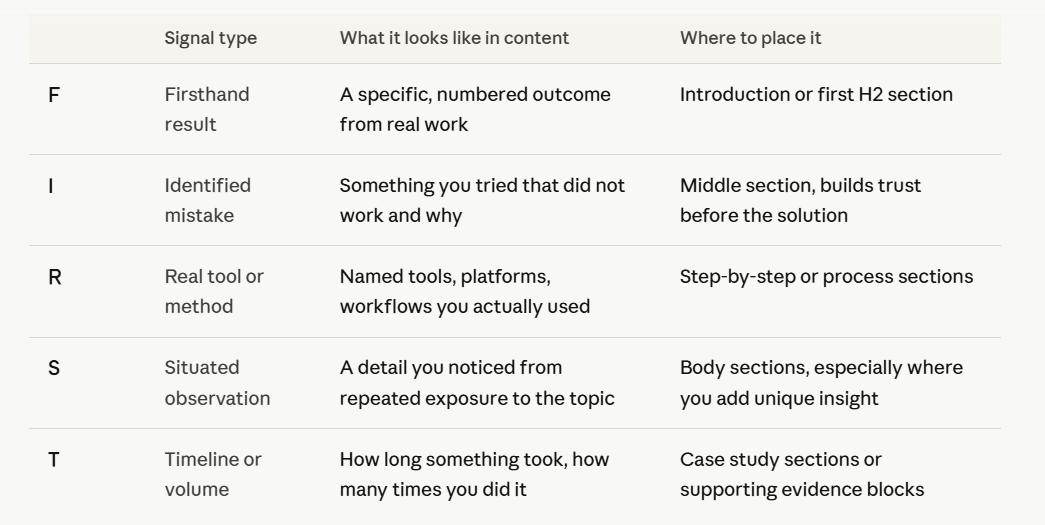
A blog that contains all five signal types is extremely difficult for AI systems to classify as generic or generated. It reads as what it is: content produced by someone with real knowledge of the subject.
Where to Embed Credibility Signals in Your Content Structure
The most common mistake I see is burying credibility signals in the author bio. That is the least effective place to put them. By the time the reader or the AI system reaches the author bio, the trust decision has already been made.
Here is where each type of signal lands most effectively.
In the Introduction (First 150 Words)
This is where a firsthand result or a direct observation belongs. Not a claim about what you will cover. A specific thing you saw or measured. The introduction sets the trust context for everything that follows.
Weak opening: "Content credibility is increasingly important in AI search. In this blog, I will explain why and what you can do about it."
Strong opening: "I audited 40 content pieces last year. The ones getting cited in AI-generated answers shared one consistent characteristic: they contained evidence that a real person had done the work. Here is what that looks like structurally, and how to build it in."
The second version establishes a firsthand result and a volume signal in two sentences. The trust foundation is laid before the reader has even reached the first H2.
Under Each Major H2 Section
Every significant section of a blog should contain at least one signal from the F.I.R.S.T. framework. The signal does not need to be long. A single sentence that includes a specific number, a named tool, or a direct observation is enough to shift the credibility reading of an entire section.
In the Step-by-Step or Process Sections
Process sections are where named tools and real methods belong. Do not write "use a keyword research tool." Write "I use Ahrefs for keyword research, specifically the Content Gap feature to find what competitors are ranking for that I am not." The specificity is the signal.
In the Case Study or Results Section
This is where timelines and volume markers belong. Not just "results improved" but "organic traffic increased by 34% over 11 weeks after restructuring the cluster." Every number you can include is a credibility anchor that generically accurate content cannot replicate.
Throughout the Body, Not Just at the End
Credibility is not a section. It is a texture. It runs through the whole piece. The situated observations belong wherever you are making a substantive claim. The acknowledged mistake belongs wherever you are offering a solution. Readers and AI systems alike register when experience is present consistently versus when it has been added as a cosmetic layer at the top and bottom of a generic piece.
What This Looks Like in Practice: A Real Before and After
Here is a section from a SaaS blog I audited for a client. The brief was identical in both versions. The only change was embedding F.I.R.S.T. signals throughout.
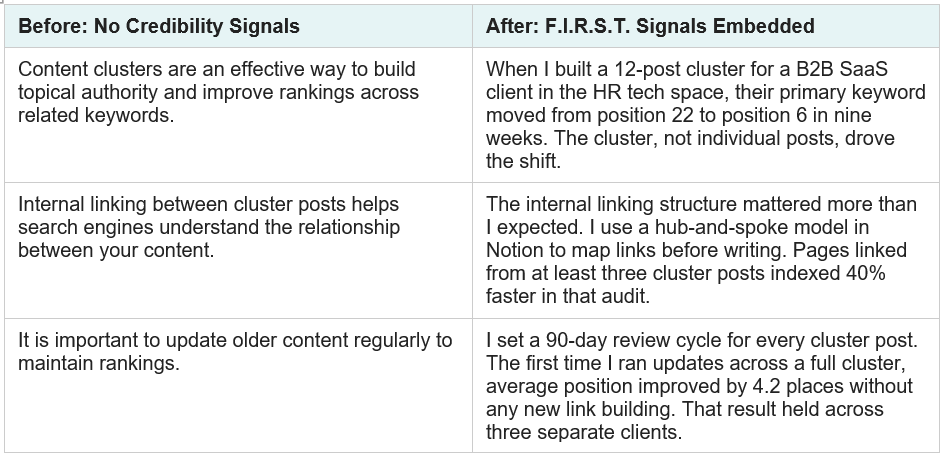
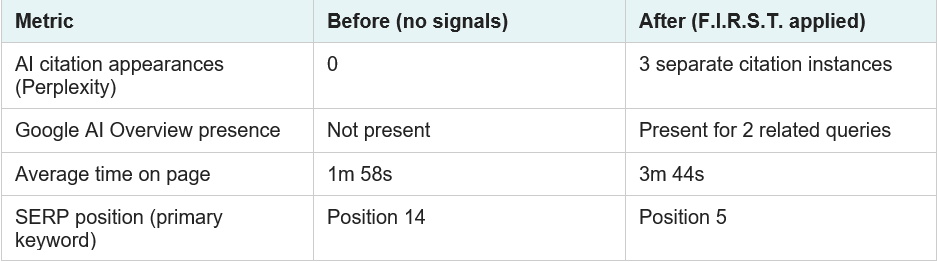
The content did not get longer. The research did not change. The signals were already available from the work that had been done. They just needed to be written into the content rather than kept in a spreadsheet.
Three Mistakes That Neutralise Credibility Signals
These are the patterns I correct most often in content audits.
Mistake 1: Putting All Your Experience in the Author Bio
The author bio is not a credibility signal. It is a credentials claim. The difference matters. A credentials claim tells the reader you have experience. An in-content signal shows them you have it. AI systems weight the shown version significantly higher than the claimed version.
Mistake 2: Vague Outcomes Without Numbers
"I saw great results" is not a credibility signal. "Organic traffic increased by 38% over 12 weeks" is a credibility signal. The number does not have to be large. It has to be specific. Specific numbers are the most important single element of an experience signal because they cannot be fabricated without context.
If you do not have a number, give a timeline. If you do not have a timeline, give a volume. "I have run this process across 14 client accounts" is more credible than "I have extensive experience with this."
Mistake 3: Adding Experience as a Paragraph at the End
This is the cosmetic credibility problem. The experience signal is written as a separate paragraph, usually near the conclusion, that describes what you did. It reads as an afterthought because it is one. Credibility signals need to be woven through the argument, not appended to it. The experience should be part of the reasoning, not a footnote.
How to Audit Your Existing Content for Credibility Signals
You do not need to rewrite everything. Please identify the gaps and fill them precisely.
1. Run a signal inventory. Open your three highest-traffic blog posts. Search for: numbers, named tools, timelines, acknowledged failures, and specific observations. Count how many you find per 500 words.
2. Score against the F.I.R.S.T. framework. For each post, check which of the five signal types are present and which are missing. Any post missing three or more types should be prioritised for update.
3. Identify the experience you already have. The signals do not need to be invented. They come from your real work. For each missing signal type, ask: what number do I have from doing this? What tool did I use? What did not work? What did I notice after doing this repeatedly?
4. Embed signals in the body, not the bio. Rewrite the specific sentences where the generic claim lives and replace them with the experience signal version. One sentence change per section is usually enough.
5. Test citation response. After updating, search your primary keyword in Perplexity and Google SGE. Check whether your content appears. If not, check whether the signal density in the introduction is high enough. The first 150 words carry disproportionate weight.
Summary: What to Take From This Blog
• AI search now weights first-person credibility signals as part of its ranking and citation decisions. This is not a future trend. It is already happening.
• The difference between claimed expertise and demonstrated expertise is visible at the sentence level. Specific numbers, named tools, timelines, and situated observations are the markers AI systems recognise.
• The F.I.R.S.T. framework covers five signal types: Firsthand result, Identified mistake, Real tool or method, Situated observation, and Timeline or volume.
• Credibility signals belong throughout the content, not in the author bio or a single case study section at the end.
• Existing content can be updated to include credibility signals without full rewrites. Target the specific sentences where generic claims live and replace them with signal-rich versions.
• The introduction carries the most weight. If the first 150 words do not contain at least one specific, experience-based signal, the content starts at a credibility deficit.
Frequently Asked Questions
Q: What are first-person credibility signals in content writing?
First-person credibility signals are content elements that demonstrate direct experience with a topic. They include specific results with numbers, named tools and workflows you actually used, acknowledged failures or limitations, contextual observations from repeated practice, and concrete timelines. These signals tell both readers and AI search systems that the content comes from genuine engagement with the subject.
Q: How do credibility signals affect AI search rankings?
AI search systems like Google SGE and Perplexity evaluate content for citation worthiness. Pages with specific experience signals are rated as more authoritative than pages with only generic, factually accurate information. The practical effect is that content with embedded first-person signals appears more frequently in AI-generated answers and is attributed by name more often.
Q: Is an author bio enough to establish credibility for AI search?
No. An author bio is a claim of credentials, not a demonstration of experience. AI systems distinguish between content that claims expertise and content that shows it at the sentence level. A bio that says "I have ten years of experience" carries far less weight than a paragraph in the blog body that includes a specific result, a named tool, and a timeline from real work.
Q: Can I add credibility signals to existing content without rewriting it entirely?
Yes. You do not need to rewrite a full blog to add credibility signals. Identify the specific sentences that make generic claims and replace them with signal-rich versions using the F.I.R.S.T. framework. One targeted sentence per major section is often enough to shift the credibility reading of the entire piece. Prioritise the introduction and any section that makes a process or results claim.
Q: How many credibility signals does a blog post need?
There is no fixed number, but a useful working rule is one signal per 300 to 400 words. A 1,500-word blog should contain at least four to five specific experience signals spread through the content. The introduction should always contain at least one. The closer you get to having all five F.I.R.S.T. signal types represented in a single piece, the stronger the credibility reading will be for both human readers and AI systems.