Why Your SaaS Copy Is Killing Sales (And How Direct Response Fixes It)
B2B SaaS copywriting is the practice of writing website, email, and landing page content that moves a business buyer to take a specific action: a demo, a sign-up, or a purchase. Unlike brand copywriting, it focuses on measurable outcomes: conversion rates, pipeline, and revenue, not awareness or tone of voice.
I've watched founders stare at a blank page for an hour and type "synergistic cloud-native paradigm" at the end of it.
They've built something genuinely useful. Code that solves a real, painful problem for real people. But the moment they sit down to describe it, something breaks. The words that come out sound nothing like the product they built. They sound like a regulatory filing.
Meanwhile, churn ticks up. CAC creeps north. The runway shortens.
This isn't a product problem. It's a copywriting problem.
In B2B SaaS, your copy is the software's interface with human desire. If that interface is broken — if visitors bounce, if prospects glaze over, if nobody clicks the demo button — the business struggles regardless of how good the code is underneath.
That's what this piece is about. Not vague "brand voice" advice. A specific, psychological framework that I've seen transform conversion rates on SaaS landing pages, cold email sequences, and pricing pages.
The Myth I Want to Kill Immediately
The most damaging belief in B2B marketing is this: business buyers are different.
The idea that once someone walks into an office, they transform into a rational, emotionless machine who only responds to ROI spreadsheets and feature comparison tables.
It's nonsense.
The person buying your software is terrified of making the wrong call in front of their board. They're exhausted from manually doing the thing your tool automates. They desperately want to look competent, move up, and stop working late.
The golden rule I return to constantly: you are not writing to an enterprise. You are writing to a lonely, stressed individual who happens to hold a corporate credit card.
Direct response copywriting is the art of reaching that individual and moving them to act. It's not about brand awareness. It's about a click, a reply, a booking.
If your copy doesn't ask for a specific action, it's expensive decoration.
Why Most SaaS Copy Fails: The Committee Problem
Most SaaS copy is written by committee, and committees are where specificity goes to die.
The product team wants every API integration listed. Legal wants every bold claim softened. The CEO wants to sound visionary. The result is copy that sounds like this:
"An integrated suite for enterprise resource optimisation."
Nobody woke up at 3 AM sweating about "resource optimisation." They woke up sweating because their payroll software crashed and twenty contractors are threatening to walk off the job.
Direct response flips the telescope around. You don't start with what the software does. You start with the chaos the software fixes.
The distinction sounds obvious, but I see this mistake constantly — even in well-funded SaaS companies with dedicated marketing teams.
The Psychology Behind Every B2B Purchase
To write copy that converts, you need to understand what's actually driving the decision.
B2B purchases are high-stakes. A bad B2C purchase costs someone £20. A bad B2B purchase can cost someone their job.
Three forces dominate every enterprise buyer's thinking:
Fear of public failure. If the software breaks at the wrong moment, they look incompetent in front of the board, the CFO, or the entire customer success team.
The burden of change. Switching software is painful. People prefer a familiar hell to an unknown heaven. Implementation risk is real, and buyers feel it viscerally.
The committee hurdle. Your champion inside the business still has to convince the CTO, the procurement team, and the finance director. They need political cover, not just a good product.
Your copy has to do more than explain the software. It has to arm your reader with the arguments they need to fight those internal battles on your behalf.
The AASPA Framework: A Direct Response Arc for SaaS
Every high-converting SaaS page follows a specific psychological sequence. I call it AASPA.
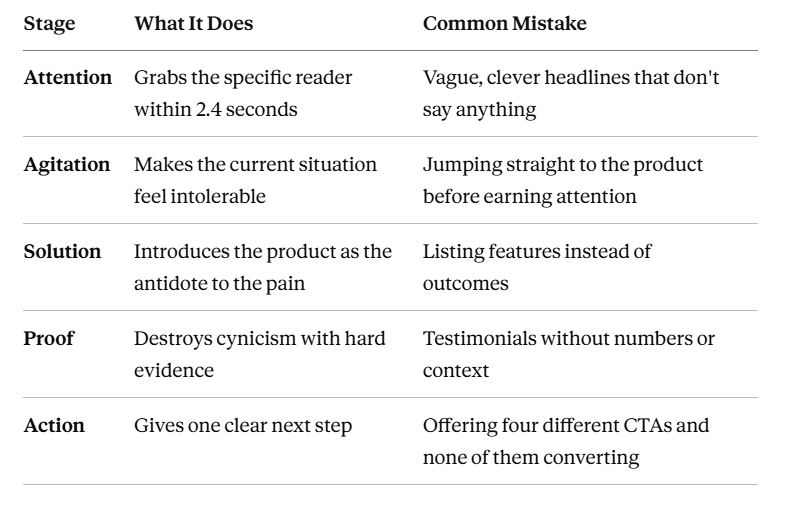
Let me walk through each stage in detail.
Stage 1: Attention — Grab the Collar
Your headline has 2.4 seconds to answer one question: what is in this for me?
Vague headlines lose. Clever headlines lose. Specific, clear, benefit-driven headlines win.
In B2B direct response, the three headline formulas that consistently perform are:
The direct value proposition. State exactly what the software does and for whom.
Bad: "Revolutionising the Accountancy Ecosystem."
Good: "Run UK Payroll in 3 Clicks. No Spreadsheets. No Compliance Errors."
The pain-driven hook. Target the specific daily misery of your buyer.
Bad: "Smarter Inventory Management Systems."
Good: "Stop Losing £5,000 Every Time Your Warehouse Miscounts Stock."
The ROI guarantee. Speak directly to the budget holder.
Bad: "Optimised Ad Spend Through Advanced Analytics."
Good: "Cut Your CAC by 30% in 14 Days. Or Pay Nothing."
Eighty per cent of your conversion battle is the headline. Win that, and everything else gets easier.
Stage 2: Agitation — Twist the Knife
Before you mention the product, you need the reader to feel the weight of their current situation.
Remind them of the spreadsheets that crash. The hours spent on manual data entry. The Friday afternoon spent copy-pasting numbers into PowerPoint when they could have been driving home.
Make the status quo feel genuinely intolerable. Not in a manipulative way — in a this is real and I understand your life way. Buyers who feel understood are buyers who trust you.
Stage 3: Solution — Reveal the Hero
Now — only now — do you introduce the product.
Don't introduce it as a feature list. Introduce it as the specific antidote to the pain you just described. The bridge from their current hell to the life on the other side.
Stage 4: Proof — Build the Wall
B2B buyers are cynical. They've been burned by vaporware before. They've sat through demos of software that looked incredible and shipped nothing.
You need to crush their doubt with hard evidence: quantified case studies, recognisable client logos, security certifications, data points with specific numbers.
"Customers love us" is not proof. "We reduced Acme's payroll processing time from 4 hours to 22 minutes" is proof.
Stage 5: Action — The Binary Choice
End with one clear call to action. Not three. Not "read our blog, follow us on LinkedIn, and book a demo." One path forward.
The more choices you give, the fewer decisions people make.
The So What? Method: Translating Features Into Benefits
The most common mistake in SaaS body copy is listing features as if they're benefits.
They're not. A feature is what the software does. A benefit is what the user gets to feel, gain, or avoid because of that feature.
The technique I use is called the So What? method. Take any feature, ask "so what?", and repeat until you hit a human emotion.
Example 1: Database speed
Feature: "Our platform uses a proprietary NoSQL database architecture."
So what? Data queries resolve in under 50 milliseconds.
So what? Customer support agents don't have to make awkward small talk while waiting for records to load.
Benefit: "Keep angry customers calm with instant account retrieval. No awkward pauses. No dropped calls."
Example 2: Automated reporting
Feature: "Automated weekly PDF generation."
So what? The system compiles marketing data and emails it to the board every Friday morning.
So what? You don't spend Thursday evening copy-pasting numbers into PowerPoint.
Benefit: "Take your Thursday nights back. Let our system build your board presentations while you drive home."
Run every feature on your landing page through this exercise. If you can't get to a human emotion by the third "so what?", the feature probably shouldn't be on the page.
Case Study: RouteMaster Fleet Software — Before and After
Let me show you what this looks like in practice with a fictional UK-based fleet management company.
Their original copy was written by their engineering lead:
"RouteMaster utilises advanced algorithmic pathfinding and GPS telemetry streams to optimise multi-stop logistical operations. Our cloud-based interface integrates seamlessly with existing enterprise resource planning software via a robust REST API framework, offering real-time latency reductions."
Accurate. Clean. Completely uninspiring. It reads like a technical specification, not a sales argument.
Here's the rewrite using direct response principles:
Stop Burning Fuel on Inefficient Routes. Save £420 Per Van Every Month.
RouteMaster tracks your fleet in real time, automatically rerouting drivers around traffic bottlenecks before they get stuck. Cut delivery times by 22%, keep customers happy, and slash fuel bills — without buying new vehicles.
Zero setup fee: Link your vehicles in under an hour.
No long contracts: Pay monthly, cancel whenever.
Guaranteed savings: If you don't reduce fuel spend in 30 days, you pay nothing.
The "After" version speaks directly to the business owner's wallet. Every sentence is about what they get, not how the software works.
That shift alone — from technical description to business outcome — is usually where conversion improvements come from.
The Four Objections Every B2B Buyer Has (And How to Answer Them)
Every prospect has a chorus of cynical voices in their head. Your copy needs to anticipate and neutralise them before they harden into a closed tab.
Objection 1: "It will take too long to set up."
Implementation fear kills deals. Answer it with brutal specificity:
"Up and running in 17 minutes. Our migration wizard pulls your data from Salesforce automatically. Zero downtime. Zero developer hours required."
Objection 2: "We don't have the budget right now."
Reframe the price as an investment. If your tool costs £500 per month but saves £5,000 in lost labour, the maths speaks for itself:
"If our platform doesn't save your team at least 10 hours a week in its first month, cancel. We'll refund every penny."
Objection 3: "Is it secure?"
In the UK, data protection is non-negotiable. Don't tuck this in a footer:
"Bank-grade security, GDPR compliant, hosted on ISO 27001 certified infrastructure with end-to-end encryption."
Objection 4: "Our team won't actually use it."
Adoption risk is real. Address it directly:
"Designed for humans, not tech elites. If your team can send an email, they can use this platform. No training days required."
Micro-Copy: The Words Nobody Thinks About
The smallest words on your site can have a disproportionate impact on conversions.
Default button text like "Submit" or "Click Here" triggers anxiety — they imply effort without explaining what the user gets. Replace every generic CTA with value-centric language that completes the sentence "I want to…"
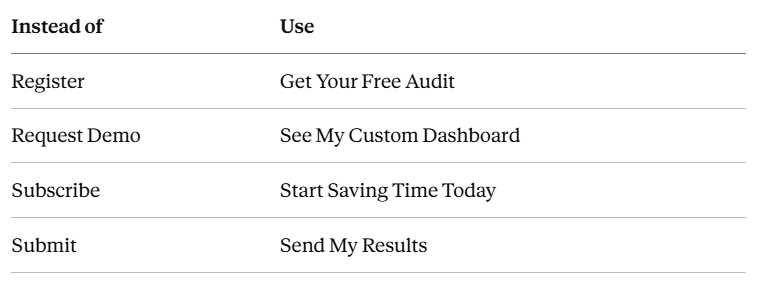
Add a reassurance line directly beneath your primary CTA. "No credit card required. Cancel anytime. Setup takes 2 minutes." These small phrases reduce friction at the exact moment of decision.
Long-Form vs Short-Form: When to Use Each
The length debate has a simple answer: it depends on awareness and price.
High price + low awareness = long-form copy required.
If you're selling a £2,000-per-month cybersecurity platform to non-technical business owners who've never experienced a ransomware attack, you need to educate, agitate, reassure, and build an airtight case. One short page won't do it.
Low price + high awareness = short-form copy required.
If you're selling a £15-per-month project management tool to productivity geeks who already understand the concept, keep it short. UI, speed, and social proof are all you need.
The rule I follow: copy can never be too long. It can only be too boring. If every sentence delivers value, the right buyer will read every word.
The Editing Checklist I Use Before Publishing
Before any SaaS copy goes live, I run it through this filter:
Is it in active voice? ("Thousands of businesses trust our software" beats "Our software is trusted by thousands.")
Have all buzzwords been removed? (Delete: synergy, paradigm, holistic, world-class, cutting-edge.)
Are paragraphs short and scannable on mobile? No block of text should be thicker than a finger width.
Does the copy say "you" more than "we"? Count the pronouns. If "Our product" appears more than "Your business," rewrite it.
Is there one, singular call to action? If the reader can't tell what to do next, the page is incomplete.
What to Do Next
If you've read this far, you already know whether your current copy passes the test. Most SaaS landing pages don't.
Start with the So What? exercise on your three most prominent features. See where it takes you. The jump from feature description to benefit-driven copy is usually the single highest-leverage improvement you can make without touching the product or the pricing.
FAQs
What is direct response copywriting in B2B SaaS?
Direct response copywriting in B2B SaaS is the practice of writing website and email content specifically designed to prompt an immediate action — a demo booking, sign-up, or trial. Unlike brand copywriting, it's measured by conversion rates and revenue, not impressions or engagement.
Why does most SaaS copy fail to convert?
Most SaaS copy is written by committee, focused on features rather than outcomes, and speaks to an abstract "enterprise" rather than the stressed individual making the buying decision. It also tends to lack risk reversal, specific proof, and a clear singular call to action.
How long should a B2B SaaS landing page be?
Length should match awareness and price. High-cost products sold to buyers unfamiliar with the problem category need long-form pages that educate and build trust. Lower-cost, widely understood tools can convert on a short, focused page. The rule: copy should be as long as it needs to be to answer every objection, and not a word longer.
What is the most important element of a SaaS landing page?
The headline. It determines whether anyone reads anything else. A vague or feature-driven headline will cause most visitors to bounce before seeing any of the copy below it.
How do I write copy that addresses multiple buyer personas?
Don't. Write separate landing pages for each persona. Trying to speak to the marketing director, the data analyst, and the procurement officer on the same page means you speak to none of them effectively. One page, one reader, one problem, one action.