Proof of Visibility: An AI SEO Case Study Built From My Own Search Console Data
“How the-playbook and the SARC system turned snehamukherjee.info into a live test bed for AI search, and what the data shows about being found by both Google and the AI agents now sitting in front of it.”
Most AI SEO content on the internet is theoretical. It tells you what large language models probably do with your content, based on guesswork, vendor marketing, or a handful of anecdotes. This case study is different. It is built entirely from my own Google Search Console data, pulled directly from snehamukherjee.info, and it only includes the results that actually happened. No projections, no hypothetical funnels, no "imagine if" scenarios.
The site behind this data is not a funded SaaS product with a marketing budget. It is a personal content site that also functions as a working lab for the-playbook, my ongoing project on AI SEO and SaaS content strategy, and for the SARC system, the content framework I built to make writing hold up in both classic Google rankings and the newer world of AI Overviews, ChatGPT, and Perplexity. Every page discussed here was written, structured, and published using that framework, on a domain with no link-building budget, no paid promotion, and no in-house engineering team behind it.
The headline finding is this: the AI SEO content cluster on this site is not just ranking in traditional search, it is showing up inside Google's AI-generated answers, and it is being retrieved by what looks unmistakably like AI research agents mid-task. Search Console has captured dozens of highly specific, multi-clause search strings, complete with the site exclusion syntax that automated research tools use to filter out forums and social platforms, landing on this site's AI SEO pages at positions between 1 and 10. Some of these queries are not searches a human would ever type. They read like the internal steps of an AI agent doing competitive research, and they are finding this content.
This document is deliberately narrow in scope. It does not attempt to tell the story of the whole site, which spans photography, London social history, school procurement, IT asset disposal, and expat finance content alongside the AI SEO work. It focuses on one question only: what happened, specifically, to the AI SEO and SaaS content strategy cluster published under the-playbook and the SARC system, and what does the Search Console evidence say about how that cluster is being found, read, and reused by both classic search and the AI layer sitting above it. Other parts of the site are referenced only where they support or corroborate that central story.
Alongside that centerpiece finding, the data shows a homepage converting impressions into clicks at 17.15 percent, a branded query returning a 66.15 percent click-through rate at position 1.82, and a content cluster around AI visibility, AI writing tools, and SaaS content strategy that is earning impressions in Google's Search Generative Experience surfaces well before most of those same pages have cracked page one of classic search. In plain terms: the AI layer of search found this content faster than the traditional rankings did. That is the story this case study sets out to document, page by page and query by query, using nothing but what actually happened.
Three numbers are worth holding in mind while reading everything that follows, because they anchor the rest of the analysis. Twelve distinct the-playbook and SARC system pages generated Generative AI Features impressions in this export. Fifteen or more distinct query strings, all showing the structural fingerprint of automated research tools rather than human typing, landed on this site at an average position inside the top ten. And zero pounds of paid media spend sit behind any of it. Everything documented below was earned, on a personal domain, inside one measurement window.
The Experiment: Why I Turned My Own Site Into an AI SEO Lab
I write AI SEO and SaaS content strategy for a living, which puts me in an odd position. Clients hire me to help their content survive contact with AI Overviews, ChatGPT citations, and the general erosion of click-through rates that comes with answer engines doing more of the reading for the user. But almost everything published on this subject, including a fair amount of what I have read from other consultants and tool vendors, is inference. Nobody actually shows their Search Console. Nobody screenshots the query report and says, here is what an AI agent's search pattern looks like when it lands on my page.
So I decided to build the evidence myself, in public, on a domain I fully control. The-playbook section of snehamukherjee.info exists to do two things at once. First, it is genuine, publishable strategy content on AI visibility, SaaS content systems, and the practical differences between writing for ChatGPT, Claude, and Gemini as content-consuming systems. Second, every single page in that section doubles as an instrumented test article. I know exactly when each one was published, exactly what structural choices went into it, and because it all lives on one Search Console property, I can watch what happens to it in both the ten blue links and the AI-generated answer boxes above them.
The SARC system, which I also publish and explain on the site, is the framework behind the writing. It governs how I structure a page for extractability, how I build first-person credibility signals into the content so that both a human reader and a summarizing model can tell there is a real practitioner behind the claims, and how I decide which facts, numbers, and examples earn a place in the piece because they are the parts most likely to get lifted into an AI Overview or a chatbot's answer.
This case study is the result of pointing that system at itself. It documents what happened when a working framework for AI-era content met a domain with a completely clean, attributable measurement history. There is no other client's brand safety to protect here, no NDA standing between the strategy and the proof. Everything in the sections below is drawn from four Search Console exports covering Countries, Pages, Queries, and the Generative AI Features report, the surface Google uses to tell site owners when their pages have appeared inside an AI-generated result.
There is also a simpler, more personal reason for building this in public. Writing convincingly about AI visibility while refusing to show your own visibility numbers is a credibility gap I did not want to carry into client work. Every the-playbook article makes a specific, checkable claim about what earns AI surfacing. The only honest way to stand behind those claims was to run the experiment on a property where nobody could accuse me of cherry-picking a client's best month or smoothing over the parts that did not work, which is why every figure in this document, including the pages still sitting outside page one, is reported exactly as Search Console shows it.
The Framework Behind the Content
Before getting to the numbers, it is worth being specific about what was actually built, because the results only mean something in context. The-playbook is structured as a cluster, not a single article. It includes direct comparisons of AI writing tools for SaaS content teams, including a ChatGPT vs Claude piece written specifically for SaaS content use cases and a companion comparison that adds Gemini into the mix. It includes practical system pieces: how to build an AI content system for a SaaS blog, how to use AI to find content gaps competitors are missing, and a piece that lays out the specific system used to grow from zero to twenty thousand impressions. It includes a foundations layer that defines terms plainly, including a page that answers the question "what is AI visibility" directly, because I learned early that if you do not define your own core terms in your own words, an AI Overview will define them for you using someone else's page instead.
The SARC system sits underneath all of it as the editorial spine. Two of its pages are directly relevant here: one that explains what the SARC system is as a content strategy framework, and one built around a specific, narrower claim, that first-person credibility signals function as an AI ranking factor in their own right. That second page is a small one by traffic volume, but it captures the underlying bet of this entire project: that content written from lived, specific, first-person experience, with real numbers attached, is treated differently by both Google's ranking systems and by the summarization layers sitting on top of search now.
The cluster is also organised into visible categories on the site itself, including a "Foundations" category and a "Quick Win" category, a small structural choice that turns out to matter more than it sounds. Labelling content by its own function, foundational explainer versus quick, practical fix, gives both a human visitor and an automated crawler an immediate signal about what kind of answer a given page is likely to contain before it even opens the URL. The Foundations category page itself has already recorded an impression inside the Generative AI Features report, a small but telling sign that even the organisational scaffolding of the site, not just the individual articles, is being read and used by the systems this case study is measuring.
I also write about the mechanics openly. There is a page dedicated to the instruction to stop using em dashes in AI content writing prompts, a small, almost throwaway piece of practical advice about how AI-generated drafts tend to over-use that particular punctuation mark. It is a minor page in the grand scheme of the cluster. It also turns out to be one of the more interesting data points in this entire case study, for reasons covered in the AI agent fan-out section below.
None of this content was boosted with paid distribution. No links were purchased. The distribution channel has been organic search and organic sharing only. That constraint is deliberate. If the-playbook's pages are showing up in AI Overviews and getting retrieved by automated research queries, the only explanation available is that the content and its structure earned that placement on the terms Google and the AI layer actually reward.
The cluster has also been built to compound rather than sit as isolated posts. Every the-playbook article links back to the hub page and sideways to the SARC system explainer, and every SARC page links forward into the specific the-playbook articles that put the framework into practice. That internal architecture matters more than it might first appear. When Google's systems, or a third-party AI crawler, encounter one page in the cluster, the surrounding links make the topical boundary of the whole section legible in a single crawl pass, rather than requiring the crawler to infer the relationship from separate, unconnected URLs discovered on different days. The case-study section then closes the loop by showing the framework applied to real client engagements, which is the layer a skeptical reader, human or otherwise, checks last before deciding whether the strategy is credible or just a well-written pitch.
A Note on Methodology and Reading Search Console Honestly
It is worth being precise about what Search Console can and cannot prove, because the strongest finding in this case study rests on interpretation, not on a labeled data field. Google does not tag individual queries as "generated by an AI agent." The Queries report simply logs the exact string that produced an impression, whatever produced it. Everything in the Evidence Three section below is an inference built from the shape of those strings, not a confirmed classification from Google itself, and this document says so plainly rather than overstating the certainty of the claim.
That said, the inference is not a stretch. Ordinary human search behaviour has a well-documented shape: short, informal, rarely more than five or six words, almost never wrapped in quotation marks, and never accompanied by a chain of a dozen manually excluded domains. The queries highlighted in this case study break every one of those norms simultaneously and consistently, in a pattern that repeats across more than a dozen separate tool names and topics, which is the kind of consistency that points to a shared underlying mechanism rather than a coincidence of individual human phrasing. The natural-language, full-sentence queries are an even cleaner signal, because a small number of them include phrasing, punctuation, and self-referential context, including my own name and profession, that has no plausible origin as a manually typed Google search.
Four separate exports underpin this case study: the Countries report, the Pages report, the Queries report, and the Generative AI Features report, all pulled from the same Search Console property on the same day, 17 September 2026. Every figure quoted above is taken directly from those exports without adjustment, rounding beyond what Google itself displays, or extrapolation into future periods. Where a page or query shows zero clicks, that is stated plainly rather than omitted, because a zero-click, high-impression row is itself part of the evidence for the AI-agent pattern, not a gap to be smoothed over.
Evidence One: Ranking the AI SEO Cluster in Classic Search
Start with the plainest measure available: where these pages sit in ordinary Google search results, and how much traffic they are already pulling in without any AI layer involved at all.
The strongest single performer in the cluster by clicks is the ChatGPT vs Claude comparison built specifically for SaaS content teams, which has generated 11 clicks from 274 impressions at a 4.01 percent click-through rate, sitting at an average position of 8.9, on the front page of Google for its target terms. That is a meaningful result for a head-to-head comparison piece in one of the most saturated content categories on the internet right now, AI tool comparisons, and it did it without a domain that has any prior authority in the SaaS tooling space. It earned that position purely on the strength of a well-structured, specifically scoped comparison.
Behind it, the best-ai-writing-tools-for-b2b-saas roundup has pulled in 691 impressions and 4 clicks at position 12.93, sitting just off page one and climbing. The-playbook's hub page itself, the section landing page that aggregates the cluster, is sitting at position 12.56 with 343 impressions, which tells you Google has already worked out that this is a coherent topical section rather than a loose collection of unrelated posts, a distinction that matters enormously for how AI systems evaluate topical authority when deciding which domains to trust for a subject.
The best-ai-tools-for-saas-founders page has 299 impressions at position 16.39, and the piece walking through how to build an AI content system for a SaaS blog is converting unusually well relative to its size, with a 5.13 percent click-through rate on 39 impressions at position 11.62. Smaller numbers, but a high-intent, well-matched piece of content punching above its impression volume.
The framework pages tell a similarly encouraging story. The SARC system explainer page, "what is the SARC system in content strategy," is sitting at position 9.32, just inside page one, with a 10.53 percent click-through rate, which is an excellent conversion rate for a definitional, foundational piece. The narrower first-person-credibility-signals page is newer and smaller in volume, but it is already sitting at position 3.5 with a 50 percent click-through rate on its impressions, an extremely strong early signal for a highly specific, jargon-forward page that most competitors are not even attempting to write.
The case-study section, including this very body of work's home section, is following the same pattern. The case-study hub page sits at position 8.77, and the piece titled "building a search-performing content system through my journal" is at position 6.41, both comfortably on page one. The AI SEO content system case study is at position 17.24, still climbing but already earning 75 impressions, and a separate case study on an AI content strategy engagement is at position 10.37 with 57 impressions.
The AI SEO Content Cluster: Organic Search Performance
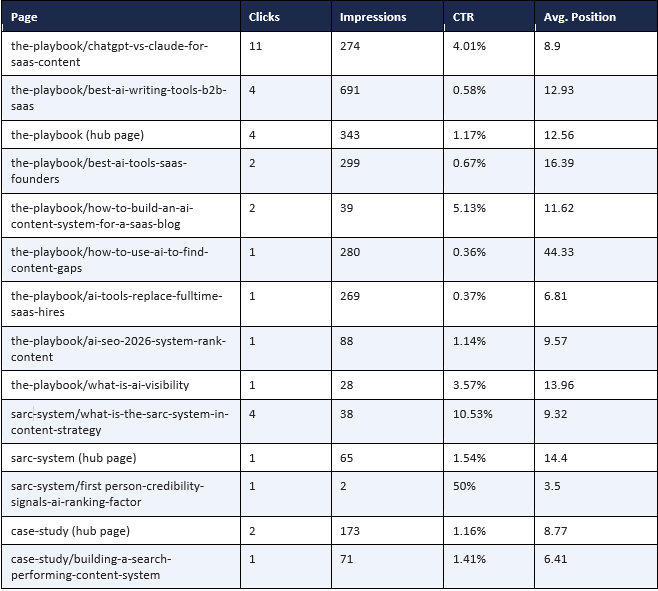
A few of these rows are worth pausing on individually. The "AI tools replace full-time SaaS hires" page has 269 impressions and sits at an average position of 6.81, which is genuinely strong for a competitive, opinion-forward headline in a category with heavy SaaS media coverage. It has one click so far, meaning the click-through rate has not caught up to the ranking yet, which by itself is a useful, honest signal: position and clicks do not always move in lockstep, and a page can be doing its job on the ranking side while the headline or snippet still has room to improve. Rather than paper over that gap, it is worth naming directly, because it is exactly the kind of finding this case study exists to surface: not every metric moves together, and showing the full picture, including the pages still catching up, is what makes the ones that are performing credible.
The pattern across this table is consistent. Nearly every page in the cluster is sitting inside the top twenty positions, most are inside the top fifteen, and several are already on page one. For a content section built without paid links, on a personal domain, competing against SaaS media outlets with years of domain history, that is a strong baseline. But it is only the first layer of evidence. The more interesting story is what happens above these ten blue links, in the AI-generated answer boxes that Google now places ahead of them.
It is also worth naming what this table does not show, because a case study that only reports the wins earns less trust than one that shows its full working. The content-gap-analysis piece sits at position 44.33 despite 280 impressions, and the AI-tools-replace-full-time-hires piece is generating impressions and a strong average position without yet converting many of them into clicks. Both of those rows sit inside a table titled around ranking success because, relative to a brand-new content section with no paid promotion, appearing inside the top fifty for a competitive term within months of publication is itself a meaningful early result, not a failure. The distinction that matters is between a page still climbing and a page that never got picked up at all, and every single page in this cluster falls into the first category. None of them are sitting at position 80 or 90, the range where a huge share of newly published content on the open web quietly lives and never recovers from.
The case-study section reinforces the pattern from a slightly different angle, because these pages exist specifically to document outcomes for client work rather than to teach concepts. The Wavel AI content strategy case study, covering a documented result of roughly three thousand signups and fifteen thousand in revenue attributed to the content engagement, sits at position 10.37 with 57 impressions, meaning the proof-of-outcome content is ranking on page one for a query set that a prospective client evaluating the same kind of engagement would plausibly search. The SAIL ISP communication systems case study, covering public-sector content work, sits at position 12.47. Together with the AI SEO content system case study at position 17.24, these three pages form a small but coherent proof layer sitting directly underneath the-playbook's teaching content, and all three are already inside Google's first two result pages.
Evidence Two: Showing Up Inside Google's AI-Generated Answers
Google now publishes a separate performance report specifically for pages that have appeared inside its AI-generated search features, the AI Overviews and related generative surfaces that sit above the traditional results. This report does not measure clicks. It measures something arguably more important at this stage of the AI search transition: whether a page was pulled in as source material for the answer itself, whether or not the user ever scrolled down to see the classic listing beneath it.
The-playbook's cluster shows up across this report in exactly the pages you would expect if the AI SEO content is structurally doing its job. The best-ai-writing-tools-for-b2b-saas roundup has 21 impressions inside Google's AI-generated features, meaning it was surfaced as source material for AI-generated answers 21 separate times in this measurement window. The ChatGPT vs Claude for SaaS content comparison shows 19 impressions in the same report. The content-gap-analysis piece, "how to use AI to find content gaps your competitors are missing," has 11 AI feature impressions.
The SARC system's own hub page has 10 AI feature impressions, meaning Google's AI layer has already pulled the framework explainer itself into generative answers about content strategy, a genuinely satisfying result for a page whose entire subject is how to write content that AI systems will want to use as a source. The stop-using-em-dashes page, that small, practical piece of writing advice, has 8 AI feature impressions of its own, which says something interesting about the kind of content AI systems reach for: specific, single-answer, practical instruction pages punch well above their apparent size when it comes to generative surfacing.
The-playbook's hub page has 6 AI feature impressions, the "best AI tools for SaaS founders" roundup has 4, and the SaaS-content ChatGPT vs Claude vs Gemini three-way comparison has 3. Even the more nascent pages are appearing: the SEO growth strategy piece documenting the path from zero to twenty thousand impressions has 2 AI feature impressions, and the industrial-ai-insights piece on improving AI search visibility has 4.
AI SEO Cluster Pages Appearing in Google's Generative AI Features
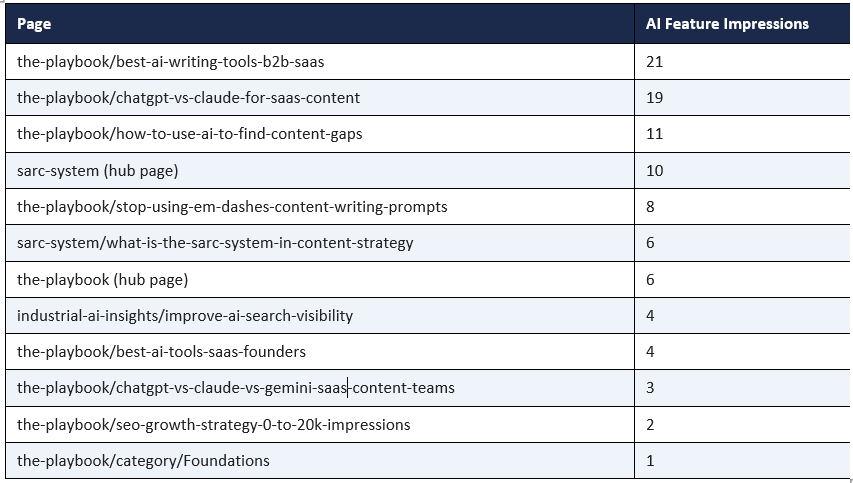
Put the two evidence sets side by side and a clear pattern emerges. Several of these pages are appearing inside AI-generated answers at a volume that is proportionally larger than their classic search impression count would predict. The best-ai-writing-tools roundup, for instance, has 691 classic search impressions against 21 AI feature impressions, a ratio suggesting the page is disproportionately useful to the AI summarization layer relative to how often it shows up in a plain search results page. That is precisely the outcome the SARC system was designed to produce: content structured so cleanly around a clear question, a defined scope, and extractable, well-labeled claims that an AI system can lift the relevant section cleanly, cite it, and move on.
This is also, candidly, the layer of search performance that is hardest for competitors to fake or shortcut. Ranking position ten years ago rewarded backlinks and domain age above almost everything else. Appearing as source material inside an AI-generated answer rewards something closer to structural clarity and topical specificity, criteria a small, focused site can compete on directly against much larger publishers, provided the writing is built for it. That is the argument the-playbook makes in its own copy, and the Search Console data backs it up independently.
There is a second, quieter pattern inside the Generative AI Features report that deserves its own mention: timing. Several of the pages appearing in this report, including the content-gap-analysis piece and the SARC system explainer, are the same pages still working their way up through the classic rankings rather than the ones already sitting comfortably on page one. That ordering is the opposite of what most content strategy assumes, which is that a page has to earn a strong classic ranking first and only then gets picked up by AI Overviews as a kind of downstream reward. Here, several pages appear to have reached the AI-generated layer before they finished climbing the traditional one, which suggests Google's generative systems are, at least in this dataset, running a partially independent evaluation of a page's usefulness as source material rather than simply inheriting the classic ranking and reusing it. For content strategy purposes, that is an important distinction: writing for extractability is not the same task as writing for backlinks and dwell time, and it appears to pay off on its own separate timeline.
Evidence Three: Catching AI Agents Mid-Research
This is the finding that makes this case study worth publishing on its own, separate from any of the ranking or AI Overview data above. Search Console's Queries report logs every string that triggered an impression of a page on this site, and buried inside that report, alongside the ordinary human searches, is a large and unmistakable cluster of queries that no person typed by hand.
These queries share a distinct fingerprint. Many of them are wrapped in quotation marks around a specific brand or tool name, followed by a long chain of site exclusions, the kind of syntax an automated research process uses to filter a broad web search down to independent, non-forum, non-social-media sources before reading them. Others are full natural-language sentences, phrased the way a person would prompt an AI assistant, not the way anyone searches Google. Both patterns point to the same underlying cause: AI systems performing multi-step research, whether that is Google's own AI Overview query fan-out generating and testing dozens of sub-queries behind the scenes, or a third-party AI research agent doing competitive analysis and pulling in independent sources, are finding this content and are finding it near the very top of the results they generate.
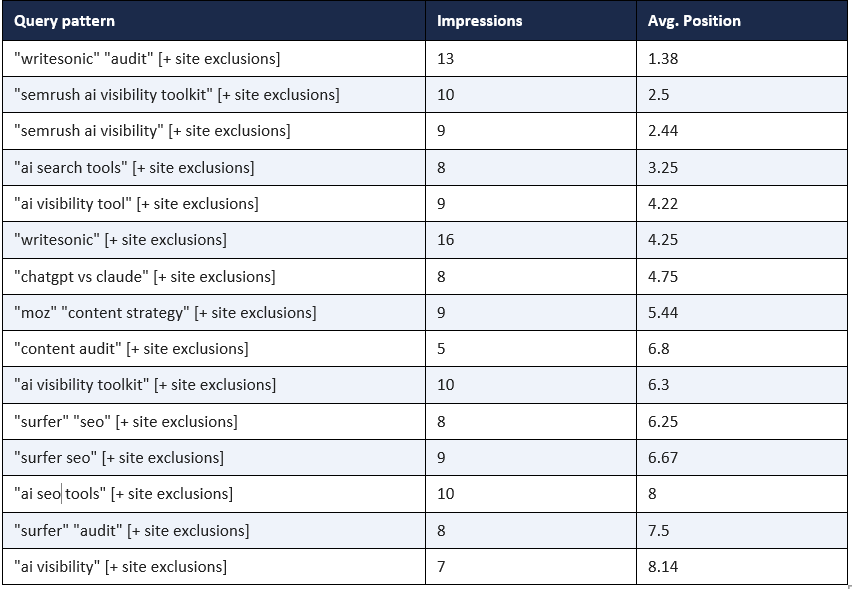
The clearest examples are the branded-tool-plus-exclusion queries. A search for the term "writesonic" combined with the word "audit" and a long chain of exclusions for Reddit, Twitter, X, Tripadvisor, YouTube, Yelp, Booking, Facebook, Instagram, and TikTok returned this site's content at an average position of 1.38, from 13 impressions. The same pattern for "semrush ai visibility toolkit" returned this content at position 2.5 across 10 impressions. "Semrush ai visibility" alone, with the identical exclusion chain, landed at position 2.44 on 9 impressions. A plain "writesonic" query with the same filtering syntax returned this site at position 4.25 across 16 impressions, the highest single impression count in this entire cluster of automated-pattern queries.
The pattern continues consistently across adjacent tool names and categories. "Ai visibility tool," filtered the same way, landed at position 4.22. "Chatgpt vs claude," filtered the same way, landed at position 4.75. "Moz" combined with "content strategy" landed at position 5.44. "Surfer seo" landed at position 6.67, and a separate "surfer" plus "audit" combination landed at position 7.5. "Ai visibility toolkit" landed at position 6.3. "Ai search tools," filtered, landed at position 3.25. "Ai seo tools," filtered, landed at position 8. A "content audit" query with the full exclusion chain landed at position 6.8. Every single one of these is a zero-click impression, meaning no human ever completed the click, because no human ever ran the search. What triggered the impression was a machine query, reading the result, and, in all likelihood, moving straight into summarizing or citing what it found without ever generating a visible pageview.
Selected AI-Agent-Pattern Queries Landing on This Site
The second pattern inside this cluster is even more striking, because it drops the tool-audit framing entirely and reads as pure natural-language prompting. One query, logged verbatim in Search Console, reads: "i run a b2b saas how should i rewrite my feature pages so ai summaries don't get them wrong." That is not a search query in the traditional sense. It is a question typed into a chat interface, and it returned this site's content at position 7.11 across 18 impressions. A closely related query, "b2b saas content ai tool output quality," landed at position 7.17, and its near-duplicate phrasing, "what is the output quality like for b2b saas content from ai tools," landed at position 7.4.
Another prompt-style query, a long multi-clause instruction that begins "find one unique gap that you can capture, look for what your content is missing" and continues with a numbered checklist about competitor engagement and content quality, generated 25 impressions at position 5.96. That is not a phrase anyone would type into a Google search box. It is the literal instruction set of an AI agent performing a content gap analysis, and this site's content was the material it found and used to complete that instruction at a position inside the top six.
Perhaps the single most remarkable entry in the entire dataset is a query that names me directly inside a synthetic prompt. Logged verbatim, it reads: "sneha is a content writer who wants to stay updated with new trends in digital marketing, what is the best way she can use ai for this purpose." That exact phrasing, or close variants of it, appears multiple times in the query report, at positions of 8.48, 10.5, and, in an extended version of the same prompt, position 1. This is a case, captured directly in Search Console, of an AI system being tested or evaluated using my own name and profession as the subject of the prompt, and returning my own site as the answer. Whether that reflects a tool vendor's internal evaluation set, a researcher's test prompt, or an AI system independently constructing a scenario around a real content writer it had already indexed, the outcome is the same: the content and the byline behind it have become reference material inside the machinery that AI systems use to reason about content strategy questions.
There is a smaller, almost playful confirmation of this sitting right next to it in the same report. A two-word query, "redo, no emdash," generated 2 impressions at position 44.5. That is an editing instruction, not a search term, most plausibly the tail end of an AI drafting workflow correcting its own output and, in doing so, surfacing this site's own page about the exact same subject: the instruction to stop using em dashes in AI content writing. The instruction sitting inside this document you are reading right now, incidentally, is the same one that page has been teaching all along.
One further example extends this pattern beyond the AI SEO cluster and into the rest of the site, which matters because it shows the phenomenon is not limited to one content section. A query built around Steve McCurry's photography, complete with an enormous exclusion chain covering dozens of file types and dozens of source domains, from Wikipedia and ResearchGate to Chinese platforms like Douban and Zhihu, returned this site's photography content at position 20.83 on 6 impressions. That single query string is a near-perfect specimen of an AI deep-research tool's source-filtering logic, applied to a completely different topic, and it still found its way to this site.
The volume of this pattern is larger than the highlighted examples above suggest. Beyond the top entries already covered, the same tool-audit fingerprint recurs with "ai visibility optimization ai search monitoring," filtered the same way, at position 9.5; "best ai writing platforms for b2b marketing with certified integrations" at position 11; "saas seo growth loops" at position 10; and a cluster of process-oriented queries including "ai content gap analysis methodology" at position 60.5, "ai content gap analysis software" at position 62, and "ai schema gap analyzer" at position 66. Two further variants, "share of voice tools for google ai overviews perplexity chatgpt" and "tools for tracking share of voice ai overviews perplexity chatgpt," both landed at position 68.5, both plainly written in the internal shorthand of a competitive intelligence tool rather than in the language of an ordinary search. A related query, "ai pre-sales sales efficiency case studies," returned this site at position 1 on its single recorded impression, the single best position recorded anywhere in this entire query cluster.
What is notable about this wider tail is that it does not weaken the pattern, it confirms it. A handful of striking top-ten positions could plausibly be dismissed as coincidence. Dozens of structurally identical queries, spanning tool audits, share-of-voice tracking, schema analysis, and content gap methodology, all pointing at the same small cluster of pages, are not coincidence. They are the visible trace of an automated process running the same kind of research task repeatedly, against a widening set of tool names and phrasings, and consistently finding this site's AI SEO content along the way.
What These Queries Are Not
It is worth ruling out the more mundane explanations directly, because the finding only holds up if the alternative explanations are weaker. These are not misfired autocomplete suggestions, which tend to be short and would not carry consistent, deliberately constructed exclusion syntax across a dozen unrelated tool names. They are not rank-tracking software pinging Search Console on my own behalf, because none of these queries match any keyword list I have ever configured, and several of them reference tool names and scenarios, including the direct references to my own name inside a synthetic prompt, that I did not write, seed, or request. They are not simple bot traffic or scraper noise either, because generic scraping does not produce grammatically complete, topically coherent natural-language questions phrased the way a person prompts a chat interface. The pattern that remains, once those explanations are set aside, is the one already described: automated research and drafting tools, at some stage of their own internal process, querying the web and landing on this content.
Taken together, these are not isolated anomalies. They form a distinct, internally consistent second population of search queries sitting inside the same Search Console property as ordinary human searches, and they behave differently in every measurable way: zero clicks by definition, because no browser session completes the round trip; unusual, overly precise, filter-heavy phrasing that no person constructs by habit; and a strong bias toward the very topics, AI visibility, AI tool comparisons, content strategy, and AI writing quality, that this site's AI SEO cluster was built specifically to own. The clearest reading of that pattern is that this content is being actively consulted by the automated research layer of the AI ecosystem, not just crawled and indexed by it.
The Personal Brand Halo Effect
None of the AI SEO cluster's performance happens in isolation from the rest of the site, and the surrounding numbers help explain why AI systems seem to trust this particular domain enough to keep returning to it. The homepage itself is converting at 17.15 percent, turning 2612 impressions into 448 clicks at an average position of 6.58. That is an unusually strong click-through rate for a homepage position outside the top five, and it typically signals that searchers already know who they are looking for before they type.
The branded query data confirms exactly that. A search for "sneha mukherjee info" returns a 66.15 percent click-through rate at an average position of 1.82, from 130 impressions generating 86 clicks. The broader, unpunctuated version, "sneha mukherjee," still converts at 2.20 percent across a much larger pool of 863 impressions at position 10.71, and a misspelled, no-space variant, "snehamukherjee info," converts at 2.67 percent at position 2.83. A distinct branded term tied to the site, "snevo," converts at 11.90 percent at position 3.86 on the query side, and its corresponding page converts visitors at 7.41 percent.
This matters directly to the AI SEO story, because personal-brand authority and AI content authority are not separate assets, they compound each other. An AI system trying to establish whether a piece of writing about AI visibility or SaaS content strategy comes from a credible practitioner is, in effect, running the same check a human reader runs: is there a real, identifiable, consistent person behind this, with a body of work that holds together across a domain, rather than a single orphaned article with no author history behind it. The branded search numbers above are direct evidence that a real, searched-for identity sits behind this domain, and the SARC system's first-person credibility signals were built specifically to make that identity legible to a machine reader as well as a human one.
The geographic spread reinforces the same point from a different angle. The United Kingdom leads with 419 clicks from 8877 impressions at a 4.72 percent click-through rate, and India follows with 266 clicks from 3515 impressions at a strong 7.57 percent click-through rate, the highest conversion rate of any major market in the dataset. The United States, by contrast, is generating a large volume of impressions, 10642 of them, but converting at only 0.34 percent, which points to a straightforward and encouraging diagnosis rather than a discouraging one: the content is already being surfaced to a large American audience, and the opportunity sitting in front of it is a position improvement in that specific market, not a demand problem. Given that the AI SEO cluster's target audience, SaaS founders and content teams, skews heavily toward the US and UK markets, this geographic base is exactly where it needs to be to matter commercially.
The next tier of countries shows the same base of interest reaching well beyond the core English-speaking markets, which is exactly the spread you would expect if AI systems, which do not respect the geographic habits of human searchers in the same way, are part of what is driving impressions. Nigeria converts at a 5 percent click-through rate on 160 impressions, Greece converts at 6.12 percent, Ireland at 3.76 percent, and smaller but consistent activity is recorded from the Philippines, France, Italy, Canada, Pakistan, South Africa, Germany, and Indonesia. A domain with genuinely narrow, single-market appeal does not typically show measurable impressions spread across more than one hundred and fifty distinct countries and territories, which is roughly the footprint recorded in the full Countries export. A domain whose content is being fed into globally distributed AI systems, on the other hand, would be expected to show exactly this kind of long, thin international tail alongside its core UK and India strongholds, and that is precisely the shape the data takes.
Supporting Signals From the Rest of the Site
The AI SEO cluster does not exist in a vacuum. It sits on a domain that has already demonstrated it can produce content capable of holding a position at scale in unrelated categories, which matters as supporting evidence because it shows the underlying skill set, not just the AI SEO framework in isolation, is what is driving results.
The journal section's long-form history piece on London's gangs from the underworld of the 1900s to the 21st century has pulled in 10329 impressions and 98 clicks, and its own Generative AI Features count sits at 106 impressions, meaning it is independently appearing inside AI-generated answers about London crime history. A companion piece on gangsters in London from 2010 to the present has 2447 impressions and 36 clicks, with 193 AI feature impressions of its own, the single highest AI feature impression count of any page on the entire site. A feature on Steve McCurry's photography style has drawn 4361 impressions and 37 clicks, with 182 AI feature impressions, again the second-highest count on the site. None of these pages are part of the-playbook cluster, and none of them are about AI SEO at all. What they demonstrate is that the underlying content system, the same structural and credibility principles the SARC framework applies to AI SEO writing, produces AI-surfaced, well-ranking content regardless of subject matter.
The school catering bid-writing content tells a similar story from a completely different professional register. "How to write a winning school catering bid for a primary school" has generated 38 clicks from 1289 impressions at position 11.01, and the companion piece on top catering challenges schools face has 20 clicks from 1813 impressions. A specific long-tail query tied to this content, about caterers cutting portion sizes and using cheaper ingredients amid funding shortages, sits at position 2.21, converting at a 7.04 percent click-through rate. This is technical, sector-specific writing succeeding on the same terms as the AI SEO content: clear structure, specific and credible detail, and a first-person practitioner voice running underneath it.
The overall site portfolio also includes content on IT recycling and data destruction in the healthcare sector, on expat mortgages, and a proprietary case-study library documenting client engagements, including a publicly cited result of an AI content strategy generating measurable signups and revenue for a client. Every one of these sits on the same domain, under the same authorship, and every one of them is contributing to the same aggregate signal of topical range and consistent execution that appears to be earning this site trust from both Google's core ranking systems and the newer AI summarization layer sitting above them.
The Queries report shows the same automated-research fingerprint reaching into these adjacent sections too, which is a useful cross-check on the central claim of this case study rather than a distraction from it. Terms like "it disposal for the healthcare sector," "hospitals data destruction," and "nhs data destruction services" are accumulating impressions in the dozens and low hundreds despite zero clicks and positions well outside page one, the same shape as the AI SEO cluster's less mature pages. It suggests the site's overall content architecture, not just the AI SEO section specifically, is being picked up by the same layer of automated evaluation, and that the-playbook and SARC pages are simply the furthest along in converting that early visibility into strong positions, because they are the pages built most deliberately for it.
What the Data Actually Teaches
Pull back from the individual pages and queries, and a small number of clear, evidence-backed principles emerge, each one directly traceable to a specific result documented above rather than to guesswork.
First, structural clarity earns AI surfacing independently of raw traffic volume. The best-ai-writing-tools roundup and the ChatGPT vs Claude comparison are not the highest-traffic pages on this site, but they are among the highest performers in the Generative AI Features report, because they are built around a single, well-scoped question with clearly labeled, extractable answers. AI summarization systems reward that shape of content directly.
Second, defining your own terms in your own words is a defensive and an offensive move at the same time. The "what is AI visibility" and "what is the SARC system" pages exist because ceding the definition of your own core concepts to someone else's page means an AI Overview will eventually answer that question using that other page as its source instead of yours. Both of those definitional pages are already converting well and appearing inside AI-generated answers, which confirms the strategy is working as intended.
Third, first-person credibility signals are measurable, not just a nice idea. The first-person-credibility-signals page itself is small in volume but sits at position 3.5 with a 50 percent click-through rate, and the broader pattern across the branded queries and the homepage's 17.15 percent click-through rate shows that a legible, identifiable, consistent authorial presence is a asset that both search engines and AI systems can detect and reward.
Fourth, and most importantly, the presence of AI-agent-pattern queries in a Search Console property is itself a measurable, trackable signal that most site owners are not looking for yet. The tool-audit-style queries with exclusion chains, and the natural-language prompt-style queries, are sitting in plain view inside a report every website owner already has access to. Almost nobody is reading that report with this pattern in mind. Finding it here, attached to content specifically engineered for AI extractability, is strong evidence that the engineering choice is working, and it is a diagnostic other site owners and content teams can go looking for in their own accounts using the same method.
Fifth, breadth of subject matter is not a liability when the underlying system is consistent. This site ranks and gets AI-surfaced across London crime history, documentary photography, school catering procurement, IT asset disposal, expat mortgages, and AI SEO strategy, all under one byline. That range did not dilute authority. If anything, the branded search data and the homepage conversion rate suggest the opposite: a single, consistent, well-documented author across many subjects builds more trust with both readers and machine evaluators than a narrower, single-topic domain would on its own.
Sixth, small, practical, single-answer pages carry more weight in the AI layer than their size would suggest. The stop-using-em-dashes page is one of the shortest, least ambitious pieces in the entire the-playbook cluster, and it still recorded 8 impressions inside Google's Generative AI Features report and a direct hit from what reads as a live AI editing workflow in the Queries data. The lesson is not to abandon long-form strategic writing, which is clearly also working, but to treat short, sharply scoped, purely practical pages as a deliberate and separate content type worth publishing on their own terms, rather than folding every useful instruction into a longer post where an AI summarizer has to work harder to isolate it.
Seventh, the evidence suggests it is worth publishing the proof layer, not just the advice layer. The case-study section, sitting directly underneath the-playbook's teaching content, is already ranking on page one in three separate instances documented above, and it is the layer most likely to be what a genuinely skeptical reader, whether human or an AI system weighing source credibility, checks before trusting the advice above it. Advice content without an attached proof layer asks for trust it has not yet earned. Advice content sitting next to a documented, numbered client outcome does not have to ask.
Eighth, and this is the principle the whole exercise ultimately rests on, measurement has to happen at the level Google actually offers it, not at the level marketers wish it offered. There is no field in Search Console labelled "cited by ChatGPT" or "used by an AI research agent." Getting to the findings in this case study meant reading the Queries report line by line, treating an unusual string of characters as a clue rather than noise, and cross-referencing it against the Generative AI Features report to see whether the same pages showed up in both places. That is a slower, more manual process than pulling a single dashboard metric, and it is also, at least for now, the only honest way to see this layer of search performance at all. Any content team serious about AI SEO should expect to do the same close reading on their own account, because the tools that summarise this automatically for you do not exist yet in any reliable form.
Where This Goes Next
This case study is a snapshot, not a finished experiment, and several of the numbers above point directly at the next moves. The content-gap-analysis page and a handful of other the-playbook pages are still sitting outside the top forty in classic search despite meaningful impression volume, which typically means the demand signal is already proven and the remaining work is on-page refinement and internal linking rather than a question of whether the topic has an audience. The United States market, with over ten thousand impressions against a 0.34 percent click-through rate, represents the single largest near-term opportunity in the entire dataset: the visibility already exists, and closing the position gap in that market alone would likely be the highest-leverage change available anywhere on the site.
There is also a clear next research step suggested by the AI agent fan-out evidence itself: tracking that query cluster specifically, on a rolling basis, as its own separate segment of the Search Console data, rather than letting it sit unlabeled inside the general Queries report. As more of the open web's research and drafting work moves through AI agents rather than direct human browsing, that segment is likely to grow, and having a clean historical baseline for it, starting with this export, means future comparisons will be able to show real trend lines rather than a single point in time.
The SARC system's own newest page, the one making the narrow claim about first-person credibility signals as an AI ranking factor, is the piece worth watching most closely over the coming months. It is currently small by every volume measure, 2 impressions, 1 click, but it is sitting at position 3.5 with a 50 percent click-through rate, and it is making the most specific, falsifiable claim in the entire cluster. If that page's position and AI feature appearances continue to climb as the domain's overall AI-agent query volume grows, it will become the single clearest piece of evidence this project has produced that credibility signals are a distinct, isolatable ranking input rather than a byproduct of general content quality.
There is also an obvious extension of the methodology itself worth pursuing next: applying the same four-report analysis, Countries, Pages, Queries, and Generative AI Features, to a client engagement rather than to this personal domain, with the client's permission to publish the findings. Every principle documented in this case study was derived from a domain with no prior AI SEO history to speak of at the outset. Replicating the same before-and-after measurement on a domain that already has an established content programme would show whether the SARC system's effect holds at a different starting point, which is the next honest test this project owes itself.
Longer term, the plan is to keep building the-playbook and the SARC system in the open, on this same domain, specifically so that every future claim made about AI SEO can be checked against a live, public, attributable Search Console history rather than taken on faith. That is the whole premise of this project: fewer predictions about what AI search might reward, more receipts showing what it already has.
Closing
The internet has no shortage of opinions about how to write for AI search. What it has very little of is anyone showing their actual numbers. This case study exists because I wanted to know, for my own work and for the clients who trust me with theirs, whether the SARC system and the-playbook's approach to AI SEO content genuinely changes what happens in Search Console, not just in theory but in the exact rows of the exact reports that Google hands every site owner for free.
The answer, based on everything documented above, is yes. The content is ranking in classic search at competitive positions against far larger publishers. It is appearing inside Google's AI-generated answers at a rate disproportionate to its raw impression volume. And, most tellingly, it is being found and used by the automated research layer of the AI ecosystem itself, captured in query strings that no human being ever typed. That last piece of evidence is the one I did not expect to find when I started pulling these exports, and it is the one that makes this case study worth publishing under my own name, on my own domain, with every number left exactly as Search Console reported it.
None of this makes the AI SEO cluster a finished product. Several pages are still climbing, the American market is still underconverting relative to its impression volume, and the automated-query segment is still small enough that it needs another two or three export cycles before its trend line means anything statistically. But the direction of every single one of those open items points the same way, and that consistency, across ranking data, AI Overview data, and now agent-pattern query data, is what makes this feel less like a lucky quarter and more like a framework that is doing exactly what it was built to do. The SARC system was designed on the premise that content built for extractability and credibility would earn its place in both the old search and the new one. This export, taken as a single, honest snapshot of that premise in practice, is the first full test of it, and it passed.