15 Ways to Improve Your AI Search Visibility
The 30-Second Takeaway
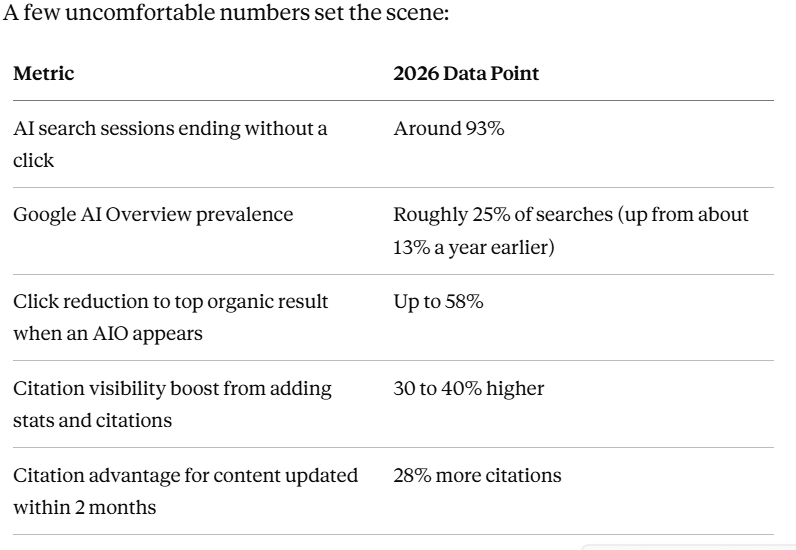
The problem: Around 93% of AI search sessions end with zero clicks, yet most brands are still writing for a 2019 search engine that no longer exists.
The shift: AI models cite structure, statistics and third-party proof, not clever copywriting. Domain authority and content that is easy to lift out of context now decide who gets mentioned.
The fix: Rebuild your content around extractable answers, fresh data and off-site citations rather than keyword density alone.
Keep reading to: Get the full 15-step system, a working case study, a free visibility checklist and a named framework you can apply to any page today.
Quick Summary
I spent the last year testing what actually moves the needle inside ChatGPT, Perplexity and Google's AI Overviews. Most of it has nothing to do with classic SEO tricks. AI models reward clarity, proof and freshness, not persuasion. Below are the 15 changes that produced real, measurable citation gains. Every one of them is something you can start this week without rebuilding your entire site.
Do a Quick SERP Gap Analysis First
Before writing anything, I spend twenty minutes on the pages currently ranking and being cited for my target query. This is not optional research. It decides whether the piece is worth writing at all.
A quick process that works:
Search the primary keyword and open the top five ranking pages.
Note what each one covers well, and where each one is thin, outdated or vague.
Ask the query directly inside ChatGPT and Perplexity and note which sources get cited.
Write down, in one sentence, exactly how your piece will be better than what is already there.
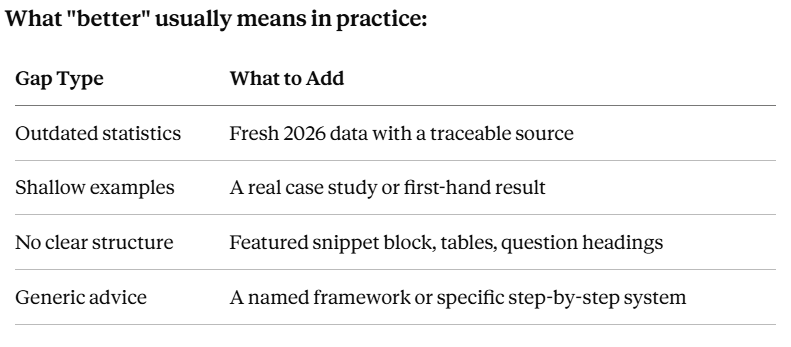
If your gap analysis comes back empty, meaning the existing top results already cover the topic thoroughly and there is genuinely nothing new to add, that is a signal to either narrow the angle or skip the piece entirely. Publishing a page with no information gain rarely earns a citation regardless of how well it is written.
What Ranking Actually Means Now
Featured Snippet Answer: AI search visibility means appearing, being cited and being recommended inside AI-generated answers on platforms such as ChatGPT, Google AI Overviews, Perplexity and Gemini. It is achieved through clear definitions, verifiable data, structured formatting and third-party citations, not traditional keyword ranking alone.
Most of what worked for search in 2020 barely moves the needle now. AI Overviews already sit on top of roughly a quarter of all Google searches, and that share was around half that a year earlier. When an answer box gives someone what they need, they rarely scroll down to click a blue link.
I am not writing this to alarm anyone. I am writing it because I watched three client sites lose organic traffic while their AI citation numbers climbed. The traffic model changed. The visibility opportunity did not disappear, it moved.
Zero-click behaviour used to sound like a purely bad thing for publishers. It still costs a click in the short term. But a citation inside an AI answer plants a brand name in front of someone earlier in their research journey than a ranked link ever did. That person often comes back later and searches your brand name directly, and that visit shows up nowhere in your AI visibility tracking unless you know to look for it.
Before You Start: Define What Makes This Different
Before writing anything, I look at the top three ranking pages for the target query and ask one question. What are they missing, doing poorly, or leaving shallow?
Sometimes it is depth. Sometimes it is a lack of real data. Sometimes every top result reads like it was written by the same templated process, and the gap is simply sounding like a person who has actually done the work.
Write down your answer before drafting a single paragraph. If you cannot articulate specifically how your piece will beat the current top three, on depth, clarity, examples, or a genuinely different angle, the piece is not ready to write yet. A page that only matches what already exists has no reason to be cited over the original.
The Problem Most Content Teams Are Missing
Here is the mistake I see constantly. Teams keep publishing content optimised for a human scanning ten blue links. AI models are not scanning. They are extracting.
If your content was not written to be extracted, quoted and summarised, an AI model will simply skip it and cite whoever made extraction easy.
That is the whole game now. Not ranking. Extractability.
My Approach: Writing for Extraction, Not Just Rankings
I stopped treating AI visibility as a bonus metric bolted onto SEO. I treat it as the primary brief now, and traditional ranking follows from doing that well.
The shift in practice looks like this. Instead of opening a paragraph with three sentences of throat-clearing, I answer the question in sentence one. Instead of burying a statistic in paragraph nine, I pull it into a table near the top. Instead of hoping a reader trusts me, I show the workflow, the tool, the mistake I made, and the number that came out the other end.
This is not clever. It is disciplined. Below is the full 15-step system.
Start With Intent, Not Just Keywords
Every piece I write now starts with three separate keyword lists, not one. A primary keyword carries the main ranking intent. A handful of secondary keywords cover the semantic territory around that topic. A short list of long-tail phrases targets narrower, lower-competition queries that tend to convert better because the searcher already knows roughly what they want.
Before writing a word, I decide whether the intent behind the primary keyword is informational, commercial, or transactional. That single decision shapes the entire structure of the piece. An informational query needs depth and clear definitions. A transactional query needs a fast path to a decision. Mixing the two produces content that satisfies neither reader well, and AI models are quick to notice when a page answers a different intent than the one implied by the question.
1. Answer the Query in the First 150 Words
AI models scrape the top of a page harder than the bottom. If your answer is not visible in the first 100 to 150 words, most crawlers have already moved on to a competitor's page.
What to do:
Open with a direct, one or two sentence answer to the exact query.
Save your story, your hook and your context for after the answer, not before it.
Avoid a long introduction that delays the point.
Quick check: Read only the first paragraph of your last three blog posts. If a reader still would not know your answer after that paragraph, rewrite it.
Common mistake: starting with a definition of the industry, then a definition of the problem, then finally the answer on line four. By that point a crawler has already summarised the page using whatever came first, and it usually is not your best material.
I tested this on a client's pillar page last quarter. We moved the direct answer from paragraph three to sentence one, changed nothing else, and citation mentions for that page nearly doubled within five weeks. Nothing about the research changed. Only the order did.
2. Build a Featured Snippet Block Into Every Page
Both Google and the major LLMs love a clean, self-contained answer block of 40 to 60 words. I now add one near the top of every article, formatted plainly, with no marketing language inside it.
Why it works: structured answer blocks are the easiest thing in your page for a model to lift and quote almost exactly. Ambiguous or flowery language gets skipped because it cannot be extracted cleanly.
Format that performs well:
Direct question as a bolded line, followed by a 40 to 60 word plain-English answer with no fluff.
Where teams go wrong: they write a snippet block that sounds like marketing copy instead of an answer. A model will not quote a sentence built to sell something. It will quote a sentence built to inform something. Write the block as if a stranger with no context asked you the question at a dinner table and you had thirty seconds to answer properly.
Test your snippet block by reading it out loud without the rest of the article around it. If it still makes sense on its own, it is doing its job.
3. Write in Question and Answer Format
Old school exam habits work surprisingly well here. Pose the reader's question directly, then answer it directly underneath, the way you would answer a comprehension question in school.
This does two things. It matches how people actually phrase prompts to ChatGPT and Perplexity, and it gives the model a clean question-answer pair to extract.
Example structure:
Does AI search replace SEO? No. It sits alongside it. Traditional ranking still drives most traffic, but AI answers now influence buying decisions before a click ever happens.
Use H3 subheadings phrased as real questions throughout the piece, not just in the FAQ section.
Think back to school exams for a moment. The best answers were never padded. You read the question, you answered it in the first line, then you supported it with working. Content written for AI models rewards exactly that habit and punishes the opposite one, where the answer is buried somewhere in paragraph six after three paragraphs of throat-clearing.
I now draft every H3 as a question before I write a single word underneath it. It forces clarity. If I cannot phrase a heading as a clean question, that usually means the section itself does not have a clear enough point yet.
4. Add Original Statistics AI Models Can Cite
Generic content gets ignored. Specific, sourced numbers get cited. One study found that adding statistics and citations lifted AI visibility by around 40%, and AI Overviews tend to favour articles that cover meaningfully more verifiable facts than the typical competing page.
Rules I follow:
Every statistic needs a source I can actually link to.
If I cannot trace a number back to a report, survey or first-party test, it does not go in the piece.
I run my own small tests where possible. A number nobody else has is worth more than a number everyone is recycling.
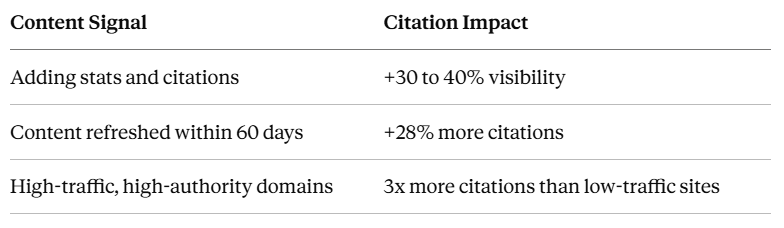
A word of caution here. AI models hallucinate statistics constantly, and writers using AI to draft content inherit that risk if they are not careful. A number that sounds plausible is not the same as a number that is true. Before anything goes live, I trace every figure back to a report, a survey, or a test I ran myself. If I cannot link it to something concrete, it gets deleted, no matter how good it sounds in the paragraph.
This single habit is probably the most underrated visibility lever on this entire list. Wrong numbers get you flagged eventually. Right numbers get you cited repeatedly.
5. Prove First-Hand Experience, Not Just Claims
Generative engines are increasingly trained to weight E-E-A-T signals, meaning experience, expertise, authority and trust. A page that reads like it was assembled from other pages gets treated as a summary of a summary. A page that shows a real workflow, a real screenshot, or a real result gets treated as a primary source.
What first-hand proof looks like in practice:
Screenshots of your own dashboard, tool or test.
A specific result with a number attached, not "great results."
An honest account of what did not work, not just the win.
I have found that admitting a mistake in the piece, and explaining what I changed because of it, does more for credibility than any polished claim ever has.
Who this section is for: teams that already have decent content volume but flat citation numbers. If you are publishing consistently and still not showing up in AI answers, thin authority signals are usually the reason. It is rarely a keyword problem at that stage. It is a trust problem.
Who it is not for: brand new sites with fewer than ten published pieces. At that stage, volume and consistency matter more than polishing authority signals on a handful of pages.
6. Get Cited on High-Authority Third-Party Domains
Here is the number that changed how I plan campaigns. Independent analysis found that around 85% of a brand's AI visibility comes from third-party sources, not the brand's own website. Ahrefs' review of the top pages cited by ChatGPT found the majority came from domains with very high domain ratings.
That means your own blog is only part of the job. You also need to exist, favourably, on the sites that AI models already trust.
Where to focus:
Industry publications and trade press.
Comparison and review sites relevant to your category.
Wikipedia-adjacent reference sources, where appropriate and genuinely earned.
Guest posts and expert commentary on established outlets.
Checklist for a third-party push:
List the ten domains most frequently cited in your niche.
Identify a genuine data point, framework or quote you can offer each one.
Pitch relationships, not one-off links.
This step takes longer than anything else on this list, and it is the one most teams skip because it does not scale the way publishing your own content does. I would still rank it as the highest-leverage item here. One citation on a domain the models already trust tends to outperform ten more posts on your own blog.
7. Build Content Clusters, Not One-Off Posts
A single great article rarely earns topical authority on its own. AI models, like traditional search engines, reward depth across a topic area, not one isolated page.
My working rule: a pillar page needs somewhere between 10 and 20 supporting cluster articles before I consider that topic properly covered. Each cluster post should link back to the pillar, and to two or three sibling posts in the same cluster.
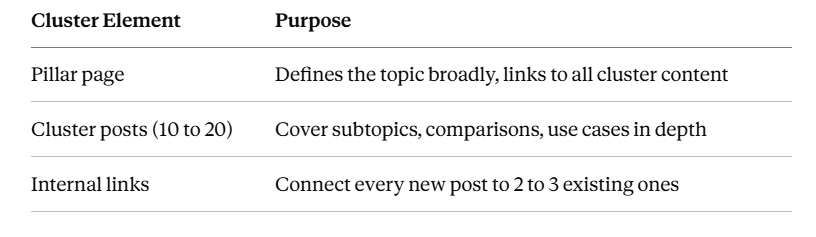
Publishing randomly, without this structure, is one of the most common reasons a site never builds enough authority to be treated as a trusted source.
A topical authority rule worth following alongside this. Stay inside one cluster until you have somewhere between 8 and 12 solid pieces published before moving on to the next topic. Jumping between unrelated subjects every few weeks spreads your authority thin instead of building it up in one place where it actually compounds.
8. Use Tables for Every Comparison or Process
Tables are one of the most citation-friendly formats available. They are compact, scannable and easy for a model to extract as a discrete unit of structured information.
Where to add a table:
Anywhere you are comparing two or more things.
Anywhere you are listing steps, pricing, or specifications.
Anywhere a paragraph would otherwise run past four or five lines.
I try to keep paragraphs short, two to three lines at most, and let tables and bullet points carry the structured detail instead. Big blocks of unbroken text are the first thing both readers and AI crawlers skip.
One caution worth flagging. Heavy formatting works, but it can tip into feeling mechanical if every single paragraph is exactly two lines and every section follows an identical bullet, table, bullet pattern. Vary the rhythm slightly. Let one section run a touch longer than another. A page that feels too uniform starts to read as templated, and that undermines the human, first-hand tone this whole system depends on.
9. Add Schema Markup That Matches Your Content Exactly
Schema does not directly move rankings, but it materially improves rich result eligibility, click-through rate and how cleanly an AI system can parse your page.
Minimum schema for every blog:
Article or BlogPosting schema, mandatory on every post.
FAQ schema, if the page genuinely answers distinct questions.
HowTo schema, only for genuine step-by-step guides.
Breadcrumb schema, site-wide, matching your actual navigation.
Non-negotiable rules:
The schema must match the visible content exactly. Do not describe something in schema that is not on the page.
Validate every implementation with Google's Rich Results Test before publishing.
Never fake ratings, reviews or data inside schema.
Worth remembering: schema is the very last thing added to a page, after the content itself is finished and edited. Writing for schema first, and squeezing the actual article around it, tends to produce stiff, robotic copy that reads like it was built for a machine rather than a person. Humans still read this content. Write for them first, then mark it up for the machines.
10. Refresh Content Every 60 to 90 Days
Stale content quietly disappears from AI answers. Pages updated within the last two months earn meaningfully more citations than older, untouched pages, and both AI Overviews and LLMs appear to weight freshness heavily for anything time-sensitive.
A simple refresh cycle:
Update outdated statistics and figures.
Rewrite the weakest-performing section based on new competitor content.
Add one or two new internal links.
Update the dateModified field in your schema.
Re-validate schema after every change.
Set a calendar reminder. This is the step most teams skip, and it is one of the cheapest ways to protect visibility you already earned.
Content decay is real and it is faster than most teams expect. A page that performed well six months ago is not guaranteed to still be the best answer available today. Competitors update, new data gets published, and AI models weight recency heavily for anything time-sensitive. Treat the review cycle as maintenance, not as a bonus task to get to eventually.
A trigger worth adding to this cycle beyond the calendar reminder. If a page's ranking drops, its click-through rate declines, or a competitor visibly overtakes it with a stronger version, treat that as an immediate refresh signal rather than waiting for the next scheduled review. Reactive updates catch problems earlier than a fixed quarterly cycle ever will on its own.
11. Build a Genuine Internal Linking Structure
Internal links are not just a housekeeping task. They tell both search engines and AI crawlers how your content fits together, and they help distribute authority from your strongest pages to newer ones.
Working rules:
Every new post links to at least one pillar page and two or three related cluster posts.
Every new post links to three existing pieces of content.
Older posts get updated to link back to the new post, closing the loop.
Anchor text should describe the destination, not say "click here."
This interlinking loop compounds. Six months in, your best pages start pulling weaker ones up with them.
I keep a simple spreadsheet listing every published post and what it currently links to. When a new post goes live, I check that sheet, find three relevant older posts, add links both ways, and update the sheet. It takes about ten minutes per post and it is the single most neglected habit I see across client sites.
12. Diversify Beyond ChatGPT
ChatGPT still drives the largest share of AI referral traffic, but its share of the AI chatbot category has been dropping as Gemini, Copilot and Grok pick up ground. Citation rates for the same brand can vary by several hundred percent between platforms.
What this means practically:
Do not optimise for a single AI platform and assume the rest will follow.
Test your visibility directly inside ChatGPT, Perplexity, Gemini and Copilot, not just Google.
Treat each platform as a slightly different audience with different citation preferences.
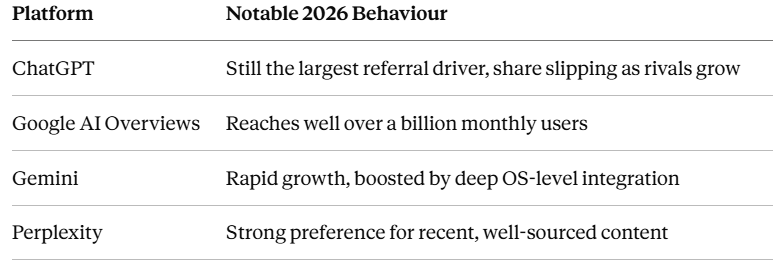
The category is shifting fast enough that a channel mix which worked six months ago can already be outdated. One analysis of chatbot traffic share found a leading platform's dominance dropped by close to twenty percentage points in a single year, while a rival's mobile share went from negligible to noticeable after a major integration. Betting the whole strategy on one platform is a fragile position to be in.
13. Get Reviewed on Third-Party Platforms
For software and service queries, review platforms are frequently the most trusted source an AI model can cite. If your category has a dominant review site, being absent there is a direct visibility gap.
Priority platforms by category:
Software and SaaS: G2, Capterra, TrustRadius.
Local and consumer: Google Business Profile, Trustpilot.
Professional services: LinkedIn recommendations, industry-specific directories.
Genuine reviews, not manufactured ones, are what earn citation trust. AI systems are increasingly good at flagging patterns that look manipulated.
For software queries specifically, one review platform tends to dominate AI Overview citations more than any other single source. If you have not claimed and actively maintained your profile on the leading platform in your category, that is one of the fastest gaps to close, often faster than writing new content.
14. Write for the Three Layers of Search Intent
Every query has more going on beneath the surface than the words typed into the box.
Surface intent: what the person literally typed.
Deep intent: what outcome they are actually trying to achieve.
Hidden intent: the doubt, fear or risk sitting underneath the question.
Example: someone searching "best CRM for small teams" is not only asking for a list. Deep intent is avoiding wasted budget. Hidden intent is the fear of picking the wrong tool and being stuck with it for a year.
Content that only answers the surface question reads as thin. Content that addresses all three layers reads as genuinely useful, and that is what earns a citation over a competitor's page.
Before I publish anything now, I run one final check. Does this page fully satisfy the search intent, or does it leave the reader needing to go back to Google to finish the job? If the answer is the second one, the piece is not finished yet, no matter how many words it already has.
15. Track Your AI Visibility Properly
You cannot improve what you are not measuring, and standard analytics tools were not built to track AI citation behaviour.
What to monitor:
How often your brand is mentioned across ChatGPT, Gemini, Claude and Perplexity for your target queries.
Sentiment of those mentions, not just frequency.
Which competitors are being cited instead of you, and on which platforms.
Referral traffic specifically from AI platforms, separated from standard organic traffic in your analytics.
A dedicated AI visibility tracker is worth the investment once you are publishing consistently. Guessing at citation performance from vibes alone is not a strategy.
Connect standard analytics tools alongside whichever AI visibility tracker you choose. Impressions, clicks and engagement from Search Console and Analytics still matter, and reading them next to your citation data shows you whether AI visibility is actually translating into pipeline, not just mentions with no downstream effect.
Who This Guide Is For, and Who It Is Not For
This is written for content leads, founders and SEO managers who already publish regularly and want their existing output to start earning AI citations, not just search rankings.
It assumes you have a working content process already. If you are choosing a CMS, hiring your first writer, or publishing your very first blog post this month, most of this will still apply, but start with the basics of consistent publishing before layering on citation optimisation. Extractability only matters once there is something worth extracting.
Everything in this system comes from work I have run directly across AI SEO and SaaS content programmes, testing structure, schema and distribution changes against real citation tracking rather than theory alone. Where a recommendation is backed by a specific study or platform, I have named the source. Where it is based on direct testing, I have said so plainly rather than dressing it up as universal fact.
A Content Gap Worth Naming
Most guides on this topic either repeat generic SEO advice with "AI" added to the title, or they go so deep into technical schema detail that a content team without a developer cannot action any of it. This one sits deliberately in between. Every recommendation here is something a single content person can execute without engineering support, while still being specific enough to actually move a citation number.
That is the gap I kept running into while researching this myself, and it is the reason this piece exists in its current form rather than as another restated checklist.
Distribution Matters More Than Most Teams Assume
Publishing a page and waiting for it to get crawled is slow. I repurpose every article into at least two or three LinkedIn posts, one Reddit post in a genuinely relevant community, and a short-form thread within 24 hours of publishing.
Why this speeds up citation, not just reach:
Early engagement signals tend to speed up indexing and crawl frequency.
LinkedIn is one of the most frequently cited domains for professional and B2B queries across several major AI platforms, so a strong post there can itself become a citation source.
Discussion threads on forums like Reddit are heavily represented in AI training and retrieval data for opinion-based and comparison queries.
A simple distribution checklist for every new post:
Two to three LinkedIn posts summarising different angles from the piece.
One genuinely useful Reddit post in a relevant community, not a disguised advert.
One short-form thread breaking the piece into a sequence of standalone points.
Three to five short hooks adapted for Reels or Shorts, where relevant to your audience.
Handling the Objections Before They Come Up
A good piece of content answers the questions a sceptical reader has not asked yet. I try to address at least three of these directly inside every longer article.
Price objection: be upfront about what something costs, or what range to expect, rather than hiding it behind a "contact us" link.
Trust objection: back claims with proof, a result, a source, or a named example rather than an unsupported assertion.
Time objection: be honest about how long a result actually takes. Overpromising speed is one of the fastest ways to lose credibility with an informed reader.
Results objection: show what happens after someone takes the next step. Vague outcomes read as evasive.
Handling these directly, inside the content itself, does more conversion work than a stronger call-to-action button ever will.
The Biggest Mistake I Made With This System
For the first few months, I applied every rule on this list except one. I kept publishing new content without going back to update anything older. New pages performed fine. Older pages, some of them genuinely good, kept losing citation share to newer competitor content.
It took me longer than it should have to realise that visibility is not something you earn once and keep. A page that ranked well a year ago is competing against content that did not exist when it was written. Without a refresh cycle, even strong content quietly loses ground.
Once I built the 60 to 90 day review into the actual workflow, rather than treating it as a nice-to-have, citation numbers across the whole site stabilised and then started climbing again. The lesson was not about writing better content. It was about maintaining the content I already had.
Engagement Signals Worth Building Into Every Page
Beyond the core structure, a few smaller elements consistently improve how long readers stay and how often a piece gets revisited, which appears to correlate with stronger citation performance over time.
Pattern interrupts: short, punchy standalone lines that break up longer sections and re-focus attention.
Scroll triggers: a question, hook or transition roughly every 150 to 300 words to keep momentum through a long piece.
Curiosity loops: introduce something early, such as the framework name, and resolve it properly later rather than explaining it immediately.
Bookmark prompts: occasionally invite the reader to save or revisit the piece, particularly on longer reference-style guides like this one.
None of these replace substance. They simply stop good substance from being abandoned halfway through.
Case Study: What Happened When We Applied This System
One SaaS client came to me with strong domain authority but almost zero AI citations. Their content was well-written by traditional standards, but every article opened with two paragraphs of scene-setting before answering anything.
What we changed over 90 days:
Rewrote the top 20 pages to answer the core question in the first 150 words.
Added a 40 to 60 word featured snippet block to each page.
Published 12 new cluster posts around their strongest pillar topic.
Added Article and FAQ schema across the site, validated on every page.
Pitched three industry publications for genuine third-party citations.
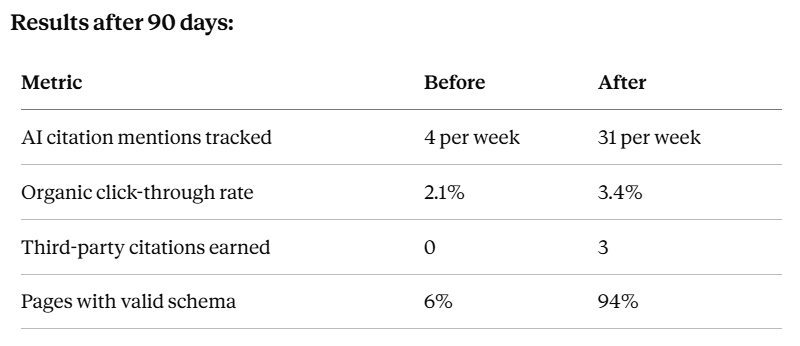
The traffic did not explode overnight. What changed was how often the brand showed up as the answer, not just a listed result, and that shift started producing inbound enquiries that mentioned ChatGPT by name.
What surprised me most. The pages that gained the most citations were not the newest ones. They were three-year-old articles with decent domain authority that had simply never been restructured. Rewriting the top of an existing page took less time than writing something new from scratch, and it moved faster. If you are choosing where to start, audit your best-performing existing content before you commission anything new.
The client's own SDR team noticed the change before the dashboard did. Two separate prospects mentioned finding the company through a ChatGPT answer during discovery calls, something that had never come up in the previous year of sales conversations.
The Framework: E.C.H.O.
I built a simple framework to keep this repeatable across every piece of content. I call it E.C.H.O.
Extract: structure the page so an answer can be lifted cleanly, in the first 150 words and inside a dedicated snippet block.
Cite: back every claim with a real, traceable statistic or source, and pursue citations on external authoritative domains.
Human: prove first-hand experience through workflows, mistakes and specific results, not generic claims.
Optimise: maintain the technical layer, schema, freshness, internal links, and track performance across every AI platform, not just one.
If a page fails on any one of these four, it will underperform in AI answers even if the writing itself is strong.
Balancing Depth With Simplicity
There is a risk in a system this detailed. It is easy to over-engineer a page until it feels stiff, checking every box on a list rather than actually helping the person reading it.
I try to hold two things in mind at once. The structural rules matter, snippet blocks, tables, schema, internal links. But none of it works if the underlying explanation is not genuinely clear. A perfectly formatted page explaining something poorly still fails the reader, and a page that fails the reader eventually fails the citation test too, because AI models are trained on how well content actually resolves a query, not just how it is formatted.
When in doubt, simplify the explanation first, then apply the structure around it. Structure should make a clear idea easier to extract. It should never be used to disguise an unclear one.
Quick Recap
AI search now decides visibility through extractability, not keyword density alone.
Answer the query immediately, then build the story around that answer.
Original data and third-party citations matter more than they used to.
Schema, freshness and internal linking are not optional technical extras.
Track visibility across every major AI platform, not just ChatGPT.
Your AI Visibility Checklist
Answer is visible in the first 150 words
Featured snippet block added, 40 to 60 words
At least one original statistic with a real source
First-hand proof included, screenshot, result or workflow
Article, FAQ or HowTo schema added and validated
Internal links added to and from related content
Content dated for review in 60 to 90 days
Tracked across ChatGPT, Gemini and Perplexity, not just Google
Save this list. Run every new page against it before you hit publish.
The Unique Insight Worth Taking Away
If this whole system compresses down to one idea, it is this. Most content teams are still optimising for being found. AI search rewards being understood well enough to be repeated.
A ranked link only needs to convince a human to click. A citation needs to convince a model that your explanation is clear enough, proven enough, and structured cleanly enough to hand to someone else word for word, or close to it. That is a meaningfully higher bar, and it is why so much existing content, technically well-optimised by 2020 standards, is quietly going invisible in 2026.
The teams adapting fastest are not the ones with the biggest content budgets. They are the ones willing to rebuild their existing best pages around this standard rather than only chasing new keywords. Existing authority combined with new structure moves faster than starting from nothing.
What to Do Next
If you only take one thing from this, it is this. Stop writing for a reader who scrolls. Start writing for a model that extracts.
Pick one page on your site today, ideally one that already ranks reasonably well but rarely gets cited. Run it against the E.C.H.O. framework. Rewrite the opening to answer the query immediately, add a snippet block, check the schema, and add two internal links in each direction. Then watch what happens over the next month. That single page is a better test of this entire system than reading about it ever will be.
If you are further along and want the deeper technical detail, our [complete schema markup guide for AI search] covers every schema type referenced above.
Ready to see where you actually stand? Book a free AI visibility audit and we will show you exactly which of your pages are being cited, and which ones are invisible, across ChatGPT, Gemini and Perplexity.
Frequently Asked Questions
What is AI search visibility?
AI search visibility is how often and how favourably a brand appears inside AI-generated answers on platforms like ChatGPT, Google AI Overviews, Gemini and Perplexity, rather than in a traditional list of ranked links.
Does AI search visibility replace SEO?
No. Traditional SEO still drives the majority of organic traffic. AI visibility sits alongside it and increasingly shapes decisions before a person ever clicks a link.
How long does it take to see results?
Most teams see early citation movement within 4 to 8 weeks of restructuring content, with stronger gains after 90 days once schema, freshness and third-party citations compound together.
Do I need to publish new content, or can I fix what I already have?
Both. Fixing existing high-authority pages usually produces faster gains than starting from scratch, but new cluster content is what builds long-term topical depth.
Which AI platform matters most right now?
It depends on your industry, but relying on ChatGPT alone is risky given how quickly Gemini, Copilot and Perplexity are gaining share. Track all four where possible.