12 AI Visibility Signals B2B SaaS Must Track in 2027
The 5-Line Reality Check
The Problem: Roughly 44 percent of B2B SaaS brands never show up when a buyer asks an AI engine for a recommendation, even with strong Google rankings.
The Shift: AI-referred buyers convert at a far higher rate than organic search traffic, so invisibility inside AI answers is now a pipeline problem, not a branding problem.
The Fix: Track 12 specific signals across citation, identity, trust, and engagement instead of guessing which ones matter.
Keep reading to: Get the CITE Framework, a full scoring table for all 12 signals, and a starter checklist you can run this week.
Last month I typed the exact question a buyer would type into ChatGPT: best project management tool for a fifty person agency. A client of mine, ranked first page on Google for that category, did not show up once.
That gap is not rare. Roughly 44 percent of B2B SaaS brands are invisible inside AI answers right now, even when their SEO numbers look healthy.
Search has split into two systems. One still runs on blue links and rankings. The other runs on citations, entity recognition, and trust signals inside a language model. By 2027, the second system decides who even makes it onto a buyer's shortlist.
This guide breaks down the 12 signals worth tracking, grouped under a framework I use with SaaS clients called CITE: Citation, Identity, Trust, Engagement.
Who this is for: marketing leaders, founders, and content teams at B2B SaaS companies who already rank on Google but have no idea what happens when a buyer asks an AI engine instead. Who this is not for: teams looking for a quick keyword hack. There is no shortcut here, only measurement.
The CITE Framework
I built CITE because clients kept asking for one metric and there is no single metric that captures this. Four pillars, three signals each, twelve total. Track all four or the picture stays incomplete.
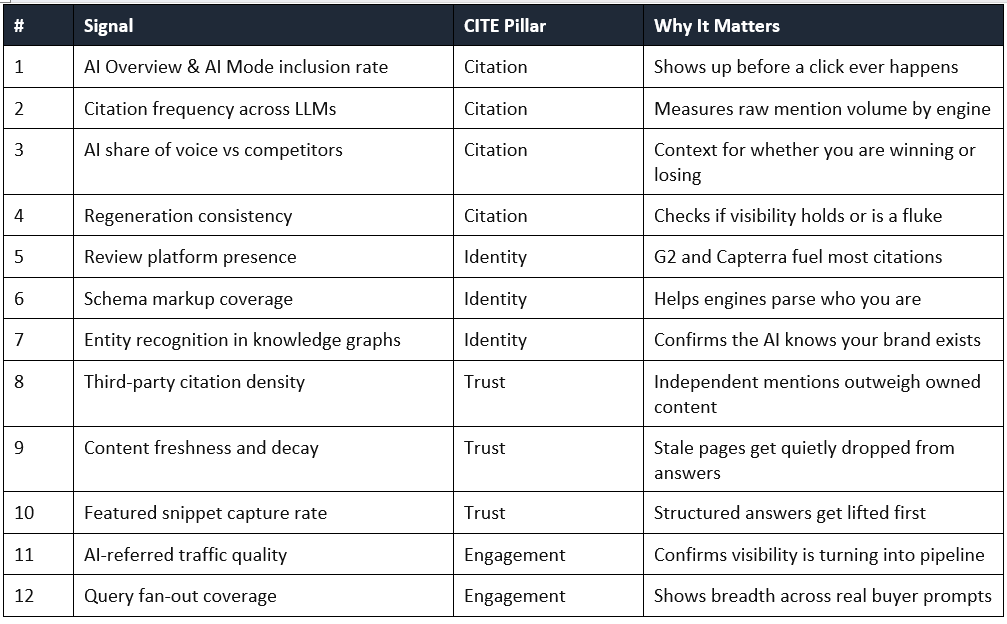
Citation Signals: Is the AI Even Naming You?
1. AI Overview and AI Mode Inclusion Rate
This tracks how often your brand appears when Google's AI Overview or AI Mode answers a category question. It is the closest AI equivalent to a page one ranking.
• Track a fixed list of 20 to 30 buyer-intent prompts monthly
• Note whether you appear, and in what position within the answer
• Separate branded prompts from unbranded category prompts
2. Citation Frequency Across LLMs
ChatGPT, Perplexity, Claude, and Gemini each pull from different sources and cite differently. A brand can be strong in one and absent in another.
• Run the same prompt set across at least three engines
• Log domain citations, not just brand name mentions
• Repeat over a two week window, not a single day
3. AI Share of Voice Against Competitors
Raw citation counts mean little without context. Share of voice tells you whether you are gaining or losing ground against the three or four brands buyers actually compare you to.
• Score every named competitor on the same prompt list
• Calculate your citations as a percentage of total category citations
• Review this monthly, not quarterly, since it moves fast
4. Regeneration Consistency
Industry benchmarking research from MADX Digital found that only around 30 percent of brands stay visible from one regeneration of the same prompt to the next, which means a single snapshot can mislead you badly.
• Regenerate the same prompt three to five times per test
• Flag brands that vanish and reappear unpredictably
• Treat volatility itself as a signal worth reducing
Identity Signals: Does the AI Know Who You Are?
5. Review Platform Presence
Third party research has found that G2 alone accounts for a large share of software citations, and that most SaaS tools cited by ChatGPT carried an active Capterra profile.
• Keep G2 and Capterra profiles complete and current
• Actively request reviews after successful onboarding milestones
• Respond to every review, positive or negative
6. Schema Markup Coverage
Schema alone will not fix weak content, and recent domain-level studies found no direct correlation between schema and visibility on its own. It still helps engines parse structured facts once authority is already present.
• Apply Article or BlogPosting schema to every published post
• Add FAQPage schema only where the content genuinely answers questions
• Keep visible content and schema fields in exact agreement
7. Entity Recognition and Knowledge Graph Presence
This checks whether search engines and AI models treat your brand as a defined entity with a consistent name, category, and description, rather than a random string of text.
• Search your brand name directly and check for a knowledge panel
• Keep your name, category, and description identical across your site, LinkedIn, and review platforms
• Add Organization schema with matching details site wide
Trust Signals: Does the AI Trust What It Finds?
8. Third Party Citation Density
AI engines weigh independent mentions more heavily than a brand talking about itself. Comparison articles, buyer guides, and earned YouTube walkthroughs all count here.
• Track mentions in comparison and best-of articles you did not write
• Pursue product walkthroughs from real users on YouTube
• Pitch data and original research to journalists and analysts
9. Content Freshness and Decay
Outdated statistics and dead examples get quietly dropped from AI answers even if the page still ranks on Google.
• Review high-traffic pages every 60 to 90 days
• Replace any statistic older than 12 months
• Update the dateModified field every time you touch a page
10. Featured Snippet and Structured Answer Capture Rate
Pages with a clear 40 to 60 word answer near the top get lifted into both Google's featured snippet and AI-generated summaries far more often than pages that bury the answer.
• Answer the primary question in the first 100 to 150 words
• Use question-based H2 and H3 headings throughout
• Keep each direct answer under 60 words before elaborating
Engagement Signals: Does Visibility Turn Into Pipeline?
11. AI-Referred Traffic Quality
Visibility without conversion is a vanity number. This signal checks what AI-referred visitors actually do once they land on your site.
• Segment AI referral traffic separately in your analytics
• Compare conversion rate against organic and paid traffic
• Track which landing pages AI traffic lands on most
12. Query Fan-Out Coverage
Google AI Mode and similar systems break one search into many related sub-queries behind the scenes. Fan-out coverage measures how many of those related prompts still surface your brand.
• Map 10 to 15 related prompts around each core topic
• Check visibility across the full set, not just the main query
• Build supporting content for gaps you find
How the Big Three AI Engines Behave Differently
Treating every AI platform the same is one of the fastest ways to waste effort. Each one sources and weighs content differently.
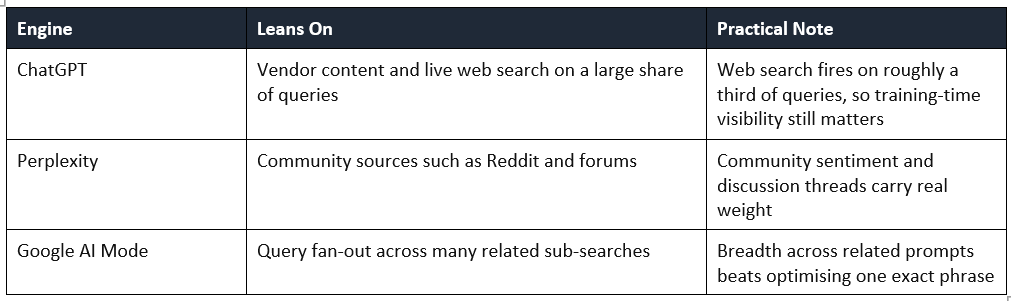
Case Study: From 6 Percent to 22 Percent Share of Voice
One workflow automation client I audited was ranked page one on Google but sat at just 6 percent AI share of voice against three direct competitors.
Over a 90 day window we focused on four moves instead of everything at once:
1. Added FAQPage schema to the 12 highest-traffic pages
2. Published three comparison articles answering exact buyer prompts
3. Requested and earned four new G2 reviews from recent customers
4. Encouraged two customers to publish product walkthrough videos
Share of voice moved from 6 percent to 22 percent, and citation frequency roughly tripled across ChatGPT and Perplexity in the same window. Nothing here involved buying links or gaming a system. It was measurement, then four specific fixes.
Your 2027 AI Visibility Starter Checklist
• Build a list of 20 to 30 real buyer-intent prompts
• Run that list across ChatGPT, Perplexity, and Google AI Mode monthly
• Audit your G2 and Capterra profiles for completeness
• Add Article and FAQPage schema to your top 10 pages
• Refresh statistics on any page older than 12 months
• Pitch two customers for a review or a walkthrough video
• Rewrite your top 3 pages to answer the core question in the first 150 words
• Map query fan-out prompts around your main keyword and fill the gaps
Key Takeaways
• Ranking on Google no longer guarantees you exist inside an AI answer
• Track all four CITE pillars, not just one favorite metric
• Third party proof, reviews, and mentions outweigh owned content
• Schema helps once authority exists, it does not replace it
• Volatility is real, so measure over weeks, not a single day
Editorial and Publishing Notes
• Internal links: connect to the pillar page on AI search strategy and 2 to 3 related cluster posts on SEO and GEO
• External links used: 2, both pointing to original 2026 B2B SaaS AI search benchmark research
• Schema: Article or BlogPosting (mandatory), FAQPage (present), ItemList (recommended for the 12-item format)
• Distribution: repurpose into 2 to 3 LinkedIn posts, 1 Reddit post, and 3 to 5 short-form hooks within 24 hours
• Review this post again in 60 to 90 days and refresh all statistics
Frequently Asked Questions
What is AI visibility for a B2B SaaS brand?
AI visibility is how often, how accurately, and how favorably an AI engine mentions your brand when a buyer asks a research or comparison question. It covers citation frequency, share of voice, and whether the mention is accurate.
How is AI visibility different from SEO rankings?
SEO rankings measure position on a results page a human scrolls through. AI visibility measures whether your brand gets named inside a generated answer the buyer never scrolls past. The inputs overlap, but the scoring does not.
Which AI platforms matter most for B2B SaaS?
ChatGPT, Perplexity, Google AI Mode, and Gemini currently carry the most B2B research traffic. Each sources differently, so track your brand across at least three of them rather than picking just one.
Does schema markup improve AI citations on its own?
Not by itself. Recent studies found little correlation between schema alone and visibility once content quality and authority are accounted for. Schema helps engines parse an already authoritative page, it does not create authority.
How often should I track these 12 signals?
Monthly at minimum, with a deeper review every 60 to 90 days. AI answers change fast, and a single snapshot can be misleading since visibility often shifts between one regeneration and the next.